7 Best Leather Awls For Pre-Punching Holes Worth Using
Struggling with inconsistent stitching? Discover the 7 best leather awls for pre-punching holes with precision. Read our expert guide and upgrade your kit today.
Selecting the right tool for leatherworking mirrors the precision required when choosing the perfect needle for a complex lace shawl. Just as the wrong needle material can cause uneven tension in a wool project, an unsuitable awl can lead to misaligned stitches or damaged grain in leather. Pre-punching holes ensures that thick hides are joined with the same structural integrity as a well-planned cable crossing. This guide explores seven essential awls to help achieve professional-grade results in every leather project.


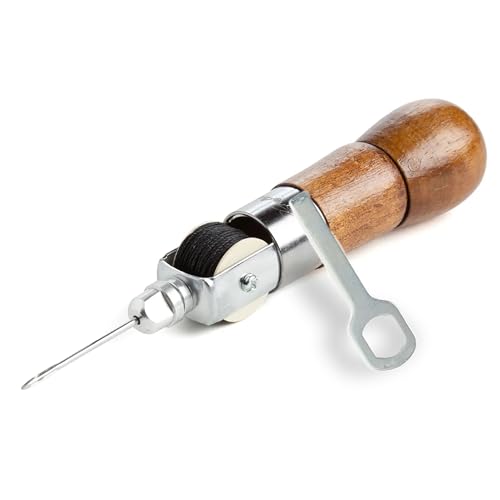
Speedy Stitcher Sewing Awl: Best All-in-One Kit

The Speedy Stitcher functions much like a mechanical sewing machine in the palm of a hand. It carries its own thread supply, making it an excellent choice for quick repairs on heavy items like canvas bags or thick leather straps.
This tool is indispensable for projects requiring a lock-stitch, such as reinforcing the seams of a heavy wool duffel or repairing a leather knitting notions pouch. While it lacks the delicate nuance of a hand-held scratch awl, its efficiency is unmatched for functional, high-stress seams.
Consider this tool if the goal is speed and strength over decorative, angled stitching. It is the practical choice for utilitarian repair work where the finish is secondary to long-term durability.
C.S. Osborne Scratch Awl: The Classic Choice

C.S. Osborne remains a hallmark of traditional leathercraft, much like a pair of high-quality stainless steel needles that last a lifetime. The scratch awl is a fundamental tool for marking stitch lines and piercing the surface of the leather to guide a needle.
A sharp, tempered steel tip is essential for consistent results. Without a high-quality tip, the tool may drag, causing the leather fibers to tear rather than separate cleanly, much like a dull needle snagging on a delicate mohair fiber.
This is a versatile, no-frills tool for any leatherworker. While it doesn’t punch through thick layers as easily as a diamond awl, it is the most reliable choice for marking and light piercing.
Tandy Leather Basic Awl: Best for Beginners
When starting with leather, much like when picking up a pair of bamboo needles for the first time, simplicity is key. The Tandy Leather Basic Awl provides a comfortable starting point that doesn’t overwhelm the user with specialized features.
These awls are generally robust enough to handle standard weight leathers used for hobbyist projects. They allow a beginner to learn the mechanics of hole placement without a significant financial investment.
Do not expect the precision of a professional-grade tool, but recognize that this awl serves as an excellent training platform. Practice using this on scrap leather to develop a steady hand before moving to more expensive equipment.
Kyoshin Elle Pro Awl: Best for Fine Stitching
Precision is paramount when working with fine, thin leathers that mimic the drape of a lightweight fabric. The Kyoshin Elle Pro Awl is engineered to create clean, small, and consistent holes that allow for tight, refined stitching.
The shape of the blade is optimized for delicate work, ensuring that the leather does not stretch or deform during the piercing process. This is the leatherworking equivalent of using 2.0mm needles for intricate, small-gauge sock knitting.
Invest in this tool if the focus lies on small leather goods like wallets or watch straps. It bridges the gap between hobbyist gear and professional atelier-grade equipment.
Vergez Blanchard Awl: The Premium Investment
Vergez Blanchard is widely considered the gold standard in the leathercraft industry, commanding the same respect that high-end, hand-turned wooden needles command among knitters. These tools are handcrafted to provide a level of performance that justifies their premium price point.
The steel is exceptionally tempered, holding a sharp edge through thousands of piercings. This durability reduces the frequency of sharpening, allowing the maker to focus entirely on the rhythm of the stitch.
Only choose this if leatherworking has become a long-term passion. Like a premium circular needle set, it is an investment that pays off through superior control and a lifetime of reliable service.
KemovanCraft Blackwood Awl: Best Ergonomic Grip

Comfort during long sessions is as critical in leatherwork as it is for a knitter working on a bulky sweater. The KemovanCraft Blackwood Awl features an ergonomic handle that minimizes fatigue by distributing pressure across the palm.
The weight and balance of the Blackwood handle provide a sense of stability that lighter, plastic-handled tools cannot replicate. This physical feedback helps the user maintain a consistent angle, which is essential for uniform stitch alignment.
If hand fatigue is a concern during large-scale projects, the ergonomic design of this awl makes a significant difference. It is a perfect fusion of aesthetic beauty and functional comfort.
Barry King Maul Handle Awl: For Heavy-Duty Use
When tackling thick, vegetable-tanned hides for heavy saddlery or rugged belts, a heavy-duty awl is non-negotiable. The Barry King Maul Handle Awl is designed to withstand the physical demands of piercing thick layers with ease.
The blade is thicker and sturdier, preventing bending or snapping under pressure. This tool provides the raw power needed to pierce heavy material without compromising on accuracy.
This is not a tool for fine detailing but rather for heavy construction. It provides the necessary leverage for projects where the material is as dense as multiple layers of tightly felted wool.
How to Choose the Right Awl for Your Project
Choosing the right awl requires an assessment of both the material thickness and the desired stitch aesthetic. Just as one would not use a bulky, wood needle for lace, one should not use a thick, diamond-point awl for delicate glove leather.
Consider the following factors: * Material Thickness: Heavier leathers require thicker blades and more robust steel. * Stitch Density: Finer awls are necessary for high-stitch-count projects that require tight, compact gaps. * Ergonomics: Projects involving hours of continuous work demand a handle that fits the grip naturally.
Assess the project’s requirements before making a selection. If the leather is soft, err on the side of a thinner blade to prevent large, gaping holes that can weaken the seam.
Round vs. Diamond Point Awls: Key Differences
Understanding the geometry of an awl tip is similar to understanding the difference between a blunt-tipped tapestry needle and a sharp-tipped embroidery needle. A round awl simply displaces leather fibers, which is useful for thinner materials where tearing is a concern.
Diamond point awls, by contrast, are designed to cut the leather fibers in a specific shape. This produces the iconic slanted stitch found in high-end leather goods, where each stitch pulls tight against the next.
For most hand-stitching, a diamond point is preferred for its aesthetic outcome. Reserve round awls for situations where the priority is avoiding any cutting of the grain, such as in ultra-delicate or specialized skins.
Awl Safety and Maintenance Tips for Long-Term Use
Safety in the workshop is as important as knowing how to properly finish and block a garment. Always keep the awl tip pointed away from the body, and ensure the workspace is well-lit to prevent accidental slips that could mar the project or cause injury.
Maintenance is the secret to a tool that performs well year after year. Regularly hone the tip on a leather strop loaded with polishing compound to keep the edge razor-sharp.
Avoid using the awl on non-leather surfaces, as hard materials like glass or metal can dull the edge instantly. Treat the steel with a light coating of machine oil if the environment is humid to prevent oxidation, much as one might wax wooden needles to maintain their surface smoothness.
Leatherworking, much like the fiber arts, relies on the synergy between the maker’s skill and the quality of the tools utilized. By matching the right awl to the specific requirements of the hide and the stitch, you ensure that every project is built to last. Take the time to care for these instruments, and they will serve as faithful companions through years of creative endeavor.