6 Best Drawing Inks For Permanent Outlines Artists Use
Discover the 6 best drawing inks for permanent outlines preferred by professional artists. Explore our top expert recommendations and upgrade your toolkit today.
Precision matters just as much in marking a complex lace chart as it does in calculating the exact yardage for a sweater sleeve. When permanent ink meets a project—whether for labeling stash, customizing labels, or marking fabric guides—the choice of medium dictates the longevity and professional finish of the work. Reliable permanent inks prevent the heartbreak of a faded label on a hand-knit heirloom or a blurred marker line that ruins a delicate custom design. This guide clarifies the options for artists who treat their tools with the same respect as their finest merino wool.
Speedball Super Black: The Go-To India Ink


Speedball Super Black India ink serves as the industry standard for a reason: it possesses a depth of pigment that resists fading even after years of exposure. When applying this to tags or paper-based pattern notes, the opacity remains consistent, providing a crisp outline that does not bleed into the fibers of the paper.
This ink behaves like a high-twist yarn—sturdy, reliable, and predictable under varied conditions. It dries to a matte, non-reflective finish that makes legibility simple, especially when sketching out intricate stitch patterns or complex colorwork charts.
The primary limitation involves its drying time, which requires patience similar to blocking a large linen shawl. Rushing the process leads to smudging, particularly on non-porous surfaces, so let the ink set fully before stacking labeled projects.
Dr. Ph. Martin’s Black Star: Best Waterproof Ink
For projects involving archival labeling or items that may encounter moisture, Dr. Ph. Martin’s Black Star stands out for its extreme permanence. Once cured, this ink exhibits a level of water resistance that rivals the durability of superwash wool in a washing machine.
Artists often favor this ink when they require an ultra-fine, sharp line that will not soften or migrate over time. It adheres well to various surfaces, including specialized label tapes used for organizing wool bins or tracking project details.
While it is exceptionally robust, the high pigment load can clog fine-tipped technical pens if left uncleaned. Treat this ink with the same care as a wooden needle; rinse tools thoroughly immediately after use to maintain their precision and lifespan.
Winsor & Newton Drawing Ink: For Vibrant Color
When a project demands more than standard black, Winsor & Newton provides a spectrum of permanent, lightfast options. These inks are ideal for color-coding yarn swatches or adding custom flourishes to project journals.
The vibrancy of these inks remains stable, resisting the dulling effect of time and light. They flow smoothly from a dip pen, much like the effortless glide of a smooth nickel-plated needle through soft silk.
Keep in mind that while these are permanent, they are not universally waterproof once dry. Test a small sample on your specific material to ensure the ink holds its own against future handling or accidental humidity.
Sakura Pigma Micron: The Ultimate Fineliner Pen
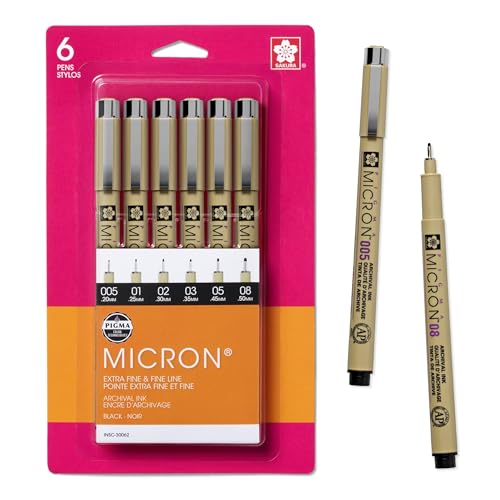
The Sakura Pigma Micron is the definitive choice for those who prefer the convenience of a pen over the maintenance of bottled ink. These pens utilize archival-quality pigment ink that is chemically stable and waterproof, ensuring your notations on pattern printouts remain sharp forever.
Available in a vast range of tip sizes, these pens function much like a set of interchangeable needles. You can select a 0.05mm tip for adding tiny row counts to a dense cable chart or a 0.5mm tip for labeling heavy-duty storage bags.
Because they are fineliners, they offer consistent flow without the risk of an ink spill. They are the perfect low-maintenance tool for the knitter who values organization but prefers to spend their energy on the stitches rather than the preparation.
Faber-Castell Pitt Pen: Archival Quality Choice
Faber-Castell Pitt Pens utilize India ink in a convenient, modern delivery system that is highly resistant to light. They provide a high-quality, professional look for marking garment labels or personalizing woven tags without the mess of a dip pen.
The ink is pH-neutral and acid-free, making it safe to use on delicate materials that might come into contact with sensitive skin. This is the equivalent of choosing high-quality, eco-friendly wool; you are prioritizing the long-term health and integrity of the item.
Since the ink is odorless and smudge-proof once dry, it is perfect for working in a small space or in shared environments. The ink adheres exceptionally well to most surfaces, offering a permanent solution for those who want their craftsmanship to bear a lasting signature.
Kuretake Sumi Ink 60: Traditional & Versatile
Kuretake Sumi Ink 60 offers a rich, dense black that is favored for its smooth flow and high-quality soot-based pigment. This ink is incredibly versatile, working beautifully for both bold outlines and fine, delicate hand-lettering.
Like a high-quality hand-dyed yarn, this ink carries a sense of character and tradition. It is less about synthetic perfection and more about the depth of the mark left on the page, providing a sophisticated look for custom project tags or artisan branding.
While it excels in traditional settings, it is a water-based ink that requires a moment to fully set. Always verify that your chosen surface is compatible with the ink’s properties before applying it to a final project piece.
Choosing the Best Permanent Ink for Your Project
Selecting the right ink follows the same logic as choosing the right yarn for a sweater. First, consider the substrate: are you marking paper patterns, cotton labels, or synthetic storage bins?
Next, evaluate the environment. If the markings will be handled frequently or exposed to humidity, prioritize waterproof, archival-grade formulas. If the goal is simply organization in a dry studio, standard India ink or high-quality fineliners will suffice.
Always consider the tools available. Dip pens offer the most control for artistic flourishes, while pens provide the speed required for functional, repetitive labeling. When in doubt, start with a test swatch—or in this case, a test scrap of your fabric—to ensure the ink performs as expected before committing to the final product.
Waterproof vs. Water-Resistant: The Real Story
The distinction between waterproof and water-resistant is as critical as the difference between hand-wash-only silk and machine-washable superwash wool. Waterproof inks, like the Black Star, form a permanent bond that stands up to water saturation once cured.
Water-resistant inks, by contrast, may withstand accidental splashes but can smear or bleed if submerged for a significant period. Understanding this difference prevents the disaster of a faded label after a light hand-wash cycle.
Check the manufacturer specifications carefully, as labels can be misleading. A permanent ink is not necessarily a waterproof one, and choosing the wrong type can compromise the long-term utility of your project labels.
Dip Pen, Brush, or Fineliner: A Tool Guide
Your choice of applicator acts as your connection to the medium. Dip pens and brushes offer the greatest range of line variation and artistic expression, perfect for custom tags or personalizing knitted gifts.
Fineliner pens provide the consistency and convenience of a standard writing tool, making them the superior choice for fast, precise notation. Treat the choice of tool as you would the choice of needle material—match the tool to the desired outcome and your own level of dexterity.
For intricate work, a fine-tipped pen is the equivalent of small-gauge needles for detail work. For bold, expressive labeling, a brush or broad-nib dip pen offers the necessary surface coverage and aesthetic impact.
Tips for Using Permanent Inks on Fabric Surfaces
When applying permanent ink to fabric, tension and surface preparation are paramount. Use a hard, flat surface to ensure even pressure and prevent the ink from bleeding into the fibers of your workspace.
Test for “wicking,” which occurs when ink travels along the yarn fibers, similar to how liquid spreads in loose-knit wool. Using a stabilizer or keeping the fabric taut can prevent this, ensuring your markings remain crisp and legible.
Heat setting, when permitted by the ink type, significantly improves the durability of the mark. Once fully dry, iron the area on a low setting with a pressing cloth to lock the pigments into the fibers, providing a finish that stands up to regular use and laundry.
Choosing the right permanent ink transforms the way projects are organized and presented, adding a layer of professionalism that complements the effort put into the knitting itself. By selecting the correct medium for your specific needs, you ensure that every label, chart, or note remains as enduring as the stitches they accompany.