6 Best Wire Gauge Tools For Consistent Sizing
Struggling with inconsistent sizing? Discover our top 6 wire gauge tools to ensure precision in every project. Click here to find your perfect measuring tool today.
A loose needle sits unlabeled in a project bag, leaving the knitter to wonder if it is a 3.5mm or a 3.75mm. Precision in needle sizing is the difference between a sweater that fits perfectly and one that ends up two sizes too large. These small metal or plastic tools act as the final arbiter for those unlabeled needles and forgotten tips. Investing in a reliable gauge ensures that project specifications remain consistent from cast-on to bind-off.
KnitPicks View Sizer: Best Budget-Friendly Option


The KnitPicks View Sizer offers a straightforward, no-nonsense solution for identifying needle sizes. Its clear plastic construction makes it easy to see through to the needle being tested, removing the guesswork often found with opaque tools.
This tool covers a wide range of standard needle sizes, making it a reliable staple for any basic knitting kit. Because it is lightweight and inexpensive, it serves as an ideal spare to keep tucked into a secondary notion tin or a travel project bag.
While the plastic may eventually show signs of wear or scratches over years of heavy use, the legibility remains high. For the knitter who frequently misplaces tools, this is an economical choice that provides immediate utility without a steep investment.
The Knitter’s Pride Gauge: An All-In-One Classic

The Knitter’s Pride gauge is a sturdy, reliable tool that bridges the gap between basic utility and long-term durability. It features a wide range of sizing holes, catering to both standard US and metric measurements in a single, compact profile.
This gauge is particularly useful for those who work with a variety of needle materials, from polished brass to grippy bamboo. The holes are precisely cut, providing a snug fit that prevents “wobble” and ensures the needle truly matches the stated measurement.
As a versatile addition to a knitting collection, this tool often includes extra features like a built-in ruler. It is a workhorse tool designed to withstand years of being tossed into crowded bags or tucked under heavy projects without bending or warping.
ChiaoGoo Metal Gauge: Built to Last a Lifetime

Metal gauges are the gold standard for those who demand absolute precision and structural integrity. The ChiaoGoo metal gauge resists the bending and distortion that can plague plastic versions, ensuring the sizing holes stay perfectly round over time.
Because needle tips can sometimes nick or damage plastic sizing tools, metal gauges are superior for heavy-duty use. If you are frequently measuring sharp, lace-weight needles or abrasive vintage metal needles, the steel construction of this gauge will not degrade.
The etching on these tools is usually deep and permanent, preventing the size markings from rubbing off after years of friction. While it carries a slightly higher weight in the hand, it is nearly indestructible and serves as a permanent investment for the serious maker.
Susan Bates Knit-Chek: The Tried-and-True Gauge
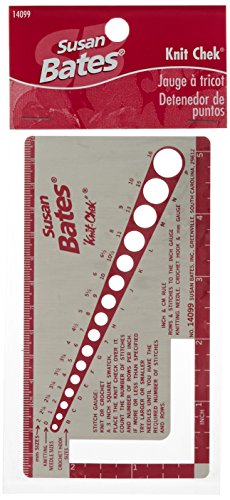
The Susan Bates Knit-Chek is perhaps the most iconic tool in the fiber arts world. Its classic, multi-functional design has been a staple in knitting baskets for generations, serving as a needle gauge, stitch counter, and ruler simultaneously.
Its lightweight, flat profile makes it exceptionally easy to store in any notions pouch. The specific design of the Knit-Chek often includes notches for measuring both needle diameter and row counts, which is helpful when trying to replicate a gauge swatch from a pattern.
New knitters often find comfort in its simple, utilitarian layout that doesn’t overwhelm the user with unnecessary features. It is a straightforward, functional tool that remains a reliable standard for checking needle diameter during the initial stages of a project.
Clover Swatch Ruler: Best for Checking Your Gauge

While technically a gauge, the Clover Swatch Ruler is specialized for the critical task of measuring stitch density. It features a transparent frame that allows the knitter to place the tool directly over a knitted fabric to count stitches and rows per inch.
Measuring gauge accurately requires a steady, flat reference point, and this tool provides exactly that. By isolating a specific section of the fabric, it helps eliminate the common error of miscounting stitches due to the natural pull and drape of the yarn.
This is an essential upgrade for any knitter moving beyond simple scarves into garments where fit is paramount. When paired with a needle size gauge, this ruler completes the analytical toolkit needed to achieve professional results.
Akerworks Needle Gauge: The Precisionist’s Choice

Akerworks tools are designed for the maker who values both mechanical precision and aesthetic beauty. These gauges are often 3D-printed with exacting tolerances, providing a distinct, tactile experience that standard mass-produced tools cannot replicate.
The design philosophy focuses on ease of use, often including specialized shapes that make inserting needles feel intuitive. For those with dexterity issues or who simply appreciate high-quality engineering, the ergonomic design of these gauges provides a superior user experience.
These are not merely functional items; they are crafted pieces that bring a sense of intention to the knitting process. While they occupy a higher price point, the accuracy and durability make them a favored choice for dedicated hobbyists who want a tool that performs as well as it looks.
Getting an Accurate Reading from Your Needle Gauge
To get an accurate reading, always insert the needle tip into the hole until it stops. If the needle slides through loosely, the next smaller hole is the correct size; if it does not fit, move to the next larger one.
Never force a needle into a hole. If you have to push, the needle is too large, and forcing it can damage either the needle surface or the gauge tool itself.
Ensure you are reading the side that corresponds to your preferred unit of measurement, whether US or metric. Lighting is key; check that the needle sits flush against the gauge without tilting to ensure a true diameter reading.
Why Needle Sizes Aren’t Universal: US vs. Metric
Needle sizing is notoriously inconsistent across different manufacturing regions. A US size 6, for instance, does not always translate perfectly to 4.0mm, and manufacturers often vary their specific tolerances.
- US sizing: Based on older industrial standards that do not always align with millimeter measurements.
- Metric sizing: Generally more precise and used by the majority of international pattern designers.
- The “Gap”: Some sizes, such as 3.75mm, are often labeled differently in the US (sometimes as a size 5, sometimes as a size 6).
Always rely on the millimeter measurement when checking against a pattern. Pattern writers frequently specify the metric size to ensure the intended stitch density is achieved, regardless of the local US sizing convention.
Metal vs. Plastic vs. Wood: Which Gauge Is Best?
The material of the gauge tool affects both its lifespan and its accuracy over time. Plastic gauges are inexpensive and lightweight, but they can warp when exposed to extreme heat or pressure.
Metal gauges are the most stable, providing consistent measurements that won’t change as the tool ages. They are ideal for high-volume users who need a tool that stands up to daily wear in a busy studio or knitting group.
Wooden gauges exist, often as decorative or specialized items, but they are prone to humidity changes. While beautiful, they are rarely the most precise choice for a knitter who requires rigid, repeatable measurements across a wide range of projects.
More Than Sizing: Extra Features on Gauge Tools
Many modern gauges include additional features that simplify the life of a knitter. Look for tools that incorporate rulers for measuring swatches, or small cutouts for checking crochet hook sizes.
Some gauges even feature specialized slots for checking the thickness of circular needle cables or identifying thread weights. These “all-in-one” tools reduce clutter, ensuring you have the most vital measuring functions in one compact, easy-to-reach location.
When choosing a gauge, consider the items you lose most often. An all-in-one tool is harder to misplace than a single needle sizer, making it a functional investment that saves time during every step of the creative process.
Choosing the right gauge tool is an essential step in moving from casual crafting to consistent, professional-grade knitting. By selecting a tool that matches your material preferences and durability needs, you eliminate one of the most common points of frustration in the craft. Once you have a reliable gauge on hand, you can focus on the rhythm of your stitches, confident that your equipment matches your pattern exactly.