
6 Jewelry Pliers For Manipulating Metal Embellishments
Master metalwork with these 6 essential jewelry pliers. Discover the best tools for manipulating metal embellishments and upgrade your craft today. Read more.
Knitting is increasingly becoming a multidisciplinary craft where the soft, tactile world of yarn meets the rigid, structural potential of wire and metal. Incorporating beads, charms, and custom stitch markers requires a shift from needles and hooks to precision metalworking tools. While knitting needles handle tension, jewelry pliers handle the mechanical stress of bending and securing embellishments without marring delicate finishes. Understanding these tools ensures that hardware stays functional and aesthetically pleasing, just like a well-executed cable or perfectly picked-up edge.
Xuron 450 TweezerNose: For Tiny Stitch Markers
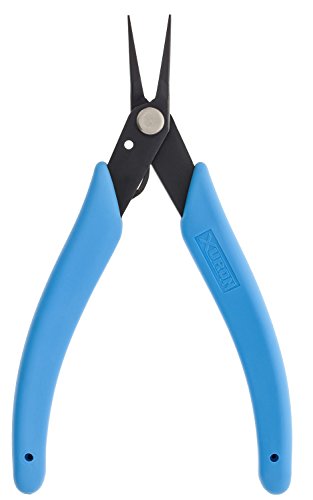

Tiny, delicate work requires a level of control that standard pliers simply cannot provide. The Xuron 450 TweezerNose acts as an extension of the fingers, offering a fine tip that is perfect for grabbing miniature jump rings when attaching custom charms to stitch markers.
Because the tips meet perfectly at the point, these pliers excel at manipulating wire gauges that are too fine for heavier tools. If a jump ring is slightly misaligned, this tool provides the necessary leverage to nudge it back into place without distorting the metal’s shape.
The primary tradeoff is that these are not designed for heavy-duty structural work. Attempting to bend thick-gauge wire can eventually compromise the fine alignment of the tips. Treat these as precision instruments, not construction tools.
Beadalon Chain Nose Plier: All-Purpose Workhorse

The Chain Nose Plier is the foundational tool for any knitter venturing into jewelry-making accessories. These pliers feature smooth, tapered jaws that allow for grabbing, holding, and forming right angles in wire with consistent ease.
Think of these as the standard circular knitting needle of the jewelry world; they are the reliable starting point for most tasks. When closing a jump ring on a cable-knit sweater charm, the flat internal surface provides the grip necessary to prevent the metal from slipping.
Be cautious of budget versions with serrated jaws, as these will leave unsightly marks on silver-plated or enameled findings. Always prioritize smooth-jawed models to preserve the appearance of decorative metal embellishments.
Wubbers Round Nose Pliers: For Making Wire Loops
Creating custom eye pins or decorative wire-wrapped toggles is only possible with round nose pliers. The conical shape of the jaws allows for the creation of perfectly uniform loops, which is essential when crafting handmade stitch markers from scratch.
Mastery of these pliers relies on understanding the tapering of the jaw. By moving the wire further toward the hinge, the loop size increases; moving it toward the tip produces a smaller, tighter coil.
While they are indispensable for curves, they provide zero grip for pulling or twisting straight wire. These are specialized tools meant for shaping, not for securing tension or closing hardware.
The Beadsmith Bent Nose: For Tight, Awkward Angles
Bent nose pliers offer a unique ergonomic advantage when working in confined spaces. The angled tip allows for a natural hand position while providing a clear line of sight, which is critical when navigating the tight corners of complex hardware or wire-wrapped accents.
These are particularly useful when adjusting a clasp that is already attached to a finished piece of jewelry or a complex garment embellishment. The bend keeps the hand from obstructing the view of the work, reducing the risk of accidental slips that might snag the surrounding yarn.
They serve as a secondary tool rather than a primary one. While excellent for specific angles, they do not replace the stability of a standard chain nose plier for general tasks.
Lindstrom Flat Nose Pliers: Best for Shaping Wire
Flat nose pliers are designed for high-tension tasks where maximum surface contact is required. Because the jaws have a wide, flat surface, they distribute pressure evenly across the wire, making them the superior choice for straightening wire or creating crisp, sharp bends.
For knitters, these are the heavy-lifters when working with thicker gauges of craft wire. They provide the necessary purchase to hold wire firmly while another tool works to twist or wrap the metal.
The tradeoff is the size of the jaws; they are often too bulky for delicate jump ring work. Reserve these for the structural “heavy lifting” phase of crafting your project’s hardware.
Hakko Micro Cutter: For Snipping Wires Cleanly

Cutting wire with standard household scissors or even kitchen shears will quickly ruin the blades. The Hakko Micro Cutter is designed specifically for soft metals, providing a flush cut that leaves a smooth, snag-free edge.
A flush cut is critical when working with yarn; any sharp burr or jagged edge left on a wire will catch on your fiber, causing fuzzing or catastrophic snagging. Always check the cut end for sharpness before incorporating it into a project.
These tools are strictly for non-ferrous metals like copper, brass, or silver. Attempting to cut hardened steel or memory wire will cause the blades to develop permanent gaps, rendering them useless for fine work.
How to Choose Your First Pair of Jewelry Pliers
Start by identifying the specific projects you intend to tackle. If the goal is simply to open and close pre-made jump rings to attach charms, a single pair of high-quality Chain Nose pliers is sufficient.
Avoid the cheap, multi-piece sets often found in craft aisle bargain bins. These tools frequently suffer from poor hinge alignment, stiff operation, and sharp, unfinished edges that can ruin expensive metal findings.
Invest in tools with ergonomic handles and return springs. Much like choosing a comfortable pair of knitting needles to avoid hand fatigue, proper jewelry pliers should feel balanced and easy to manipulate for extended sessions.
Chain vs. Round Nose: Which Pliers Do You Need?
Chain nose pliers are for holding, grabbing, and bending straight lines. Round nose pliers are strictly for creating curves, loops, and coils.
If you are just starting, prioritize the Chain Nose Pliers. Their versatility allows them to perform most basic functions, including closing jump rings, which is the most frequent task for adding embellishments to knitwear.
Only add Round Nose pliers to your kit once you decide to design custom findings. The ability to form a loop is a significant step up, but it is not required for basic assembly work.
A Quick Guide to Opening and Closing Jump Rings
Never pull a jump ring open by spreading the ends apart. This distorts the circular shape, making it nearly impossible to get a secure, clean closure.
Instead, use two pairs of pliers to grasp the jump ring on either side of the seam. Twist the ends in opposite directions—one forward, one backward—to create a gap.
Once the ring is through the eyelet of the charm or the stitch marker, twist it back into place so the two ends meet perfectly. This shearing motion keeps the metal’s structural integrity intact and ensures no sharp gaps remain to snag your yarn.
Caring for Your Tools: Preventing Rust and Wear
Jewelry pliers are made of metal, and like any high-quality tool, they require maintenance to remain effective. Keep them in a dry environment, as humidity can cause surface rust, especially on carbon steel tools.
Wipe the jaws occasionally with a soft, dry cloth to remove oils, debris, or metal shavings. A tiny drop of machine oil on the pivot joint once every few months will ensure smooth, fluid operation.
Store them upright or in a dedicated case to keep the tips from colliding with other tools. If the tips become scratched or pitted, the tool loses its precision, necessitating a replacement.
Equipping your toolkit with these specialized pliers provides the mechanical freedom to personalize your knitting with custom metal accents. With the right tools held in your hands, the transition from fiber to metal becomes as seamless as transitioning from a knit to a purl.
