6 Best Wool Blends For Durable Pompoms To Try
Discover the top six wool blends for crafting long-lasting pompoms. Learn how fiber combinations enhance durability and texture for your next DIY project.
Pompoms are the ultimate finishing touch, yet many knitters struggle with "floppy" results that lose their shape after a week of wear. The secret to a professional-looking pompom isn’t just your trimming technique; it is choosing a yarn that balances loft with structural integrity. By selecting the right wool blend, you ensure your pompom stays dense, rounded, and resilient against the elements. These six yarns offer the perfect fiber composition to elevate your handmade accessories.
Cascade 220: The Classic Choice for Full Pompoms
Cascade 220 is a staple in almost every knitter’s stash for a reason. Its high-twist structure provides a fantastic foundation for a dense, round pompom that doesn’t collapse under its own weight.
Because it is a traditional wool yarn, it possesses a natural "tooth" that grips well when you tie off your center knot. This friction is essential, as it prevents the individual strands from slipping out of the center binding over time.
While it is a standard worsted weight, it fills up a pompom maker beautifully without needing excessive yardage. For the best result, ensure you wrap your maker consistently to maintain even density throughout the sphere.
Wool-Ease Thick & Quick: Best for Quick Results
When you are finishing a bulky hat and want a massive, squishy pompom, this super-bulky blend is your best friend. Its mix of acrylic and wool allows it to maintain a high volume without the heavy weight of pure wool.
The synthetic component provides a slight springiness that keeps the pompom looking "fresh" even after being stuffed into a coat pocket. It is remarkably forgiving if you are a beginner who needs to re-tie your center knot multiple times.
Because the yarn is so thick, you will reach your desired density much faster than with finer weights. Just remember to use a very sharp pair of scissors, as the thick strands require a clean, single-cut motion to avoid frayed edges.
Patons Classic Wool Blend: Ideal Sturdy Texture


Patons Classic Wool Blend offers a slightly firmer hand than pure merino, which translates into a pompom that holds a crisp, spherical shape. This added structure makes it a top contender for children’s wear that will inevitably see a lot of rough handling.
The blend is specifically engineered to resist pilling, which is a common downfall of softer, high-end fibers. If you’ve ever had a pompom turn into a fuzzy, matted ball, this yarn is the antidote.
It has a balanced ply that cuts cleanly, leaving you with a crisp silhouette after your final trim. It is a reliable, no-nonsense choice for makers who prioritize longevity over extreme softness.
Plymouth Encore Worsted: Great for Shape Retention

Plymouth Encore is legendary in the knitting community for its incredible durability and resistance to shrinking. When used for pompoms, this acrylic-wool blend behaves predictably, maintaining its bounce and volume even after light exposure to moisture.
The yarn’s inherent "memory"—its ability to return to its original state—is what keeps your pompom from flattening out. It is an excellent choice for items that will be worn in snowy or damp conditions where natural fibers might otherwise lose their loft.
Because it is a workhorse yarn, it is also very cost-effective for large-scale pompom production. If you are making matching sets for a family, this is the most reliable fiber to ensure consistent results across every piece.
Lion Brand Vanna’s Choice: Durable Everyday Blend

Vanna’s Choice is a 100% premium acrylic that behaves much like a high-quality wool blend, making it an accessible and highly durable option. It is exceptionally resilient, meaning your pompom will hold its shape even if it gets crushed or snagged.
Many knitters overlook acrylics, but for a pompom, the lack of natural "fuzz" can actually be an advantage. You get a clean, defined look that stays looking polished for years rather than months.
It is also available in a massive range of colors, allowing you to match your pompom perfectly to your main project. It is the perfect choice for high-traffic items like mittens or everyday beanies.
Berroco Vintage: Softness Meets High Durability

Berroco Vintage strikes a rare balance between a soft, luxurious hand and the structural strength of a synthetic blend. It is ideal for cowls or hats where the pompom might touch the skin, as it lacks the scratchiness associated with some sturdier wools.
The fiber blend is designed to be machine washable, which is a huge benefit for finished garments. You can confidently toss your hat in the wash, knowing the pompom will bounce back to its original shape after a quick shake.
It has a lovely sheen that adds a subtle, professional glow to the finished pompom. If you want durability without sacrificing the "premium" feel of your project, this is the yarn to reach for.
Why Wool Blends Outperform Pure Wool for Pompoms
Pure wool is beautiful, but it often lacks the structural "snap" required for a perfect pompom. Over time, 100% natural fibers can stretch, mat, or flatten, especially when subjected to the friction of daily wear.
Wool blends, typically featuring acrylic or nylon, introduce a synthetic "skeleton" to the fiber. This keeps the strands standing upright and prevents the pompom from losing its spherical geometry.
Furthermore, blends are often more resistant to the elements. While pure wool is wonderful for warmth, it can hold onto moisture; synthetic blends help the pompom dry faster and maintain its fluffiness.
How Fiber Content Affects Your Pompom Density
Density is the secret to a professional pompom, and fiber content dictates how much "fill" you need. Finer, softer fibers tend to collapse inward, requiring you to wrap your maker more times to achieve a solid core.
Sturdier, blended fibers occupy more space and offer more resistance during the wrapping process. This means you can often achieve a dense, heavy-feeling pompom with fewer wraps than you would need with a delicate yarn.
Always consider the "loft" of your yarn before you begin. A high-loft yarn will create a larger, fluffier pompom, while a tightly plied, smooth yarn will create a smaller, more compact and defined sphere.
Essential Tools for Trimming Perfect Pompoms
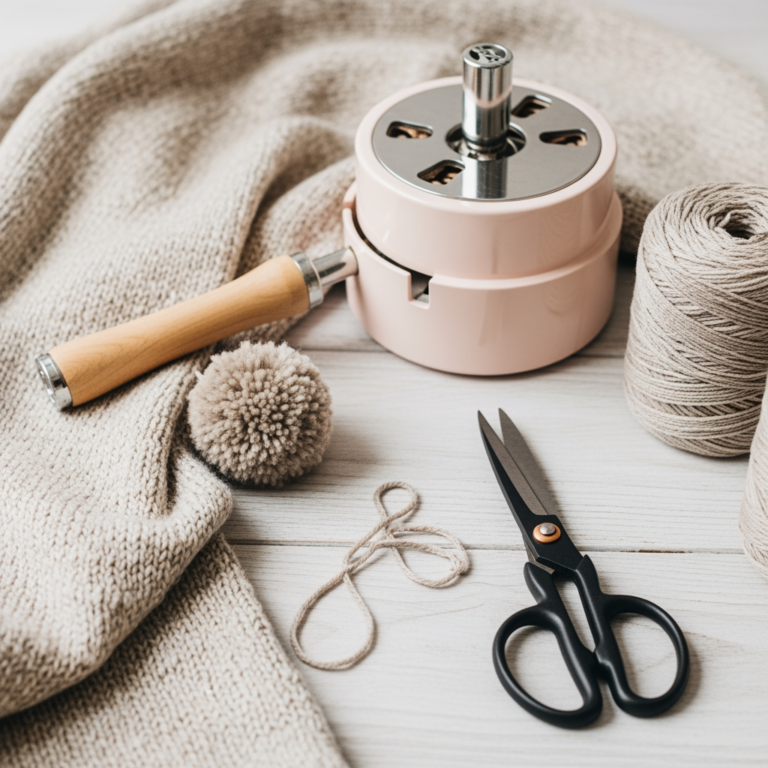
The best yarn in the world won’t save a pompom if your tools are inadequate. You need a dedicated pair of sharp, pointed embroidery or fabric scissors to ensure every strand is cut at the exact same length.

Avoid using kitchen shears or dull craft scissors, as they will "chew" the yarn rather than cutting it. This creates uneven ends that make your pompom look ragged instead of smooth.
- Pompom makers: Plastic ring-style makers ensure uniform distribution of yarn.
- Sharp, pointed scissors: Essential for precision trimming.
- Comb or brush: Use a small pet brush to fluff the fibers after the initial trim.
- Tapestry needle: Use this to weave in your long tails securely.
Expert Tips for Securing Pompoms to Your Knits
Never rely on a single knot to secure your pompom to a hat. The weight of the pompom, combined with the movement of your head, will eventually cause a single knot to loosen or snap.
Instead, leave your two long tails from the center binding quite long—at least 8 to 10 inches. Use a tapestry needle to pull these tails through to the inside of the hat, placing them about an inch apart.
Tie these tails together on the inside over a small button or a piece of felt. This creates a "stopper" that distributes the tension across the fabric of the hat, preventing the pompom from pulling a hole in your knitting.
Choosing the right yarn for your pompom is a small detail that makes a massive difference in the longevity of your knitwear. By prioritizing blends that offer both resilience and loft, you ensure your hard work stays looking pristine for years. Experiment with these recommendations to find the balance of texture and weight that suits your personal style. Happy knitting, and may your pompoms always be perfectly round!