6 Best Swatch Rulers For Checking Gauge Worth Owning
Master your knitting projects with these 6 essential swatch rulers. Learn how to measure gauge accurately and ensure your garments always fit perfectly.
Every knitter has experienced the heartbreak of finishing a sweater only to find it fits like a tent or a tourniquet. The difference between a wearable heirloom and a closet-filler almost always comes down to the accuracy of your gauge swatch. Investing in a reliable ruler is the simplest way to ensure your hard work results in a garment that actually fits. Here are the best tools to help you master your tension and achieve professional results.
CocoKnits Maker’s Keep Gauge Ruler: Best Overall
This tool is a favorite because it integrates seamlessly into a busy maker’s workflow. It features a sturdy, matte finish that eliminates glare, making it much easier to count stitches under various lighting conditions.
The standout feature is the inclusion of both imperial and metric measurements, which is vital if you switch between US and European patterns. Its wide, flat surface allows you to lay it perfectly flush against your fabric without distorting the stitches.
If you are someone who frequently misplaces your notions, the design of this ruler is a game-changer. It is built to be durable enough to live in your project bag for years, serving as a constant, reliable reference point.
ChiaoGoo Needle Gauge and Ruler: Best for Travel


When you are knitting on the go, you need tools that won’t take up precious space or snap under the weight of your yarn stash. This needle gauge is impressively slim, fitting easily into the smallest pocket of a notions pouch.
Beyond its portability, it serves a dual purpose by helping you identify needle sizes that have rubbed off over time. For those of us who use metal needles exclusively, the printed sizes on this tool remain clear and legible even after heavy use.
The tradeoff here is the size; it is compact, which means it isn’t ideal for measuring large, complex lace swatches. However, for a quick check on a sock or hat project, it is the most efficient tool in your kit.
Katrinkles Wooden Gauge Ruler: Best for Aesthetics

Knitting is an art form, and there is something deeply satisfying about using tools that feel as good as they look. These wooden rulers are crafted with a precision that synthetic materials often lack, providing a warm, tactile experience.
Because they are made from wood, they have a slight "grip" that prevents them from sliding around on slippery silk or bamboo swatches. This stability makes it much easier to get an accurate count without the ruler shifting mid-measurement.
Be aware that wood can be sensitive to extreme humidity or moisture if you leave it sitting on a damp, freshly blocked swatch. Wipe it clean and store it in a dry place to ensure the markings stay crisp and the wood doesn’t warp.
Susan Bates Knit Check Tool: Best Budget Option
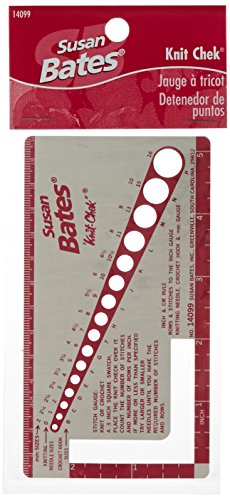
You do not need to spend a fortune to get an accurate measurement. The classic Susan Bates Knit Check is a staple for a reason; it is a no-nonsense, functional tool that has been helping knitters for generations.
It includes a built-in needle gauge and a window for counting stitches, which keeps your focus centered on the fabric. While it lacks the premium feel of wood or metal, it is incredibly lightweight and nearly indestructible.
If you are a beginner overwhelmed by the variety of expensive notions, start here. It will teach you the fundamentals of gauge without the distraction of bells and whistles, and it will last until you decide to upgrade.
Knitter’s Pride Mindful Gauge: Best Ergonomics

The Mindful collection is designed with the knitter’s physical comfort in mind, and this gauge is no exception. It features a shape that is easy to grip, which is particularly helpful if you suffer from hand fatigue or dexterity issues.
The color scheme is calming and the markings are high-contrast, which reduces eye strain during long sessions of counting rows. It feels substantial in the hand, giving you a sense of control that flimsy plastic rulers often lack.
If you find yourself squinting at your swatch late at night, this is the tool for you. The clarity of the measurements is superior, ensuring that you don’t accidentally miscount a stitch due to poor visibility.
Clover Knitting Needle Gauge: Best for Precision
Clover is renowned for its manufacturing consistency, and this gauge is a testament to that reputation. The holes for measuring needle sizes are machined with extreme accuracy, ensuring you never second-guess your needle size again.
The ruler edges are perfectly straight, which is essential for measuring the full four-inch swatch required for most patterns. It is a workhorse tool that provides the exact, repeatable results necessary for high-stakes projects like colorwork sweaters.
While it doesn’t have the "luxury" feel of other options, its precision is unmatched. It is the tool I reach for when I am working with a luxury fiber like cashmere or alpaca, where even a half-stitch difference can ruin the final drape.
Why Accurate Gauge Swatching Is Your Best Tool
Gauge is the mathematical foundation of your project, yet it is the step most knitters try to skip. A swatch allows you to see how a specific yarn interacts with a specific needle size, revealing the true character of the fabric.
Different fibers behave differently; a superwash wool will grow significantly after washing, while a linen blend might tighten up. If you don’t swatch, you are essentially flying blind, hoping that your tension matches the designer’s.
Think of the swatch as a prototype. It gives you the chance to test your stitch pattern, check your tension, and see if you actually like the feel of the finished fabric before committing weeks of your life to the project.
How to Measure Stitch Density With Your Ruler
Place your swatch on a flat surface and let it rest for a few minutes; do not stretch or pin it unless the pattern specifically calls for it. Lay your ruler across the center of the swatch, ensuring you are measuring at least four inches of fabric.
Count the number of full stitches within that four-inch span, then count the partial stitches at the end. For example, if you have 20 full stitches and a half-stitch, your count is 20.5.
- For Stitches: Count horizontally across the row.
- For Rows: Count vertically from the bottom of one stitch to the top of the next.
- The Math: Divide your total count by the number of inches to get your stitches-per-inch.
Common Mistakes When Measuring Your Knit Swatch
The most common error is measuring a swatch that is too small. If you only knit two inches, you cannot accurately extrapolate the gauge for a full garment, as your tension often changes as you settle into the rhythm of the stitch.
Another mistake is measuring right at the edge of the swatch. The stitches at the very edge are often distorted by the transition from the needle, so always focus on the center "field" of your knitting for the most accurate data.
Finally, never skip the blocking process. If you measure your swatch before washing and blocking, you are measuring the "temporary" state of the yarn, not the "final" state of your garment.
Essential Tips for Consistent Tension Control
Tension is not just about how tightly you hold the yarn; it is about the consistency of your movements. If you find your gauge changes throughout the day, try to knit for fixed periods rather than sporadic bursts.
If you are a tight knitter, consider going up one needle size to achieve the recommended gauge. If you are a loose knitter, drop down a size; the goal is to reach the fabric density that the designer intended for the project.
- Relax your hands: Periodically drop your needles and shake out your wrists.
- Check your posture: Slouching can change the angle of your needles and affect your tension.
- Stick to one brand: If you are struggling with consistency, try using needles with a consistent finish, such as polished wood or nickel-plated metal, throughout the entire project.
Mastering your gauge is the single most important step toward becoming a confident, successful knitter. While it may feel like a chore to knit and measure a square before starting your main project, the time saved by avoiding a poorly fitting sweater is well worth the effort. Choose a ruler that feels comfortable in your hands, take your time with your measurements, and enjoy the process of creating a garment that truly fits. Happy knitting!