6 Best Fine Gauge Needles For Delicate Lace
Discover the top 6 fine gauge needles for delicate lace. We evaluate essential materials and tip precision to help you achieve perfect, airy stitch work.
Knitting lace with fine-gauge needles transforms a simple ball of yarn into an ethereal, wearable work of art. However, the difference between a frustrating session of dropped stitches and a meditative flow often comes down to the quality of your tool. Choosing the right needle is about balancing point sharpness, surface slickness, and cable flexibility. This guide explores the best options on the market to ensure your next lace project is as enjoyable as it is beautiful.
ChiaoGoo Red Lace: The Precision Steel Standard
ChiaoGoo Red Lace needles are the industry benchmark for a reason. They feature a surgical-grade stainless steel finish that provides just enough slickness to keep fine yarn moving without it feeling like it’s going to fly off the needle.
The hallmark of these needles is the memory-free cable, which is perhaps the best in the business. When you are working on a complex shawl with hundreds of stitches, you don’t want the cable fighting against you or coiling up in your lap.
The join where the needle meets the cable is remarkably smooth, preventing snagging even with delicate cobweb-weight yarns. If you are prone to tight tension, the slight taper of the tip helps you enter stitches with minimal effort.
HiyaHiya Sharp Steel: Best for Intricate Lace
If your project involves complex nupps, bobbles, or intricate cable-lace combinations, the HiyaHiya Sharp Steel is your best friend. These tips are exceptionally pointed, allowing you to manipulate multiple loops with surgical precision.
The stainless steel surface is quite slick, which is ideal for speed knitters working with smooth fibers like silk or bamboo. However, if you are a beginner, be aware that these tips can be quite aggressive on your fingertips during long knitting sessions.
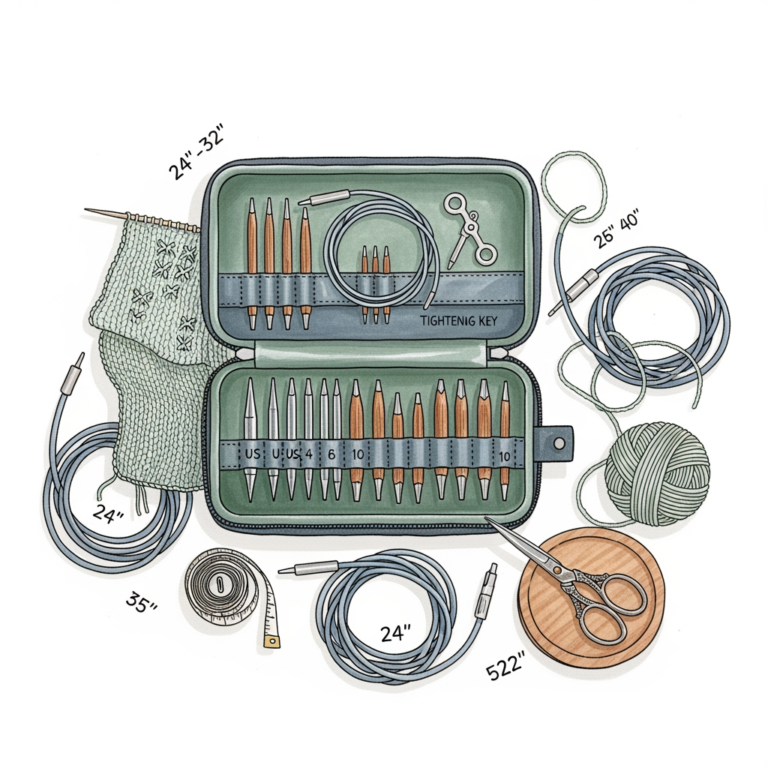
The swivel cables on the interchangeable sets are a game-changer for lace knitters. They allow the needle to rotate freely, preventing the cable from twisting as you work your way around large circular shawls.
Addi Rocket Lace: The Smooth German Engineered Pick
Addi Rocket Lace needles are known for their signature brass finish, which offers a slightly warmer feel than stainless steel. They strike a middle ground between the "grabby" nature of wood and the "fast" nature of metal.
These needles feature a very fine, tapered point that is sharp enough for lace but not so needle-sharp that it pierces your skin. This makes them a fantastic choice for marathon knitting sessions where comfort is just as important as precision.
One trade-off is the coating, which can eventually wear down after years of heavy use. However, the quality of the German engineering ensures that the join remains seamless throughout the life of the tool.
Signature Needle Arts: Premium Stiletto Points
Signature Needle Arts needles are the pinnacle of luxury, offering a custom-made feel that is hard to replicate. Their "Stiletto" point is legendary among lace knitters for its ability to pick up even the most stubborn, tightly wound stitches.
These are crafted from high-quality aluminum, making them lightweight yet incredibly durable. Because they are not interchangeable, they provide a perfectly smooth transition from needle to cord, eliminating any chance of catching a delicate fiber.
They are an investment piece, certainly, but for a lace project that will take months to complete, the ergonomics are worth the price. They are best suited for knitters who want a tool that feels substantial in the hand without being heavy.
KnitPicks Options Nickel: Best Value for Lace
KnitPicks Options Nickel needles are the go-to choice for knitters who want high performance without a premium price tag. The nickel-plated surface is incredibly smooth, allowing stitches to slide effortlessly across the needle.

These needles are somewhat "pointy," making them suitable for most lace patterns, though they may lack the extreme precision of a dedicated lace needle. They are an excellent entry point for someone transitioning from basic knitting to more complex lace work.
The trade-off is that the nickel plating can sometimes show wear or discoloration over time, especially if you have acidic skin oils. Nevertheless, they provide consistent results and are perfect for keeping a variety of sizes in your stash.
Lantern Moon Ebony: Luxury Warmth for Fine Yarn
Sometimes, metal is simply too slick for the yarn you are using. In those cases, Lantern Moon’s ebony needles offer a sophisticated, natural alternative that provides just the right amount of grip for slippery fibers like mohair or silk.
The wood is polished to a glass-like finish, ensuring that your yarn won’t snag, yet it retains enough friction to keep your stitches from sliding off accidentally. The dark, rich color of the ebony also creates a beautiful contrast against light-colored lace yarns.
These needles are lightweight and warm to the touch, reducing hand fatigue during long hours of work. If you find metal needles too cold or too fast, the tactile experience of these ebony needles is unmatched.
How to Select the Perfect Needle for Lace Weight
Selecting the right needle depends heavily on the "hand" of your yarn. For very slippery fibers like 100% silk or mercerized cotton, a wooden needle provides the necessary control to prevent dropped stitches.
Conversely, for sticky fibers like wool or alpaca, a slick metal needle is essential to maintain your rhythm. Always consider the WPI (Wraps Per Inch) of your yarn to ensure your needle size is appropriate for the desired gauge.
- Slippery Yarn: Use wood or bamboo for better control.
- Sticky Yarn: Use polished metal for faster, smoother movement.
- Intricate Patterns: Opt for a sharper point to manage complex maneuvers.
Why Point Sharpness Matters for Delicate Stitches
In lace knitting, you are frequently performing decreases that involve knitting three or more stitches together. A dull needle tip makes it difficult to insert the needle through these crowded loops, often leading to split yarn or strained hands.
A sharp point acts as a precision tool, allowing you to slide into tight stitches without distortion. This is particularly important when working with plied yarns that are prone to splitting if the needle tip is too blunt.
However, avoid the "sharpest possible" needle if you have a habit of pushing the needle tip with your index finger. You need a balance between a point that can pierce a stitch and one that won’t pierce your skin.
Managing Fine Yarn Tension for Even Lace Work
Lace work is unforgiving; small inconsistencies in tension become glaringly obvious once the piece is blocked. Using a needle that feels comfortable and natural in your hands is the first step toward achieving a consistent gauge.
If you find that your lace looks uneven, try focusing on the "pull" of the yarn as you finish each stitch. Keeping your yarn tension light and steady is more effective than trying to "fix" the gauge by changing your needle tension mid-row.
Remember that blocking is an essential part of the lace process. A good needle helps you create the structure, but the final, even beauty of your lace is revealed only after the piece has been soaked and pinned out.
Essential Maintenance for Fine Gauge Metal Tools
Even the best needles require a little care to stay at their peak performance. For metal needles, a quick wipe with a soft, lint-free cloth after each project removes skin oils and residue that can cause the needle to become "sticky."
If your needles develop a slight burr or scratch, a very fine-grit polishing cloth can sometimes smooth it out. Be careful not to use anything too abrasive, or you will ruin the finish and create a snag point that will catch your yarn.
Store your needles in a case that prevents them from clattering against each other. Keeping the tips protected is the best way to ensure they remain sharp and ready for your next intricate lace project.
Mastering fine-gauge lace knitting is a journey that begins with the right tools in your hands. By understanding the interplay between your yarn’s fiber content and your needle’s surface and point, you can elevate your craft to new heights. Take the time to experiment with these options to see which matches your personal knitting style best. Happy knitting, and may your stitches remain as even as your passion for the craft.