6 Best Pattern Reading Stands For Ergonomic Posture
Improve your craft with our top 6 pattern stands. Discover ergonomic designs that reduce neck strain and keep your workspace organized for better comfort.
Knitting for hours on end is a labor of love, but it often leaves us with a stiff neck and aching shoulders. If you find yourself hunching over your pattern like a gargoyle, your workspace setup is likely the culprit. Investing in a proper pattern stand is not just about convenience; it is a fundamental step toward preserving your body for decades of future projects. Here are the best tools to help you maintain impeccable form while your needles are flying.
K&M 10065 Music Stand: Best for Large Patterns
When you are working through a complex lace shawl with a massive, multi-page chart, standard book stands often fall short. The K&M 10065 is essentially a professional-grade music stand, offering a wide, sturdy ledge that can accommodate even the largest printed patterns without them curling or sliding.
Because this stand is height-adjustable and features a tiltable desk, you can bring your chart exactly to eye level. This eliminates the "knitter’s hunch" entirely, allowing you to keep your head neutral while you track your row progress.
The downside is its footprint; it takes up more floor space than a tabletop stand. However, if you have a dedicated knitting nook, the stability and ergonomic benefits it offers for large-format charts are unmatched.
LEVO Deluxe Book Holder: Best Floor Standing Pick


The LEVO Deluxe is the gold standard for knitters who prefer to sit in a deep armchair or on a sofa. Its swing-arm design allows you to hover your pattern directly in front of your face, regardless of how you are positioned in your chair.
This is a game-changer for those long sessions of stranded colorwork where you cannot afford to lose your place. By bringing the chart to you, you stop fighting against gravity and poor lighting, which are the primary enemies of consistent gauge.
While it is an investment piece, the build quality is robust enough to handle heavy pattern binders or tablets. It is the ultimate solution for creating a "hands-free" reading environment.

Mighty Bright Page Magnifier: Best for Fine Charts

We have all encountered patterns printed in tiny, squint-inducing font, especially when working with intricate cabling or small-gauge sock patterns. A page magnifier is not just for vision correction; it is a tool for reducing eye strain that leads to tension headaches.
The Mighty Bright is lightweight and provides a clear, distortion-free view of your chart. It is particularly useful when you are working with dark-colored yarns, where you need every bit of contrast you can get to see your stitch definition.
Keep in mind that magnifiers require you to be at a specific distance from the page to avoid blurriness. Use this in conjunction with a steady surface to ensure your chart remains in the "sweet spot" of the lens.
Bamboo Book Stand: Best Eco-Friendly Option
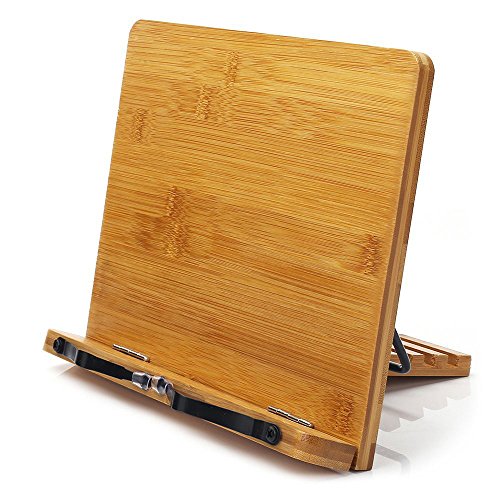
There is something inherently satisfying about using natural tools, and a bamboo book stand brings a warm, tactile quality to your knitting space. These stands are typically foldable, lightweight, and surprisingly strong, making them perfect for holding a single pattern sheet or a standard knitting book.
Bamboo is a sustainable material that ages beautifully, much like your favorite wooden knitting needles. These stands are usually simple, with two adjustable pegs to hold your pattern open, which is perfect for preventing pages from flipping during a row.
They are best suited for tabletop use, providing a modest lift that helps keep your neck in a better position. If you want a minimalist, functional tool that looks great on a side table, this is your best bet.
Wishacc Portable Stand: Best for Travel Knitting

If you are a "knitting nomad" who takes your projects to cafes, guilds, or retreats, you need something that collapses into your project bag. The Wishacc portable stand is slim, durable, and designed to disappear into your luggage when not in use.
Despite its portability, it offers multiple angle adjustments, which is vital when you are sitting in chairs of varying heights. Whether you are on a train or in a hotel room, you can set this up to maintain a healthy posture.
It is ideal for holding tablets or smartphones, which many knitters now use for digital patterns. Just ensure your device has a non-slip case to keep it secure on the stand’s surface.
OmeWook Adjustable Stand: Best Tabletop Choice
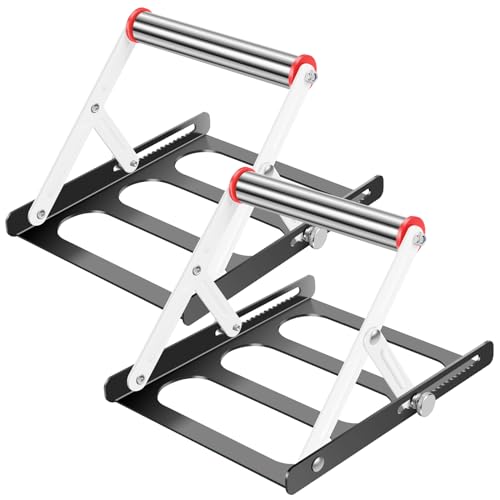
The OmeWook stand is a versatile workhorse that sits firmly on any flat surface, providing a stable platform for your charts. It features a high degree of adjustability, allowing you to tilt the stand to the precise angle that suits your line of sight.
This stand is particularly effective for knitters who use magnetic boards to track their rows. Because the surface is wide and rigid, your magnets will hold fast, and you won’t have to worry about your chart slipping or sagging.
It strikes a perfect balance between portability and stability. If you move between your living room and a dedicated craft room, this stand is easy to relocate without sacrificing ergonomic support.
Ergonomic Factors for Better Knitting Posture
Ergonomics in knitting is about more than just the chair; it is about the entire kinetic chain of your body. When you hunch, your shoulders round forward, which compresses the chest and restricts blood flow to your hands and wrists.
- Eye Level: Your pattern should be at eye level to prevent neck flexion.
- Support: Keep your back supported and your feet flat on the floor.
- Breaks: Every 30 minutes, drop your needles, roll your shoulders, and look at a distant point to reset your ocular focus.
If you ignore these factors, you risk repetitive strain injuries (RSI). Always prioritize comfort over the urge to finish "just one more row."
How to Position Charts to Reduce Neck Strain
The goal is to keep your cervical spine in a neutral, vertical alignment. If your pattern is lying flat on your lap, you are forced to look down, which puts immense pressure on your upper back and neck muscles.
Mount your chart so that your gaze is horizontal. If you are using a digital tablet, consider a stand that allows for both vertical and horizontal orientation, as some charts are easier to read in landscape mode.
Test your position by sitting in your "knitting chair" and closing your eyes; when you open them, your pattern should be exactly where your eyes naturally rest. If you have to move your head to see the chart, adjust the stand height accordingly.
Essential Features for Knitting Pattern Stands
When shopping for a stand, look for features that specifically address the unique needs of fiber artists. Stability is paramount—a stand that wobbles when you reach for your yarn will quickly become an annoyance.
- Adjustable Angles: Crucial for managing glare and maintaining line-of-sight.
- Page Clips: Essential for keeping your pattern open, especially with spiral-bound books.
- Weight Capacity: Ensure it can hold your heaviest reference books without collapsing.
- Foldability: A major plus for those who share their knitting space with the rest of the house.
Avoid stands that are purely decorative; if the hardware is flimsy, it won’t survive the daily wear and tear of a serious knitter.
Tips for Maintaining Your Knitting Workspace
A cluttered workspace is a major contributor to poor posture, as you end up contorting your body to reach for notions or yarn. Keep your essential tools—stitch markers, tapestry needles, and scissors—within easy reach of your chair.
Proper lighting is the final piece of the puzzle. Even the best ergonomic stand won’t save you if you are straining to see your stitches in a dim room. Use a dedicated task lamp that casts light directly onto your work without creating glare on your pattern stand.
Finally, treat your knitting space like a studio. Keep it clean, organized, and dedicated to your craft, and your body will thank you after every long, productive session.
Finding the right pattern stand is a small investment that pays massive dividends in your comfort and longevity as a knitter. By bringing your charts up to eye level, you are protecting your neck and shoulders from the chronic strain that often plagues our craft. Choose the option that best fits your environment, and you will find yourself knitting longer, faster, and with far more joy. Happy stitching, and keep those needles moving!