6 Best Needle Sets For Tapestry Finishing To Own
Achieving a professional tapestry finish starts with the right tools. Discover our top six needle sets, curated for precision, durability, and ease of use.
Finishing your knitting is the moment where a project transforms from a collection of loops into a professional garment. Many makers spend hours perfecting their gauge and tension, only to struggle with bulky, visible yarn tails at the very last step. Having the right tapestry needle in your kit is the difference between a clean, invisible join and a frustrating, lumpy finish. These six sets represent the gold standard for securing your hard work with precision and ease.
Clover Chibi Bent-Tip Tapestry Needle Set


The Clover Chibi set is a staple in almost every serious knitter’s notions bag for a reason. The signature bent tip acts like a tiny hook, allowing you to slide under stitches without splitting the yarn fibers.
This set is particularly brilliant when you are working with plied wools that tend to snag. Because the tip is curved, you can navigate through the back of your knitting without poking through to the right side of the fabric.
The included plastic carrying case is a massive bonus for those of us who lose needles in the couch cushions. It keeps the needles contained and prevents them from migrating into your project bag’s abyss.
Dritz Assorted Yarn Darner Needle Set

Dritz needles are the workhorses of the knitting world, providing a no-nonsense, affordable solution for basic finishing. These needles are typically made of nickel-plated steel, which offers a smooth glide through most fiber types.
The assorted sizing is helpful if you frequently switch between lace-weight mohair and chunky, single-ply yarns. Having a variety of eye sizes ensures you aren’t fighting to thread a thick, fuzzy yarn through an eye that is far too small.
While these lack the fancy bent tips of more expensive sets, they are incredibly durable. They won’t bend or snap even when you are forcing them through a dense, felted seam or a thick kitchener stitch bind-off.
Cocoknits Colored Steel Tapestry Needles

Cocoknits has mastered the art of making functional tools that are also aesthetically pleasing. These colored steel needles are not just pretty; the color-coding actually helps you identify the correct gauge for your yarn weight at a glance.
The steel construction gives these needles a satisfying weight and a slick, polished finish. They slide through delicate fibers like silk or alpaca with zero resistance, which is vital when you are trying to hide ends in high-friction areas.
These needles are on the thinner side, making them ideal for finer-gauge projects like socks or fingering-weight sweaters. If you find yourself working with heavy-weight wools, you may find the eyes a bit restrictive, but for delicate work, they are unmatched.
Bohin Extra Fine Tapestry Needle Collection

Bohin is a French brand renowned for its precision manufacturing. Their extra fine tapestry needles are designed for the knitter who demands absolute perfection in their finishing work.
These are exceptionally smooth and have a very refined point that is blunt enough to avoid splitting yarn but sharp enough to weave through tight stitch patterns. If you do stranded colorwork with long floats, these needles are your best friend for weaving in ends without distorting the tension of your design.
The trade-off here is their delicacy; they are not intended for heavy-duty upholstery or thick, roving-style yarns. Treat these as your "surgical tools" for finishing your most precious, high-end garments.

Tulip Tapestry Needle Set with Case
Tulip needles are widely considered the pinnacle of needle manufacturing, featuring a polished finish that feels almost frictionless. The set comes with a high-quality carrying case that feels like a permanent home for your tools rather than a temporary package.
The eyes of these needles are large and well-shaped, making them exceptionally easy to thread even if your eyesight isn’t what it used to be. The transition from the eye to the body of the needle is seamless, preventing the yarn from catching or fraying during the weaving process.
If you are a knitter who treats your tools as an investment, this set is worth the price. You are paying for the lack of frustration and the longevity of the steel, which resists rusting even after years of use.
Pony Aluminum Yarn Needle Assortment
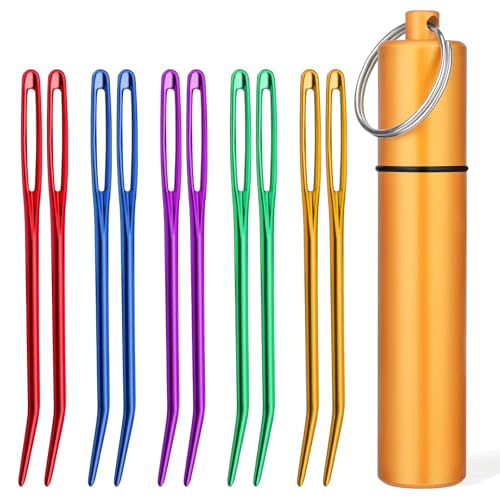
Pony aluminum needles are lightweight and comfortable, especially for knitters who find steel needles a bit too heavy or cold to the touch. The aluminum construction gives them a slightly "grippier" feel, which can be an advantage when working with slippery synthetic fibers.
These are excellent for beginners because they are easy to hold and come in large sizes that make the process of weaving in ends feel less intimidating. They are also quite affordable, making them a low-risk addition to your notions collection.
However, aluminum is a softer metal than steel. If you are a heavy-handed knitter, you might eventually notice these needles bending slightly over time, though for standard finishing work, they perform admirably.
Why Bent-Tip Needles Improve Finishing Work
The physics of a bent-tip needle is simple: it allows you to pick up stitches from behind your work without having to see what you are doing. By curving the tip, you can "scoop" the yarn through the fabric rather than pushing it straight through.
This is a game-changer for kitchener stitch, where you are duplicating stitches to create a seamless join. The hook allows you to follow the path of the yarn precisely, mirroring the existing construction of the fabric.
If you struggle with visible bumps on the inside of your garment, switch to a bent-tip. It allows you to weave through the "legs" of the stitches on the reverse side of your work, making the tail virtually disappear.
Selecting the Right Needle Eye for Thick Yarns
The biggest mistake knitters make is using a needle with an eye that is too small, which forces them to fold the yarn over itself. This creates a bulky knot that will inevitably show on the right side of your finished project.
Always choose a needle where the yarn fills about 75% of the eye’s width. If the yarn is so thick that you have to use pliers to pull it through, you are using the wrong needle.
- For chunky/bulky yarns: Use a large-eyed plastic or aluminum needle.
- For fingering/sport yarns: Use a fine-gauge steel needle.
- For mohair/fuzzy yarns: Use a needle with a larger eye but a very smooth, polished finish to prevent tangling.
Steel vs Plastic: Choosing Your Finishing Tools
Steel needles are the gold standard for longevity and smoothness. They are ideal for high-twist wools and delicate fibers where you need the needle to glide through without creating friction that could cause pilling.
Plastic needles are often larger and more flexible, making them better for heavy-gauge projects where you need to weave in bulky, lofty yarns. They are also gentler on your hands if you have arthritis or find thin metal needles difficult to grip.
Ultimately, your choice should depend on the fiber content of your project. If you are working with a sticky, high-friction yarn, a slick steel needle will save you time; if you are working with a slippery acrylic, a slightly grippier plastic or aluminum needle might give you more control.
Essential Tips for Weaving in Yarn Ends Securely
Weaving in ends is not just about hiding the yarn; it is about ensuring the garment doesn’t unravel after a wash. Never weave in your ends in a straight line, as the yarn will eventually work its way out through the movement of the fabric.
Instead, follow the path of the stitches in a "duplicate stitch" pattern. By mimicking the structure of the knit, you distribute the tension evenly, ensuring the tail stays locked in place even after the garment undergoes the stress of blocking and wearing.
Always leave a tail of at least four to six inches. It is far better to have a little extra yarn to trim than to find your hard work coming undone because your tail was too short to weave in securely.
Finishing is the final act of your creative process, and it deserves the same care you gave your gauge swatch. By investing in a quality set of tapestry needles—whether you prefer the precision of steel or the ease of a bent tip—you ensure your projects look as good as they feel. Take the time to match your tool to your yarn, and you will find that weaving in ends becomes a meditative end to your knitting journey. Happy crafting, and may your finishes always be invisible.