6 Best Tapestry Needles For Pompom Attachment Reviewed
Looking to secure your pompoms? We review the top 6 tapestry needles, evaluating durability and eye size to help you find the perfect tool for your project.
Attaching a pompom is the final, high-stakes moment of a project where a single loose thread can undo hours of hard work. Choosing the right tapestry needle is the difference between a secure, professional finish and a floppy accessory that threatens to fall off. Over twenty years of finishing garments, I have learned that the tool you choose matters as much as the yarn itself. Here are the best needles to ensure your pompoms stay exactly where you put them.
Clover Chibi Bent Tip Needles: Best Overall


The Clover Chibi set is a staple in my notions bag for one simple reason: the bent tip. This design allows you to scoop through dense pompom centers and knitted fabric without needing to flip your work over or strain your wrists.
These needles are made from a smooth, flexible resin that glides through yarn plies without snagging or splitting delicate fibers. Because they are slightly flexible, they offer a tactile feedback that rigid metal needles sometimes lack, letting you "feel" the structure of the pompom core.
They come in a convenient, portable case that prevents them from vanishing into the depths of your project bag. If you only buy one set of finishing tools, make it this one.
Dritz Finishing Needles: Best Value Pick
Dritz needles are the reliable workhorses of the knitting world. They are widely available, inexpensive, and get the job done without any unnecessary bells and whistles.
While they lack the ergonomic bend of premium options, their classic blunt tip is perfectly suited for weaving through the tight stitches of a hat crown. They are made of sturdy, nickel-plated steel that resists bending even when you are pulling thick wool through a dense pompom base.
If you are the type of knitter who tends to lose needles between the couch cushions, these are your best bet. Buy a pack, keep them in your project basket, and you will never be caught without a way to finish a project.
Bohin Extra Large Eye Needles: Best for Bulky
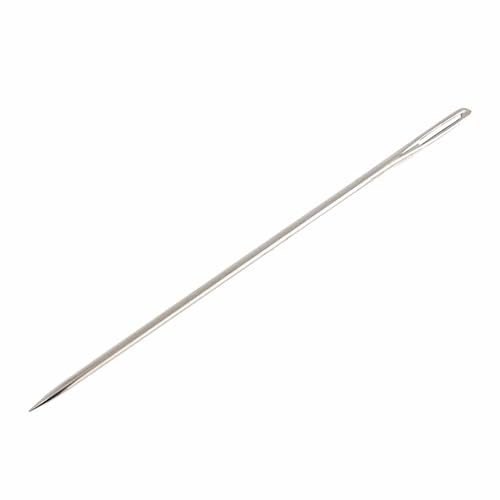
When you are working with super bulky weight yarns or multiple strands held together, a standard eye will cause nothing but frustration. Bohin’s extra-large eye needles are designed specifically to accommodate thick, unruly yarn tails.
The steel construction is incredibly smooth, which is vital when you are fighting to pull a thick yarn tail through a crowded pompom center. A rough needle will drag and fray your yarn, while these allow for a clean, friction-free pass.
These are particularly useful if you suffer from arthritis or hand fatigue. The larger eye makes threading a breeze, even if your eyesight isn’t what it used to be.
Tulip Tapestry Needles: Best Premium Quality
Tulip needles are a luxury, but they are a luxury that pays for itself in sheer ease of use. The tip is polished to a high degree of smoothness, and the eye is uniquely shaped to hold yarn securely without being bulky.
These needles feel substantial in the hand, offering a balance that makes the repetitive motion of sewing on a pompom feel almost effortless. They are remarkably resistant to corrosion, meaning they will stay slick and shiny for years.
If you have a habit of working with high-end fibers like cashmere or silk, you want a needle that won’t snag or pull the delicate plies. Tulip is the gold standard for protecting your investment.
Susan Bates Finishing Set: Best for Beginners

Beginners often struggle with the "fiddly" nature of finishing, and Susan Bates makes this process as approachable as possible. Their set includes a variety of sizes and shapes, allowing you to experiment and find what feels comfortable.
The needles are made from a durable, lightweight plastic that is gentle on the hands. They are particularly good for learning how to navigate the "live" stitches of a hat crown without accidentally splitting the yarn.
Don’t let the plastic material fool you into thinking they are flimsy. They are perfectly adequate for most standard weight yarns and provide a great entry point for someone just starting their knitting journey.
Knitters Pride Wool Needles: Best for Comfort

Knitters Pride has mastered the art of the ergonomic tool, and their wool needles are no exception. They are designed with a gentle curve that mimics the natural motion of the wrist during sewing.
The surface is smooth but provides just enough grip to keep the yarn from slipping out of the eye mid-stitch. This is a subtle feature, but it makes a world of difference when you are trying to anchor a heavy, dense pompom.
If you are finishing a large batch of hats for a craft fair, your wrists will thank you for choosing these. They minimize the repetitive strain that often comes with securing heavy accessories.
Why Bent Tips Are Essential for Pompom Work
A straight needle forces you to push the tip through the fabric and then hunt for the exit point on the other side. With a bent tip, you can slide the needle under several stitches at once and "hook" the exit point with a simple flick of the wrist.
This is especially crucial when attaching a pompom, as you need to navigate through the thick, tied-off center of the pompom and the tight crown of the hat. A bent tip allows you to maneuver in tight spaces where you cannot see exactly where the needle is going.
It essentially turns your needle into a hook, allowing you to pick up stitches with much higher precision. Once you switch to a bent tip, you will likely never go back to straight needles for finishing work.

Choosing Between Metal and Plastic Needles
Metal needles are the professional’s choice for durability and slickness. They glide through even the tightest, most felted fibers, making them ideal for heavy-duty tasks like attaching dense, oversized pompoms.
Plastic needles, however, are often preferred by those who find metal needles too slippery or cold to the touch. They are also significantly lighter, which can reduce hand fatigue during long finishing sessions.
Ultimately, it comes down to the yarn you are using. If you are working with a sticky, woolly yarn, a slick metal needle is a lifesaver. If you are working with a slippery synthetic or silk, a plastic needle can provide just enough friction to keep your yarn in place.
How to Secure Pompoms for Maximum Durability
Never rely on a single pass of yarn to hold a pompom in place. Always use the long tails left over from the pompom’s center tie to sew through the hat in multiple directions, forming an "X" or a cross-stitch pattern.
Make sure you are catching the actual fabric of the hat, not just the decorative stitches on the surface. If you are worried about the pompom pulling the hat out of shape, add a small button on the inside of the hat crown and sew through it; this acts as an anchor and prevents the yarn from stretching the knitted fabric.
Always double-knot your ends on the inside of the hat before weaving them in. A pompom is a heavy weight on top of a garment, and gravity will work against your knots over time.
Frequently Asked Questions About Finishing Tools
Can I use a sewing needle for pompoms? Usually, no. Sewing needles are too sharp and will split your yarn, and their eyes are far too small to accommodate even sport-weight yarn.
How do I keep my yarn from falling out of the needle eye? Choose a needle with a longer, narrower eye, or use a "threading trick" where you fold the yarn over the needle, pull the loop through the eye, and then thread the ends through the loop.
Are bent tip needles only for pompoms? Not at all. They are excellent for weaving in ends on sweaters, sewing up side seams, and grafting stitches, as they allow you to easily pick up the "v" of the stitch.
Investing in a quality set of tapestry needles is a small price to pay for the peace of mind that comes with a secure finish. Whether you prefer the slick speed of metal or the gentle grip of plastic, the right tool will make your finishing work feel like a treat rather than a chore. Take your time with those final stitches, and your pompoms will stay perky and secure for years to come. Happy knitting!