
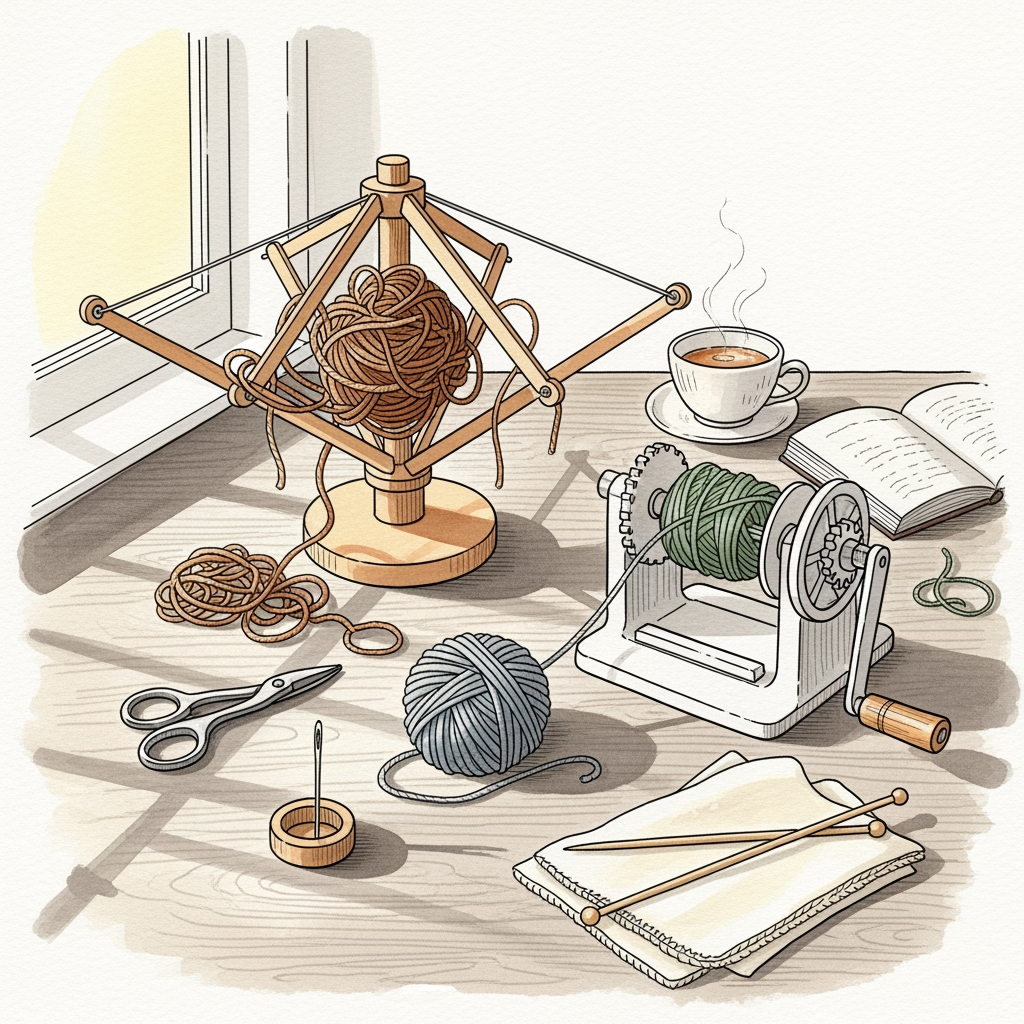
6 Best Umbrella Swifts For Delicate Hand-dyed Yarn
Find the perfect umbrella swift for delicate hand-dyed yarn. Our guide compares six top models to help you prevent tangles and protect your fiber investment.
There is nothing quite like the heartbreak of watching a beautiful, hand-dyed skein of silk-merino blend turn into a tangled, knotted disaster on your living room floor. Investing in a high-quality umbrella swift is the single most important step to preserving the integrity of your luxury fibers. When you handle hand-dyed yarn, you are working with delicate twist and often fragile color saturation that can be ruined by uneven tension or snagging. These six tools represent the gold standard for ensuring your projects begin as smoothly as they end.
Stanwood Needlecraft Tabletop Swift: Best Overall
The Stanwood tabletop swift is a staple in serious knitting studios for a reason. Its heavy-duty construction and smooth, ball-bearing rotation make it incredibly reliable for even the most voluminous skeins of lace-weight mohair.


The metal clamp design is robust, providing a secure grip on almost any table edge without the wobbling that plagues cheaper models. Because it spins with such minimal friction, you can wind your yarn without the constant tug-of-war that often leads to uneven tension in your finished cakes.
If you frequently work with expensive, hand-dyed yarns that are prone to tangling, this swift is your best insurance policy. While it takes up a bit more storage space than folding models, the consistency it provides is unmatched.

Amish-Style Wooden Swift: Best for Portability
If you are a knitter who travels to retreats or enjoys knitting in different rooms of the house, the Amish-style swift is a dream. Unlike umbrella models, these disassemble into flat, easy-to-pack pieces that won’t take up your entire project bag.
Because these swifts are typically made of unfinished wood, they offer a natural grip that prevents yarn from sliding off the arms during the winding process. This is particularly helpful for slick fibers like bamboo or Tencel, which can be notoriously "slippery" on metal or polished wood surfaces.
However, keep in mind that these require a bit more manual oversight. You will need to ensure the pegs are tightened correctly to accommodate the circumference of your skein, but the trade-off for that extra setup time is a tool that lasts a lifetime.
Lacis Wooden Umbrella Swift: Best for Precision
The Lacis umbrella swift is built with the kind of old-world craftsmanship that fiber artists appreciate. It features a finely tuned mechanism that expands and contracts with incredible smoothness, allowing you to match the exact diameter of your yarn loop.
Precision is critical when you are dealing with hand-dyed yarns that have been dyed in long, delicate color sequences. If your swift doesn’t open perfectly round, the yarn will pull unevenly, potentially causing the colors to "pool" or shift in ways you didn’t intend for your pattern.
This is a premium piece of equipment for the knitter who views their tools as an extension of their craft. It is beautiful to look at and even better to use, providing a level of control that makes the winding process feel meditative rather than like a chore.
KnitPicks Yarn Swift: Best Value for Beginners
For those just starting their journey with luxury hand-dyed yarns, the KnitPicks umbrella swift offers a fantastic entry point. It is lightweight, intuitive to set up, and performs all the essential functions without the hefty price tag of professional-grade gear.

It is particularly well-suited for standard-sized skeins of worsted or DK weight yarn. While it may not handle massive, heavy-duty skeins with the same grace as a high-end metal model, it is more than capable of handling the average project yarn.
If you are currently winding yarn by hand around the back of a chair, this will be a life-changing upgrade. It is the perfect tool to help you transition from store-bought balls to the beautiful, artisanal skeins found at local yarn stores.
Strauch Jumbo Ball Winder and Swift: Best Heavy
When you are working with large, bulky skeins—like a thick, hand-spun wool or a massive 200-gram hank of superwash merino—standard swifts often struggle under the weight. The Strauch system is built to handle the heavy lifting that other tools simply cannot manage.
This setup is designed for the high-volume knitter who regularly processes large quantities of fiber. The structural integrity of the swift ensures that even when the skein is at its heaviest, the rotation remains fluid and consistent.
You are paying for industrial-grade durability here. If you are a prolific knitter who goes through yarn at a fast pace, this is an investment that will save you from the frustration of constant mechanical failure.
Nancy’s Knit Knacks Swift: Best Professional
Nancy’s Knit Knacks has long been the gold standard for those who demand absolute perfection in their tools. Their swifts are engineered with a level of mechanical precision that you rarely see in the hobbyist market, making them the preferred choice for professional designers and shop owners.
These swifts are incredibly smooth and quiet, which is a major plus if you are winding yarn while listening to a podcast or watching a movie. They are designed to stand up to constant, daily use without losing their calibration or developing "wobble."
If you consider yourself a serious fiber artist who spends more time knitting than doing anything else, this is the final swift you will ever need to buy. It turns the task of winding yarn into a seamless, professional-grade experience.
Why Your Hand-Dyed Yarn Needs a Quality Swift
Hand-dyed yarn is often sold in hanks, which must be untwisted and wound into a ball or cake before you can begin knitting. If you use a poor-quality swift, the yarn can catch on rough edges or uneven joints, creating "snags" that break the delicate fibers.
Furthermore, a quality swift ensures that the yarn comes off the skein at a consistent tension. If the swift jerks or sticks, you are essentially "stretching" the yarn as you wind it, which can cause your gauge to be inconsistent once the yarn relaxes back into its natural state.
Investing in a swift is really an investment in your finished project. You want your hand-dyed yarn to look as vibrant and beautiful in the final garment as it did when you first fell in love with it in the shop.
How to Properly Set Up Your Umbrella Yarn Swift
The most important step in setting up an umbrella swift is ensuring it is centered on your table. You want to place the swift at a distance from your ball winder that allows the yarn to flow freely without being pulled too tight or sagging too low.
Once you have placed your skein on the swift, gently expand the arms until the yarn is taut but not stretched. A common mistake is to over-extend the arms, which puts unnecessary tension on the yarn and can cause it to snap if it’s a delicate fiber like silk or alpaca.
Always check that the yarn is resting smoothly in the grooves of the swift arms. If the yarn is catching on any part of the mechanism, stop immediately and adjust the position of the skein before you continue winding.
Avoiding Snags with Delicate Hand-Dyed Skeins
Hand-dyed yarns often have a "loftier" twist than mass-produced yarns, which makes them more prone to catching on small imperfections. Before you put the skein on the swift, take a moment to gently shake it out and ensure there are no hidden knots or tangles.
If you are working with a particularly delicate fiber, such as mohair or angora, you may want to wind the yarn at a slower, more deliberate pace. Rushing the process is the quickest way to create a tangle that is nearly impossible to fix without cutting the yarn.
Always keep your scissors nearby, but use them as a last resort. If you encounter a tangle, stop winding, take the skein off the swift, and use your fingers to gently tease the fibers apart rather than pulling on the yarn.
Essential Tips for Maintaining Your Yarn Swift
Most wooden swifts benefit from a very light application of wax or furniture polish once or twice a year to keep the wood smooth and prevent splinters. If your swift has metal parts, a tiny drop of sewing machine oil on the rotating joints will keep it spinning silently for years.
When you aren’t using your swift, store it in a cool, dry place. Extreme changes in temperature or humidity can cause wood to warp, which will throw off the balance of your swift and make it difficult to wind yarn evenly.
Finally, treat your swift with the same care you treat your needles. It is a precision tool that, when maintained properly, will serve you faithfully through hundreds of projects and thousands of yards of beautiful, hand-dyed fiber.
Choosing the right umbrella swift is about balancing your personal knitting volume with the types of fibers you love most. Whether you prioritize the portability of an Amish-style model or the heavy-duty precision of a professional system, the goal remains the same: protecting your yarn. Take your time during the setup process, keep your tools clean, and you will find that winding your yarn becomes a peaceful prelude to the joy of knitting. Happy crafting, and may your yarn always flow smoothly.
