6 Best Storage Trays For Small Notions To Organize
Struggling with tiny clutter? Discover our top 6 storage tray picks for organizing small notions, ensuring your workspace stays tidy, efficient, and refined.
Every knitter knows the frustration of hunting for a specific cable needle or a locking stitch marker while in the middle of a complex lace chart. Small notions are the unsung heroes of our craft, yet they have a notorious habit of disappearing into the abyss of a project bag. Investing in a dedicated storage system is not just about tidiness; it is about protecting your focus and flow. These six storage solutions offer the structure needed to keep your essential tools ready for the next cast-on.
ArtBin Super Satchel: Best for Large Collections
If your stash of needles, cables, and accessories has outgrown a single pouch, the ArtBin Super Satchel is the gold standard. It offers a generous, deep interior that accommodates bulky items like circular needle cases or multiple sets of interchangeable tips.


The real beauty lies in its modularity. You can configure the interior dividers to create long channels for straight needles or small squares for notions like point protectors and measuring tapes.

However, be aware that this is a "base station" solution. It is not designed to be tossed into a small purse for a quick commute to a knit night. Keep this on your craft room shelf to house your master inventory.
Beadsmith Plastic Storage Box: Best for Tiny Bits

When you are working with delicate glass beads for knitting or tiny progress keepers, you need a system that prevents migration. The Beadsmith boxes feature individual snap-tight lids that ensure your smallest notions stay exactly where you put them.
I find these particularly useful for organizing stitch markers by size or style. If you have a collection of locking, split-ring, and closed-ring markers, keeping them in separate, secure compartments is a game-changer.
The tradeoff here is the time spent opening and closing individual lids. If you need lightning-fast access, this might feel slightly tedious, but it is the safest way to prevent a spill.
Muji Polypropylene Case: Best for Minimalists
Muji cases are beloved for their clean lines and understated aesthetic. They fit perfectly into a professional or home-office environment where you might be sneaking in a few rows of a sock project during a break.
The translucent plastic allows you to see exactly what is inside without opening the lid. This is perfect for the knitter who wants to keep their tools visible but contained within a sleek, stackable footprint.
Because these cases lack internal dividers, they are best suited for storing sets of items, such as a full collection of cable needles. Use a small velvet pouch inside the case for loose stitch markers to prevent them from sliding around.
Darice 3-Tier Stackable Tray: Best for Versatility

The Darice system is a favorite because it grows as your collection does. You can start with one tier and add more as you acquire new needle sizes or specialized tools like pom-pom makers and tapestry needles.

The snap-lock mechanism is secure enough to transport, though I recommend keeping it upright. It is an excellent choice for a knitter who likes to have a "project-specific" tray that travels between the living room and the dining table.
The main consideration is the size of the compartments. They are fixed, so you cannot adjust them for unusually long tools. Measure your longest needle gauge or crochet hook before committing to this system.
Plano 3700 StowAway: Best for Durability and Size
Borrowed from the world of tackle boxes, the Plano 3700 is virtually indestructible. If you are a knitter who travels frequently or attends retreats, this box will survive being shoved into a suitcase or dropped on a hardwood floor.
The adjustable dividers are the standout feature here. You can create custom-sized slots for your favorite snips, needle gauges, and even your collection of luxury wooden needles.
Be mindful that the plastic is quite rigid. While this offers great protection, it does mean the box is bulky. It is best suited for the knitter who needs to keep a large, comprehensive set of tools protected during transit.
Fiskars Craft Organizer: Best for Quick Access
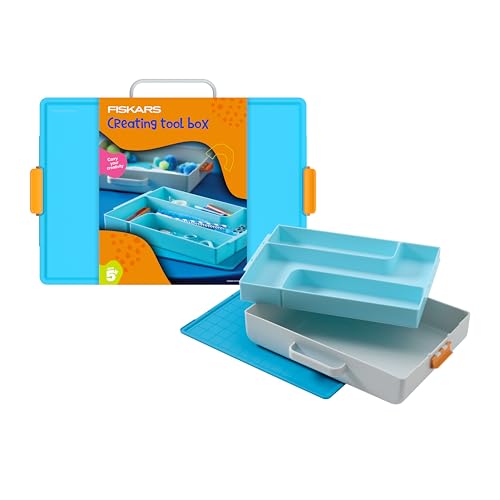
Fiskars understands the rhythm of a maker’s workflow. This organizer is designed with a low profile and an easy-open latch, making it perfect for the tools you reach for every single time you sit down to knit.
I recommend using this for your "daily driver" notions: a reliable pair of scissors, a tape measure, a few tapestry needles, and a selection of stitch markers. It keeps these items front and center on your side table.
The trade-off is that it offers less protection than a hard-sided case. It is an organizational tool for the desk, not a vault for your most expensive or fragile equipment.
Why Small Notions Require Dedicated Organization
Small notions are easily lost because they lack the physical presence of a project. A tapestry needle that falls into a carpet pile is effectively gone, and a missing stitch marker can derail an entire lace repeat.
When you organize these items, you reduce the "cognitive load" of your knitting session. Instead of searching for tools, you spend your energy on the tension and complexity of your work.
Furthermore, proper storage prevents damage. Keeping your needles and metal notions in a dedicated tray prevents them from bending or snagging against other tools, extending the life of your gear.
How to Categorize Your Stitch Markers and Tools
Start by grouping your notions by function rather than by size. I categorize mine into "Measuring," "Marking," "Finishing," and "Maintenance."
- Measuring: Tape measure, needle gauge, and row counter.
- Marking: Locking markers for cables, split rings for knitting in the round, and closed rings for pattern repeats.
- Finishing: Tapestry needles, crochet hooks for dropped stitches, and snips.
- Maintenance: Point protectors, needle wax, and small screwdrivers for interchangeable sets.
This functional approach ensures that when you hit a specific instruction in a pattern—like "place marker"—you know exactly which tray or section to reach for.
Essential Notions Every Knitter Should Organize
Every knitter needs a core set of tools that should always be ready for action. Having these gathered in one place ensures you are never caught unprepared when starting a new project.
- Tapestry Needles: Keep a variety of sizes for different yarn weights (e.g., lace vs. bulky).
- Snips: A dedicated pair of sharp scissors that never cut paper.
- Stitch Markers: A mix of styles to accommodate different needle diameters.
- Needle Gauge: Essential for identifying mystery needles after a project is finished.
Don’t forget to include a small "emergency kit" section in your tray. This should contain a few spare stitch markers, a length of waste yarn for holding stitches, and a small crochet hook for picking up dropped stitches.
Tips for Maintaining Your Knitting Tool Inventory
Audit your notions every six months to clear out items you no longer use. If you find yourself consistently frustrated by a specific type of marker or a dull pair of scissors, replace them.
Keep your storage trays clean by wiping them down with a damp cloth occasionally. Dust and lint can accumulate, especially if you work with fuzzy mohair or rustic, unwashed wool.
Finally, label your compartments. Even if you think you will remember where everything goes, a simple label makes it easier for you to return items to their home after a long knitting session.
Organizing your knitting notions is an act of respect for your own craft and the time you invest in your projects. By choosing the right storage solution, you transform your workspace from a source of clutter into a sanctuary of creativity. Start small, categorize by function, and enjoy the peace of mind that comes with knowing exactly where your favorite tools are. Happy knitting, and may your rows always be even and your markers always easy to find.