6 Best Tapestry Wools For Embroidery Worth Trying
Discover the top 6 tapestry wools for embroidery. This guide evaluates texture, durability, and color range to help you choose the best fiber for your craft.
Selecting the right thread for embroidery and needlepoint is just as critical as choosing the perfect yarn for a complex cabled sweater. While many beginners focus solely on color, the fiber content and twist of your wool will dictate the texture and longevity of your final piece. This guide breaks down the industry’s most reliable tapestry wools to help you match your materials to your artistic vision. Whether you are working on a fine crewel project or a bold needlepoint canvas, these selections represent the gold standard in fiber arts.
Appleton Crewel Wool: The Gold Standard Choice


Appleton is the yarn that most of us reach for when we want historical accuracy and consistent results. It is a two-ply, long-staple wool that behaves beautifully under the needle, offering a smooth finish that rarely knots or tangles.

If you are working on a traditional crewel embroidery piece, the way this wool covers the fabric is unmatched. It provides that quintessential matte finish that makes vintage-style floral motifs look authentic.
The main trade-off is its slightly rustic feel; it isn’t as soft as a merino blend, but that texture is exactly what gives it its durability. Always use shorter lengths when working with Appleton to prevent the yarn from wearing thin as it passes through the canvas.
DMC Tapestry Wool: Best for Versatility
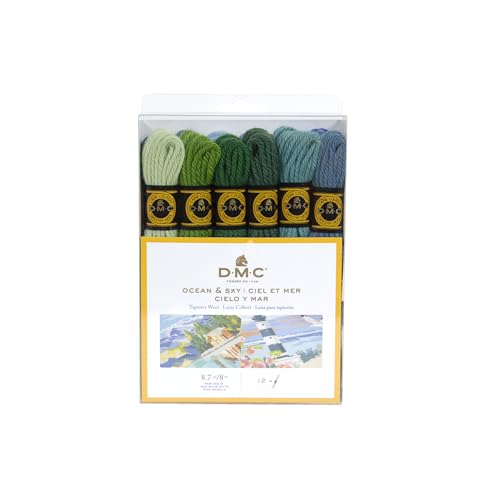
DMC is the workhorse of the embroidery world, found in almost every craft store for good reason. It is a non-divisible, four-ply wool that is specifically designed to provide excellent coverage on needlepoint canvases.
Because it is widely available, it is the perfect choice for projects where you might need to color-match later or pick up an extra skein on a whim. It holds up well to the friction of moving in and out of tight mesh, making it a reliable pick for beginners.
However, it lacks the sophisticated color palette of high-end boutique brands. Use this for bold, graphic designs rather than subtle, shaded portraits where you need a dozen variations of a single hue.
Paternayan Persian Yarn: Superior Color Range

Paternayan is legendary for its massive, nuanced color library. It is a three-ply Persian yarn, meaning you can easily untwist the strands to use one, two, or all three depending on the thickness you need for your stitches.
This flexibility makes it a dream for needlepoint artists who need to adjust their weight to fill specific gaps in a canvas. If you are doing fine detail work, separating the plies allows for a much more delicate touch.
The trade-off is the time required to prep your thread. You must be comfortable with the "stripping" process, as using the full weight when you only need a single ply will result in a bulky, uneven finish.
Gumnut Yarns Daisies: Best Australian Merino

Gumnut Yarns are a revelation if you have been struggling with the scratchiness of traditional tapestry wools. These are made from high-quality Australian merino, offering a softness that is rare in the embroidery world.
The "Daisies" line is a fine-weight wool that produces a gorgeous, lustrous sheen. It is ideal for projects that require fine detail, such as botanical illustrations or miniature landscapes where you want a smooth, almost silk-like appearance.
Because it is so soft, it is more delicate than standard tapestry wool. Handle it with care and avoid pulling it through overly abrasive or stiff canvases to keep the fibers looking pristine.
Anchor Tapestry Wool: Best Budget-Friendly Pick

Anchor provides a consistent, reliable product that won’t break the bank when you are tackling a large-scale project. It is a four-ply wool that is sturdy, colorfast, and very resistant to pilling.
This is the yarn I recommend for those large, repetitive background areas where you need a lot of yardage without a high cost. It covers the canvas effectively and stands up to the wear and tear of a long-term project.
Don’t expect the depth of color or the softness of hand-dyed wools here. Use Anchor for the "heavy lifting" parts of your project and save the premium, hand-dyed yarns for your focal points.
Renaissance Dyeing Crewel: Best Natural Dyes
If you are a purist who values the chemistry of color, Renaissance Dyeing is your best bet. These wools are dyed using traditional, natural methods, resulting in earthy, complex tones that synthetic dyes simply cannot replicate.
The colors have a beautiful, subtle variation that adds life to any embroidery piece. When you use these, your work gains a depth and "soul" that feels organic and intentional.
Because they are naturally dyed, they can be slightly less colorfast than modern synthetics. Keep your finished pieces out of direct, harsh sunlight to ensure the colors remain vibrant for years to come.
Understanding Wool Weight and Needle Sizing
Matching your wool weight to your canvas mesh size is the difference between a project that looks professional and one that looks messy. If your thread is too thin, you will see the canvas peeking through; if it is too thick, your work will buckle.
- 10-12 Mesh Canvas: Use a thicker wool like Paternayan (all 3 plies) or DMC.
- 14-18 Mesh Canvas: Switch to a finer crewel wool or use 1-2 plies of Persian yarn.
Always test a small square before committing to a large area. If your stitches feel like they are "fighting" the canvas, you are likely using too much thread for the hole size.
How to Prevent Thread Fraying While Working
Fraying is the enemy of a clean stitch, often caused by the friction of the yarn rubbing against the raw edges of your canvas. The longer your working thread, the more times it passes through the hole, and the more likely it is to pill or break.
Keep your working lengths to about 12-15 inches. This limits the "travel time" of the yarn, keeping the twist intact and the fibers smooth until the very last stitch.
If you find your thread is still fraying, check your needle eye. A needle that is too small for the yarn will strip the fibers as you pull it through, causing premature wear.
Choosing the Right Canvas for Your Project
The canvas is the skeleton of your embroidery, and choosing the wrong one will make your life significantly harder. Mono canvas is generally easier for beginners because it is uniform and stable, whereas Penelope canvas has a double-thread structure that allows for fine detail.
Consider the "stiffness" of the canvas; a high-quality, starched canvas will hold its shape better in your hoop or frame. If your canvas feels limp, it will be prone to distortion, making it difficult to keep your stitches square.
Always mount your canvas in a frame or hoop to keep it taut. Working on loose fabric is the fastest way to end up with uneven tension and warped designs.
Essential Tools for Finishing Your Embroidery
Once your stitches are in place, the finishing process is where your project truly transforms. You will need a good pair of embroidery scissors, a blunt-tipped tapestry needle, and potentially a blocking board.
Blocking is the secret step many beginners skip; it involves gently dampening your finished piece and pinning it square to ensure the edges are straight. This simple act corrects any minor distortions caused by the tension of your stitching.
Finally, keep a needle minder handy to avoid losing your needles in the fabric. A clean, organized workspace is just as important as the quality of the wool you choose.
Mastering the art of embroidery is a journey of understanding how your materials interact with your tools and your hands. By choosing the right tapestry wool and respecting the mechanics of your canvas, you elevate your craft from simple needlework to a lasting textile creation. Don’t be afraid to experiment with different brands until you find the fiber that feels like an extension of your own hand. Happy stitching, and may your tension always be even and your colors bright.