6 Best Needle Threaders For Metallic Threads To Try
Struggling with metallic threads? Discover the 6 best needle threaders designed to handle delicate, shimmering fibers without fraying or snapping your thread.
Working with metallic threads adds a beautiful, light-catching dimension to your knitting and embroidery projects, but their tendency to fray and snap can be incredibly frustrating. These delicate, often synthetic-wrapped filaments require specialized tools to navigate the needle eye without stripping the metallic coating. Finding the right threader is the difference between a meditative crafting session and a project stalled by constant breakage. This guide explores the best tools to help you manage these shimmering fibers with ease and precision.
Clover Desk Needle Threader: Best for Efficiency


If you have ever spent twenty minutes squinting at a needle eye while your project sits idle, you know the value of a desktop solution. The Clover Desk Needle Threader is a game-changer for those who find handheld tools fiddly or hard to manipulate.
It works by placing your needle into a slot and pressing a button, which pushes a tiny hook through the eye for you. It is particularly effective for metallic threads because it eliminates the human error of "aiming" the thread, which often leads to the thread rubbing against the needle eye and fraying.
The trade-off here is portability; this is a tool for your dedicated craft station, not your travel knitting bag. However, for long sessions of adding metallic highlights to a lace shawl, the sheer speed and consistency make it an indispensable investment for your studio.
Dritz Deluxe Needle Threader: Best for Visibility

Sometimes the simplest tools are the most reliable, provided they offer enough clarity to see what you are doing. The Dritz Deluxe version features a built-in magnifying lens, which is a massive help when working with high-gauge needles and fine metallic filaments.
The magnifying glass allows you to ensure the metallic thread is sitting perfectly in the hook before you pull it through. This visual confirmation is crucial because metallic fibers often have a "memory" and will kink if they aren’t guided through the eye in a straight line.
While the plastic construction may feel a bit lightweight, the added visibility is a significant advantage for makers with eye strain. If you struggle with depth perception when threading, this tool will likely become your go-to companion.
Bohin Wire Needle Threader: Best for Precision

Bohin is a name synonymous with quality in the sewing world, and their wire threaders are a testament to that reputation. Unlike cheaper alternatives that snap after a few uses, these wires are crafted to hold their shape under tension.
Precision is the name of the game when dealing with metallic threads that have a tendency to unspool or separate. The slim profile of the Bohin wire allows it to pass through even the smallest needle eyes without forcing, which prevents the wire from damaging the metallic coating of the thread.
Be aware that these are still delicate, as all wire threaders are, but the durability of the wire is superior to most generic options. Treat them gently, and they will reward you with clean, snag-free threading every time.
Singer Assorted Threaders: Best Budget Option

We have all been in a situation where we lose our favorite tool right when we are in the flow of a project. Having a few inexpensive, reliable backups on hand is a smart strategy for any serious crafter.
The Singer assorted pack provides a variety of sizes, which is helpful if you switch between tapestry needles for weaving in ends and finer needles for decorative stitching. While they aren’t as robust as the high-end desktop models, they are perfectly functional for occasional use.
The bottom line is that these are disposable, utilitarian tools that get the job done without a high price tag. Keep a few in your notions tin, and you will never be caught without a way to finish your project.
Colonial Embroidery Threader: Best for Metallics
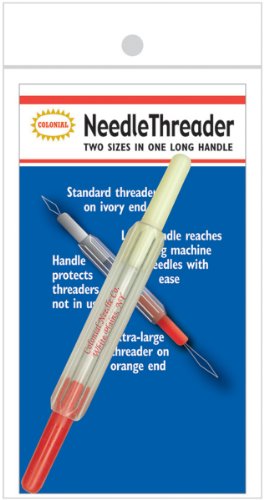
If you work primarily with metallic embroidery floss or heavy metallic yarns, you need a threader that is designed to handle the unique thickness and texture of these fibers. The Colonial threader is built with a sturdier wire loop that accommodates thicker metallic strands without bunching.
Metallic threads are often composed of a core fiber wrapped in a metallic foil, which makes them prone to stripping if pulled through a tight space with a thin, sharp wire. The Colonial’s design is more forgiving, allowing the thread to glide through the needle eye with minimal friction.
It is a specialized tool for a specialized task, and you will notice the difference immediately if you have been struggling with thread breakage. Invest in this if you frequently incorporate metallic accents into your work.
Tulip Needle Threader: Best for Fine Eyelets

Tulip is known for their exquisite needle manufacturing, and their threading tools follow the same standard of excellence. This threader is exceptionally slim, making it ideal for the fine eyelets of embroidery or beading needles.
When you are working on intricate projects where the needle eye is barely larger than the thread itself, you cannot afford a bulky tool. The Tulip threader slides in and out of the eye with a smoothness that feels almost frictionless.
While it is a premium item, the precision engineering ensures that you aren’t damaging your delicate metallic threads during the process. It is the perfect choice for the detail-oriented maker who refuses to compromise on tool quality.
Why Metallic Threads Require Specialized Tools
Metallic threads are fundamentally different from standard cotton or wool fibers because they are essentially metallic-coated plastic or foil. When you pull them through a needle eye, any friction can cause the outer layer to peel, leaving you with a frayed, unsightly mess.
Standard threaders are often designed for smooth, uniform threads that can withstand a bit of pulling and tugging. Metallic threads, conversely, have low tensile strength and high surface friction, meaning they require a tool that provides a clear, unobstructed path.
- Avoid sharp angles: The sharper the bend in the thread, the more likely the metallic coating is to crack.
- Minimize friction: Use a tool that pulls the thread through in a straight line rather than forcing it through a tight, angled eye.
- Check your needle: Ensure your needle eye is polished and free of burrs, as even the best threader can’t save a damaged needle.
Anatomy of a Threader: Selecting the Right Wire
Not all threader wires are created equal; the gauge of the wire and the flexibility of the metal dictate how well it will perform with metallic fibers. A wire that is too thick will struggle to enter the needle eye, while a wire that is too thin may be too fragile to handle the resistance of a metallic strand.
Look for wires that have a slight "spring" to them, as this indicates a high-quality alloy that won’t permanently deform after one use. The shape of the loop also matters; a teardrop shape is generally more versatile than a flat or oval loop for capturing different thread thicknesses.
Always match your threader to the size of the needle eye you are using. Trying to force a thick wire through a size 10 embroidery needle will only lead to a snapped wire and a frustrated knitter.
Techniques to Prevent Metallic Thread Fraying
Beyond using the right tool, how you handle the thread itself is paramount to success. Start by cutting your metallic thread lengths shorter than you would for standard yarn; the less distance the thread has to travel through the fabric, the less likely it is to fray.
If you are hand-sewing or embroidering, try using a "thread conditioner" or a light touch of beeswax to smooth down the fibers. This creates a protective barrier that helps the thread glide through the needle eye and the fabric without catching.
- Work slowly: Jerky movements are the enemy of metallic threads.
- Minimize passes: Try to avoid going through the same spot in your fabric multiple times, as the friction of the fabric will strip the thread.
- Use a larger needle: If possible, use a slightly larger needle than you think you need to reduce the tension on the thread as it passes through the eye.
Troubleshooting Common Needle Threading Issues
If you find your thread is still breaking, the problem might not be the threader at all. Check your needle for microscopic burrs or rust; even a tiny imperfection on the metal can act like a blade against a delicate metallic strand.
Another common issue is "twisting" during the threading process. Metallic threads have a tendency to rotate as they are pulled, which can cause them to kink and snap. Ensure the thread is laying flat as you feed it into the threader hook.
Finally, if you are using a multi-ply metallic thread, consider separating the plies if the thread is too thick for your needle. It is always better to use a thinner, stronger strand than to force a thick, fragile one that is bound to break under pressure.
Mastering the use of metallic threads is a rewarding skill that elevates your projects from simple knits to professional-grade works of art. By selecting the right threader and treating your delicate materials with care, you can mitigate the frustrations of fraying and breakage. Remember that patience and the right tools are your best allies when working with these shimmering fibers. Happy crafting, and may your stitches always be as bright as your vision.