6 Best Craft Lamps For Color Matching Artists Love
Achieve perfect color accuracy with these 6 top-rated craft lamps. Discover the best lighting solutions artists trust for precise, true-to-life color matching.
Lighting is the unsung hero of every successful knitting project, often making the difference between a perfectly matched colorwork motif and a frustrating mistake. When you spend hours on intricate lace or complex stranded patterns, poor light leads to eye strain and inaccurate color perception. These six lighting solutions are designed to help you see every stitch, ply, and hue with professional-grade clarity. Investing in your workspace is just as important as choosing the right wool for your next heirloom piece.
Daylight Company Wafer 3: The Best Light Table
The Wafer 3 is a game-changer for those who need to see the structure of their fabric in high relief. Because it is a light table, it provides an even, backlit surface that makes identifying dropped stitches or subtle color changes in lace weight yarn incredibly easy.
If you are working on a complex chart, placing your pattern directly on the illuminated surface allows you to track your progress without squinting. It is remarkably thin and lightweight, meaning you can slide it under your knitting bag or move it to the kitchen table when you need more room.
However, keep in mind that this is a specialized tool. While it is unparalleled for checking stitch definition or working with dark, low-contrast fibers, it doesn’t replace a primary ambient light for your entire room.
OttLite G-Series LED Desk Lamp: Best for Color


OttLite has long been the gold standard for crafters who need to distinguish between subtle shades of blue and green. This lamp uses technology that mimics natural daylight, which is essential when you are trying to match a skein of hand-dyed yarn to an existing project.
When you are working with variegated yarns, the color shifting that happens under standard yellow household bulbs can be disastrous. This lamp eliminates that "muddy" look, ensuring that the pinks and purples you see in your lap are exactly what you will see in natural sunlight.
The flexible neck is a major plus for knitters. You can angle it directly over your hands while you work on a 2.25mm sock project, ensuring you don’t miss a single yarn-over.
BenQ ScreenBar Halo: Best for Workspace Clarity
If your craft space doubles as your computer desk, the ScreenBar Halo is a brilliant space-saving solution. It sits on top of your monitor, casting a wide, flicker-free beam across your knitting needles without creating glare on your screen.
This is perfect for the modern maker who watches knitting tutorials or follows digital patterns while they work. It keeps your workspace tidy, which is vital when you have multiple circular needles and stitch markers scattered about.
One thing to note: it focuses on the area immediately in front of your keyboard or desk mat. If you prefer to knit in a comfy armchair away from your desk, this won’t be your primary light source.
Brightech Litespan LED Floor Lamp: Best Value
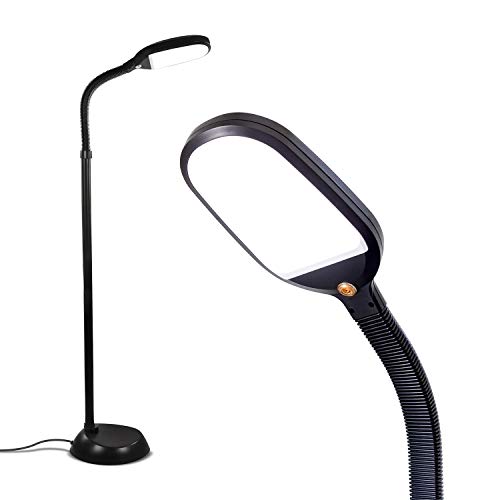
The Brightech Litespan is the workhorse of the craft world. It provides a bright, focused beam that is ideal for long sessions of knitting dark, fingering-weight wool where every stitch can feel like a guessing game.
Its height is adjustable, making it easy to position over your shoulder or directly beside your favorite armchair. For the price, the quality of light is exceptional, offering a crispness that helps you see the twist of your yarn ply clearly.
It is a straightforward, no-nonsense tool. While it lacks the high-end dimming features of more expensive models, it provides the consistent illumination necessary to prevent the dreaded "dark-room knitting" headache.
Lavish Home Swing Arm Magnifier: Best Precision

When you are working on intricate cabling or repairing a snag in a delicate silk-blend sweater, magnification is your best friend. This lamp combines a bright LED light with a high-quality magnifying lens, allowing you to see the finest details of your yarn structure.
Many knitters struggle with "tink-ing" back rows of complex lace. With this lamp, you can clearly see exactly where your needle needs to go, making the process of correcting mistakes much less intimidating.
It is a bit bulkier than a standard lamp, so ensure your craft table has a sturdy edge for the clamp. The swing arm offers great reach, but it requires a bit of space to maneuver properly.
Mighty Bright Floor Lamp: Best for Portability

If your knitting life happens in transit—at guild meetings, on the train, or in the back of a car—the Mighty Bright is a lifesaver. It is designed to be lightweight and easy to fold, yet it provides enough intensity to keep you stitching in dim environments.
Portability often comes with a trade-off in brightness, but this lamp manages to punch above its weight. It is perfect for those who want a dedicated craft light that doesn’t feel like a permanent piece of furniture.
Just remember that battery-operated or highly portable lights may not have the same longevity as plug-in floor lamps. Keep a spare set of batteries or a power bank handy if you’re planning a long weekend of knitting away from home.
Understanding CRI and Color Accuracy for Fiber
CRI, or Color Rendering Index, is the measurement of how accurately a light source reveals the true colors of an object. For knitters, a high CRI (90 or above) is non-negotiable when you are selecting yarn for stranded colorwork.
Low CRI lighting can make two different shades of red look identical, only for you to realize the mistake once you step outside. Always look for lamps that explicitly state their CRI rating to ensure your color choices remain consistent.
Think of CRI as the difference between looking at your yarn in a basement versus looking at it under the noon sun. High CRI lighting allows you to see the true saturation and undertones of your fiber, preventing costly mistakes in color selection.
How Color Temperature Affects Your Yarn Choices
Color temperature is measured in Kelvins (K), and it drastically changes how your yarn looks. A "warm" light (2700K) will make your yellows and oranges pop but can make cool-toned blues and greens look murky.
For most knitting, a "daylight" temperature between 5000K and 6500K is ideal. This neutral light provides the most accurate representation of the yarn, which is crucial when you are trying to match a dye lot or check the contrast between two colors.
If you are working with highly reflective fibers like silk or rayon, be mindful of the glare. A neutral, daylight-balanced light will help you see the drape and sheen without the harsh reflections that can sometimes accompany warmer, yellow-toned lights.
Why Lighting Matters for Dark Fiber Projects
Knitting with black, navy, or deep charcoal yarn is a notorious challenge, often referred to as "the knitter’s nightmare." Under poor light, your eyes struggle to find the stitch definition, leading to missed yarn-overs and uneven tension.
To succeed with dark fibers, you need high-contrast lighting that illuminates the texture of the yarn. Using a combination of a light table (like the Wafer 3) and a focused task lamp can help you see the "V" of the stitch against the background.
Don’t be afraid to add a light-colored lap blanket or a white towel over your knees when working with dark yarn. This simple trick provides a high-contrast backdrop that makes it much easier to track your needle movement.
Essential Tips for Setting Up Your Craft Studio
Your lighting setup should be flexible enough to change with your project. If you are doing colorwork, prioritize color accuracy; if you are doing intricate lace, prioritize brightness and magnification.
- Layer your lighting: Use a floor lamp for ambient light and a task lamp for close-up work.
- Minimize shadows: Position your lamp so that your hands don’t cast a shadow over the area where you are currently knitting.
- Reduce glare: If you are using metallic needles, point your light at an angle rather than directly down to avoid blinding reflections.
- Check your surroundings: Ensure your chair is positioned comfortably so you aren’t hunching toward the light, which can cause neck strain over long sessions.
Finding the right light is a personal journey that evolves as your knitting skills grow and your projects become more ambitious. Whether you choose a high-end light table or a portable task lamp, the goal is always the same: to see your work clearly and comfortably. By focusing on CRI, color temperature, and your specific project needs, you can transform your craft space into a professional-grade studio. Happy knitting, and may your stitches always be clear and your colors perfectly matched.