6 Best Adjustable Floor Magnifiers For Complex Patterns
Find the best adjustable floor magnifiers for complex patterns. Our guide reviews top models for precision, comfort, and clarity to enhance your craft work.
Tackling complex lace charts or dark, mohair-heavy colorwork can turn a relaxing hobby into a frustrating eye-straining marathon. As someone who has spent decades squinting at intricate cables under dim living room lights, I know that the right magnification is a game-changer. These six floor magnifiers are designed to bring your stitches into sharp focus, ensuring you never lose your place in a chart again. Investing in the right tool allows you to extend your knitting hours without the nagging headache that often follows a long night of pattern work.
Brightech LightView Pro: Best Overall Magnifier
The Brightech LightView Pro earns its top spot because it balances a wide, clear lens with a rock-solid, adjustable neck. When you are working on a multi-page lace pattern, having a lens that doesn’t sag under its own weight is essential.
Its 3-diopter lens offers just enough magnification to see fine details without distorting your peripheral view. For knitters working with dark, fingering-weight yarns, the integrated LED ring provides clean, shadow-free illumination that highlights every stitch definition.
The base is heavy enough to prevent tipping, which is a common frustration with cheaper floor lamps. If you frequently switch between your favorite armchair and a dedicated craft desk, this model’s flexibility makes it the most reliable partner for your stash.
Neatfi XL 2,200 Lumens LED Task Lamp Choice
If you are a professional-level maker who spends hours on complex stranded colorwork, the Neatfi XL is a powerhouse. It features a massive 20-inch wide lens that covers a significant portion of your knitting, meaning you aren’t constantly adjusting the lamp.
The 2,200 lumens output is incredibly bright, effectively simulating natural daylight even in a windowless room. This is particularly helpful when you are working with black or navy yarns, where stitch identification usually becomes a guessing game.
While the size is a major advantage, be mindful of your floor space. It requires a dedicated corner, but for the clarity it provides on intricate cabling, the footprint is a small price to pay.
Carson DeskBrite 200: Best Budget Floor Option
Not every knitter needs a high-end, professional studio lamp to complete a standard scarf or hat. The Carson DeskBrite 200 is a clever hybrid that functions perfectly as a floor-standing unit for those on a tighter budget.
It is lightweight and portable, making it easy to tuck away when you are finished with your row. While the lens is smaller than the premium models, it is more than sufficient for checking gauge or spotting a dropped stitch in a lace repeat.
Don’t expect the same heavy-duty stability as a full-sized studio lamp. However, for a beginner or a casual knitter looking to reduce eye strain, it provides excellent value without overwhelming your craft space.
Dayton 5-Diopter Magnifying Floor Lamp Pick
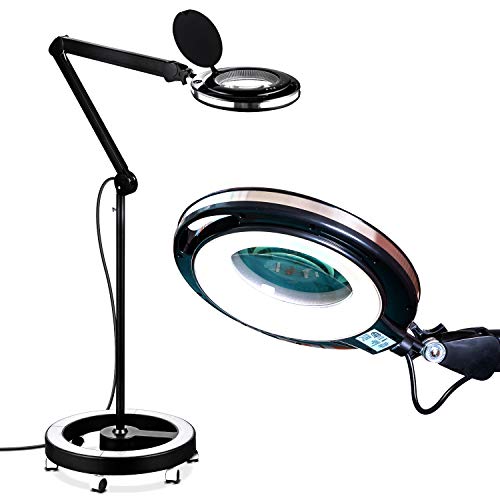

The Dayton 5-diopter lamp is designed for the knitter who needs serious magnification for tiny, intricate work. If you are working on lace shawls with 1.5mm needles and lace-weight yarn, this level of diopter strength is a significant help.
Higher diopter lenses bring the focal point closer to the object, which is perfect for precise needle manipulation. It removes the guesswork when you are picking up stitches along a delicate edge or correcting a complicated cable cross.
Keep in mind that with higher magnification comes a narrower field of view. You will need to position this lamp closer to your needles than you would with a 3-diopter model, so ensure your chair allows for that proximity.
Fancii Extra Large LED Magnifying Lamp Review
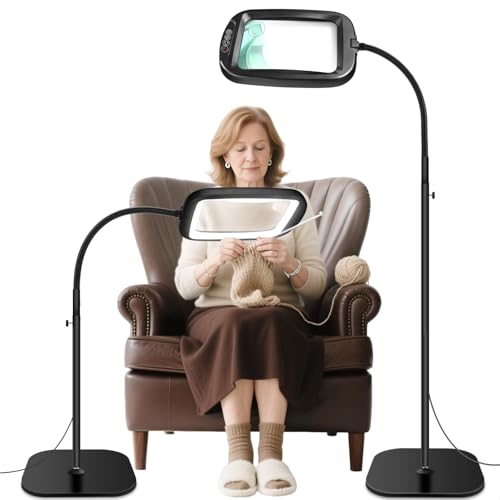
Fancii’s offering is all about user-friendly design and excellent light distribution. The lens is distortion-free, which is vital when you are tracking a complex chart where a single misplaced stitch can ruin a pattern sequence.
The LED array is positioned to minimize glare, which is a common complaint with cheaper lamps. When you are knitting with reflective materials like silk or bamboo blends, this lack of glare keeps your eyes fresh and prevents the "shimmer" that causes fatigue.
The adjustable arm is intuitive, allowing you to swing the magnifier over your lap or your side table with ease. It is a solid, mid-range choice that bridges the gap between basic utility and professional-grade performance.
V-LIGHT Natural Daylight Magnifier Selection
The V-LIGHT is favored by knitters who prioritize color accuracy above all else. If you are working on a project with subtle color shifts or variegated hand-dyed yarns, the natural daylight spectrum is non-negotiable.
It provides a clean, neutral light that prevents the yellow tint often found in standard bulbs. This ensures that the color you see under the lamp is exactly what the yarn looks like in broad daylight, preventing unpleasant surprises after you bind off.
It is a straightforward, no-nonsense tool that focuses on color fidelity and steady illumination. It might lack some of the bells and whistles of the larger lamps, but for the color-conscious knitter, it is a top-tier selection.
Key Features to Consider for Knitting Magnifiers
When shopping for a magnifier, prioritize the stability of the arm and the size of the lens. You want an arm that stays exactly where you put it, even when you bump it with your elbow while knitting.
- Lens Clarity: Look for glass lenses over plastic, as glass is more resistant to scratches over years of use.
- Adjustability: A "gooseneck" or multi-jointed arm is essential for reaching over your knitting needles.
- Light Temperature: Aim for 5000K-6000K, which is the "daylight" range that reduces eye strain.
- Base Weight: A heavy, weighted base prevents the lamp from tipping over during a vigorous knitting session.
Why Diopter Strength Matters for Complex Charts
Diopter (D) is a measure of the power of the lens, and it dictates how much larger your work will appear. For most knitting, a 3-diopter lens is the sweet spot, providing a comfortable balance between magnification and field of view.
If you are working on miniature knitting or lace with very thin needles, you might consider a 5-diopter lens. However, remember that as diopter strength increases, the working distance between the lens and your needles decreases.
Avoid the temptation to go for the highest magnification possible. Excessive power can actually make it harder to track your pattern because you lose the ability to see the context of the surrounding stitches.
Lighting Tips to Reduce Eye Strain While Knitting
Even with a magnifier, your ambient lighting matters immensely. Position your floor lamp so the light hits your needles from the side, which creates subtle shadows that make the stitch definition pop.
Avoid having the light source directly behind your head, as this creates glare on the lens and throws your own shadow onto your work. If you are knitting with dark yarn, place a light-colored towel or a knitting board on your lap to reflect light upward toward your hands.
Taking regular breaks is just as important as good equipment. Every 30 minutes, look at a distant object for a few moments to reset your focus and prevent the "locked-in" eye fatigue that comes from hours of close-up work.
How to Position Your Lamp for Optimal Visibility
The "sweet spot" for your magnifier is usually about 8 to 12 inches above your needles. Position the lens so that your knitting sits comfortably in the center of the field of view, allowing you to see at least two or three rows at once.
If you are a left-handed knitter, position the lamp on your right side to prevent your hands from blocking the light. Experiment with the angle of the lens; tilting it slightly can often eliminate those pesky reflections that bounce off metallic or slick needles.
Always ensure your posture is supported by your chair before adjusting the lamp. It is much easier to move the lamp to fit your natural, comfortable knitting position than it is to force your body to conform to the lamp’s placement.
Finding the right floor magnifier is an investment in your long-term comfort and the quality of your finished projects. Whether you choose the wide-reaching Neatfi or the budget-friendly Carson, the goal remains the same: to make your knitting sessions as enjoyable and effortless as possible. Don’t be afraid to adjust your setup as your projects change from simple stockinette to complex, chart-heavy lace. With your new vision-enhancing tool, you’ll be able to tackle even the most intricate patterns with confidence and ease.