6 Best Adjustable Arms For Magnification Tools To Try
Discover the 6 best adjustable arms for magnification tools to improve your precision and workspace comfort. Explore our top expert-recommended picks today.
Staring at dark-colored lace yarn on black needles can lead to significant eye strain and dropped stitches during long evening sessions. Magnification tools are not just for those with vision impairments; they are essential instruments for detail-oriented fiber artists working with complex charts or thin yarns. An adjustable arm provides the necessary illumination and clarity to keep hands steady and stitches precise. Investing in the right magnification system transforms a frustrating, squinting experience into a seamless and enjoyable craft.
Neatfi 3-Diopter Arm Lamp: Best Overall Pick


The Neatfi 3-Diopter lamp strikes a superior balance between wide-field coverage and ease of movement. Its design allows for a broad view, which is particularly helpful when checking the symmetry of intricate cables or verifying that a decrease row in a sweater sleeve aligns perfectly.
Because the glass lens is wide and clear, the distortion at the edges remains minimal. This is crucial for avoiding the dizzying “fish-eye” effect that can occur when shifting focus between a pattern chart and the active needlework.
The arm mechanism operates smoothly, staying exactly where it is placed without drifting under the weight of the lens head. For those working on complex, multi-page patterns, this lamp offers the perfect combination of stability and range.
Brightech LightView Flex Arm: Top Table Clamp

The Brightech LightView Flex model is designed for those who need a focused, tight magnification on a specific section of work. Its flexible neck is ideal for knitters who frequently switch between a standing frame and a seated chair position.
The clamp is robust enough to attach to most side tables or knitting carts, saving precious surface space. When working on a delicate intarsia project, the ability to maneuver the lens into precise, odd angles allows for better visibility of color junctions.
While the flex neck offers incredible versatility, it may require occasional tightening to hold positions perfectly over time. It serves as an excellent companion for detail work rather than full-row observation.
Yoozon Desk Lamp with Arm: Best Budget Option

For beginners or those who keep a modest crafting nook, the Yoozon lamp provides reliable, functional magnification without a significant financial commitment. It handles basic tasks—like identifying a split ply in an acrylic yarn or reading a standard knitting chart—with ease.
The build is lightweight, making it simple to move between a couch, a dining table, or a desk. While it lacks the heavy-duty industrial feel of professional studio gear, it serves the casual crafter who needs an occasional boost during a session of simple stockinette stitch.
Users should note that the lens size is smaller, requiring more frequent repositioning of the work underneath it. It is the perfect entry point for those just beginning to recognize the benefits of using a magnifier for their needlework.
Luxo LFM LED Magnifier Arm: Pro-Crafter’s Choice
The Luxo LFM series is the gold standard for long-term comfort, featuring high-quality optics that significantly reduce eye fatigue during marathons of brioche or complex colorwork. This lamp is built to withstand years of daily use, making it an investment piece for a permanent craft studio.
The spring-balanced arm is exceptionally fluid, allowing for nearly effortless adjustments as the work grows in size. When the project involves lace weight mohair or dark-toned merino, the light quality renders colors accurately, preventing the common mistake of confusing two very similar shades.
It is a heavy-duty tool that demands a sturdy table edge for mounting. For the serious designer or the professional knitter who spends four-plus hours a day with needles in hand, the engineering behind this arm is well worth the cost.
Brightech LightView Pro Floor Lamp: Best Stand
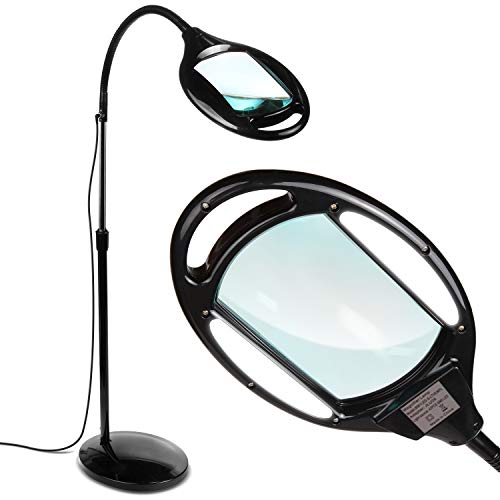
When there is no table space available for a clamp, the Brightech LightView Pro floor lamp brings the light and magnification directly to the armchair. Its heavy base ensures that the arm can extend over the lap without the risk of tipping over.
This is particularly beneficial for knitters who prefer to lounge in a deep, plush chair while working. The magnification lens is large enough to cover the entirety of a hat or sock circumference, allowing for steady work on small-diameter circular needles.
The floor stand offers the greatest degree of freedom in terms of layout. It eliminates the need to clear desk clutter, provided there is enough floor space next to the favorite knitting chair.
Daylight Company Mag Lamp S: Best for Lacework
The Mag Lamp S is engineered for high-precision work, making it the top choice for lacework that requires constant monitoring of yarn overs and complex cable crossings. Its brightness controls are sophisticated, allowing for adjustments that match the ambient light in the room.
The lens clarity is exceptional, ensuring that the texture of fine lace remains sharp even at the edges. When working with delicate fibers like silk or baby alpaca, the light output remains cool, preventing any heat buildup that might affect the feel of the yarn.
This lamp is designed to integrate into a workspace without overwhelming it. For those who obsess over gauge and stitch consistency, the visual clarity offered by this unit is unparalleled.
How to Choose the Right Magnifier Arm for You
Choosing the right tool begins with assessing the physical layout of the workspace. If the knitting area is fixed, a heavy-duty clamp-on arm offers the best stability, whereas mobile crafters should prioritize floor stands or lightweight flex arms.
- Lens Size: Larger lenses offer a wider field of view, ideal for entire garments.
- Reach: Longer, multi-jointed arms cover more surface area.
- Light Quality: High CRI (Color Rendering Index) LEDs are essential for matching colors accurately.
- Mounting: Clamps provide a permanent, space-saving solution, while stands offer mobility.
Always consider the weight of the lamp head relative to the arm strength. A weak arm will droop mid-stitch, causing frustration and interrupting the flow of the work.
Diopter vs. Magnification: What Crafters Need
Understanding the difference between diopter and magnification is key to selecting the right lens. Diopter refers to the curvature of the lens, which dictates the level of magnification, while the diopter value itself often correlates to the lens’s power and focal length.
For general knitting tasks, a 3-diopter lens is often the most comfortable, providing enough zoom to see stitches clearly without requiring the eyes to stay pressed uncomfortably close to the lens. Higher diopter lenses provide more magnification but come with a much tighter focal distance.
Working with a lens that is too strong can actually cause more eye strain by limiting the “sweet spot” of focus. Start with a moderate diopter and move up only if the projects involve truly microscopic detail or micro-crochet.
Positioning Your Arm for Maximum Comfort
Proper positioning is as important as the lamp quality itself. The goal is to keep the spine neutral and the neck relaxed while the lamp does the work of bringing the project into focus.
Position the arm so that the lens sits parallel to the work surface, reducing distortion. Avoid tilting the lens at an angle, as this distorts the view of the stitches and makes counting rows or checking gauge far more difficult.
Adjust the arm height so that the eyes sit at a natural distance from the lens. If the neck begins to crane forward, the arm is either too low or too far away from the body.
Floor Stand vs. Clamp-On: Which Is Better?
The choice between a floor stand and a clamp-on arm is primarily a matter of ergonomics and space. A clamp-on arm is more rigid and stable, which is a massive advantage when working on heavy blankets or garments that put tension on the lamp head.
However, floor stands offer the flexibility that many knitters need in a multi-use room. A floor stand can be tucked away into a corner when it is time to host dinner, whereas a clamped lamp is often a permanent fixture of the workspace.
Consider the surface where the lamp will be mounted before buying a clamp. Many modern desks or coffee tables have beveled edges or glass tops that may not support a heavy-duty clamp without the use of an additional wooden block or protective padding.
Selecting the right magnification tool is a significant step toward preserving vision and enjoying the intricate details of fiber art. By matching the lamp to the specific demands of the project and the limitations of the physical space, long sessions of knitting become much more comfortable and productive. Whether working with delicate lace or bulky wool, the right arm makes every stitch count.