6 Knitting Needle Sizers For Identifying Vintage Tools
Struggling to identify antique supplies? Discover our top 6 knitting needle sizers for identifying vintage tools and organize your craft collection today. Read now!
Finding a stray circular needle at the bottom of a project bag is a rite of passage for every knitter. Over time, those tiny size markings often rub away, leaving the needle’s diameter a complete mystery. Accurately identifying these tools is essential to maintaining the stitch gauge required for a successful garment. Utilizing a reliable sizer prevents the frustration of starting a sweater only to realize the fabric is far too stiff or loose.
Clover Swatch Ruler: The All-in-One Classic


The Clover Swatch Ruler is a staple in many knitting kits because it serves dual purposes. It acts as both a needle gauge and a standard ruler, making it helpful for measuring swatches and checking stitch counts.
Its plastic construction makes it lightweight, though it lacks the rigidity of metal gauges. This tool is best suited for knitters who appreciate having a single, multi-functional device rather than carrying multiple specialized items.
The primary drawback is that plastic can warp over time, potentially leading to inaccurate readings after years of heavy use. Consider this a reliable entry-level tool that bridges the gap between basic utility and convenience.
The Knitter’s Pride Sizer: For Total Clarity

When working with fine lace needles or dark-colored wood, contrast and clarity are paramount. The Knitter’s Pride sizer offers clear, bold markings that take the guesswork out of identifying needle sizes.
This gauge is particularly helpful for knitters who struggle with the tiny, faint etchings found on older metal needles. Its design minimizes eye strain, allowing for quick checks during a session of intensive pattern work.
Because it is made from durable, high-quality plastic, it resists the scratching that often obscures markings on other gauges. For those who frequently swap between projects, the readability of this tool provides an essential efficiency boost.
Susan Bates Knit-Chek: The Nostalgic Choice
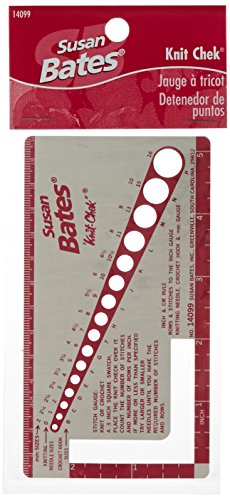
The Susan Bates Knit-Chek is an iconic tool that has been present in knitting baskets for generations. Beyond just sizing needles, it includes a built-in ruler and a window for counting stitches per inch.
This tool is a favorite for those who value classic, mechanical design over digital solutions. The metal construction offers a satisfying weight, and the simplicity of the layout makes it easy to use while on the go.
While it is a multi-purpose powerhouse, ensure that the needle holes have not been bent or stretched over the years. A worn Knit-Chek can provide a false sense of security, so test it against a known needle size occasionally to confirm its integrity.
Akerworks Tool: The Ultimate Measurement Gadget
The Akerworks gauge represents the modern evolution of knitting tools, focusing on precision and aesthetic appeal. It utilizes a custom-designed, compact frame that feels substantial and professional in the hand.
This tool is designed for knitters who demand high levels of accuracy and appreciate high-end engineering. Its unique construction allows for the measurement of both straight and circular needles without the struggle of maneuvering bulky cables.
While it sits at a higher price point than mass-produced plastic gauges, the investment reflects its durability and precision. It is the ideal choice for a serious maker who wants a tool that will last a lifetime without sacrificing performance.
Vintage Boye Gauge: Find One for Authenticity
Vintage Boye gauges are often made of stamped metal and possess a charm that modern plastic tools simply cannot replicate. These items are frequently found in estate sales and vintage shops, often still in excellent working condition.
Using a vintage gauge adds a sense of history to the craft, connecting the knitter to the tools of previous generations. Many of these older gauges include size conversions that were standard for mid-century American manufacturing.
However, caution is advised: metal gauges can occasionally develop burrs or sharp edges that might snag delicate yarns. Clean and inspect a vintage gauge thoroughly before using it to ensure it won’t damage the finish of your prized needles.
A Digital Caliper: For Unbeatable Precision

For the knitter who owns a large collection of vintage, unmarked, or handmade needles, a digital caliper is the only true source of truth. It measures diameter down to the hundredth of a millimeter, removing any ambiguity caused by worn-out markings.
This level of precision is invaluable when working with hand-turned wooden needles or rare antique finds. It completely bypasses the limitations of standardized holes and instead provides a direct physical measurement.
While it may seem like overkill for a casual hobbyist, it is a professional-grade solution for those who want total control over their gauge. If you struggle with inconsistent tension or hard-to-fit needles, the digital caliper is the ultimate problem-solver.
Why Old Needle Sizes Are So Inconsistent
Needle sizing has shifted significantly over the last several decades, and manufacturing standards were not always global. Older needles, particularly those from different countries, often fell into variations that do not match current US standard sizes.
Furthermore, material properties affect how a needle feels, even if the measurement is technically correct. A vintage aluminum needle might feel entirely different from a modern carbon fiber needle of the same labeled size due to manufacturing tolerances.
Always rely on a physical gauge rather than the label printed on the needle shaft. Over time, friction and heat can cause markings to fade, making the label unreliable regardless of the brand or quality.
US vs. UK vs. Metric: A Quick Sizing Guide
The knitting world operates on three primary sizing systems: the US standard, the UK/Canadian standard, and the Metric system. Metric (measured in millimeters) is the only truly objective standard, as it describes the actual diameter of the needle.
US and UK systems are traditional sizing conventions that do not directly correlate to a specific measurement. For example, a US size 8 is 5.0mm, but a UK size 6 is also 5.0mm, leading to frequent confusion for knitters reading international patterns.
When in doubt, always default to the metric (mm) measurement. If a pattern lists a US size, cross-reference it with a chart to find the corresponding millimeter measurement before beginning your project.
What to Do When a Needle Is Between Sizes
Sometimes, a needle may pass through one hole on a gauge but feel loose, yet be unable to fit through the next size down. This usually indicates that the needle is an “in-between” size, which is common in older or handmade sets.
In this scenario, trust the digital caliper if available, or rely on a tension swatch. If the needle is slightly off-standard, knit a small swatch in the pattern stitch to see if the resulting gauge matches the requirement.
If the fabric is too loose or tight, consider adjusting the yarn weight or changing your knitting style rather than forcing a needle that doesn’t fit the pattern. The goal is to match the project’s gauge, not necessarily a specific arbitrary needle number.
How to Properly Use a Needle Sizer Gauge
To use a needle sizer effectively, insert the tip of the needle into the holes starting from the largest and moving down until it fits snugly. The correct size is the smallest hole that the needle can pass through without force.
Never force a needle into a gauge, as this can damage the tool or the needle coating. If a needle fits loosely in one size but won’t enter the next smallest hole, that needle is likely a non-standard size.
Always keep your gauge in a protected spot to prevent the measuring holes from bending or warping. A clean, flat, and undamaged gauge is the foundation for accurate knitting across every project in your repertoire.
Investing in a reliable needle sizer is one of the most practical decisions a knitter can make to ensure consistent results. By understanding the differences between material, measurement, and manufacturing standards, you move away from guesswork and toward professional-level control. Keep your favorite gauge easily accessible, and you will find that the mystery of the “unlabeled needle” is a thing of the past.