7 Best Drying Trays For Small Prints Worth Considering
Streamline your workflow with these 7 best drying trays for small prints. Discover top-rated options to organize your workspace and shop our expert picks today.
Proper blocking is the final, essential act that transforms a collection of stitches into a professional garment. After the soaking and gentle squeezing of a finished piece, the drying process dictates the final drape, stitch definition, and overall size of the fabric. Choosing the right surface ensures air circulation and prevents unwanted moisture buildup that could lead to mildew. These seven options cater to various space constraints and project types, helping every knitter achieve a polished finish.
OXO Good Grips Dryer: Best Stackable Option


The OXO Good Grips dryer excels by offering a modular design that stacks vertically, which is a lifesaver for small apartments or crowded craft rooms. When blocking several swatches or a set of baby socks, vertical stacking utilizes air space rather than precious table surface.
The mesh screen is tight enough to prevent sagging, ensuring that delicate lace or lightweight fingering-weight yarns don’t lose their shape. Air flows freely from all sides, which significantly reduces the drying time compared to laying items flat on a solid towel.
The trade-off for this convenience is the footprint of the stackable legs, which requires a flat, stable surface. For those who frequently block small items, the ability to store these away flat when not in use justifies the investment.
Honey-Can-Do Sweater Dryer: Best Budget Pick

The Honey-Can-Do sweater dryer is a classic folding mesh unit that offers a large surface area for a minimal price point. Its primary strength lies in its simplicity; it pops open instantly and provides a generous, ventilated platform for drying garments.
Because the unit is quite wide, it is ideal for blocking items that need to remain perfectly square, such as wool cowls or small squares intended for a patchwork blanket. However, the mesh can sometimes lose tension over time, so ensure the surface is taut before placing heavy, wet sweaters on it.
Budget-conscious knitters often appreciate that this unit folds down into a small circle for storage under a bed or inside a closet. It remains the most utilitarian choice for those who value function over specialized features.
Pacon Multi-Level Art Rack: Best for Big Batches

The Pacon art rack is a heavy-duty solution typically found in studios but acts as a powerhouse for knitters managing high volumes of swatches or samples. Its multiple wire shelves allow for independent airflow to every single project simultaneously.
This is the ultimate tool for designers or knitters who need to track gauge across different yarn bases at the same time. Because each shelf is separate, moisture from one swatch does not transfer to the next, which is vital for preventing fiber cross-contamination or color bleeding.
The rack is admittedly bulky and requires a dedicated space in the studio. If you are a prolific knitter who constantly needs to block, the efficiency gains in drying time are worth the permanent floor space.
KnitPicks Blocking Mats: Best for Pinning
KnitPicks blocking mats are designed specifically for the aggressive shaping required by lace knitting and delicate stitch patterns. Unlike mesh dryers, these mats allow for the use of T-pins or blocking wires, which are non-negotiable for opening up lace eyelets.
The grid pattern printed on the foam surface helps maintain symmetry when blocking complex pieces like triangular shawls or circular doilies. A knitter can easily measure the dimensions while the piece is pinned down, ensuring the final blocked size matches the pattern requirements.
These mats are dense enough to hold pins securely but porous enough to allow for some airflow underneath. Always allow for a little extra drying time with mats, as the side pressed against the foam stays damp longer than the side exposed to air.
iKee-Cae 3-Tier Hanging Dryer: Top Space Saver
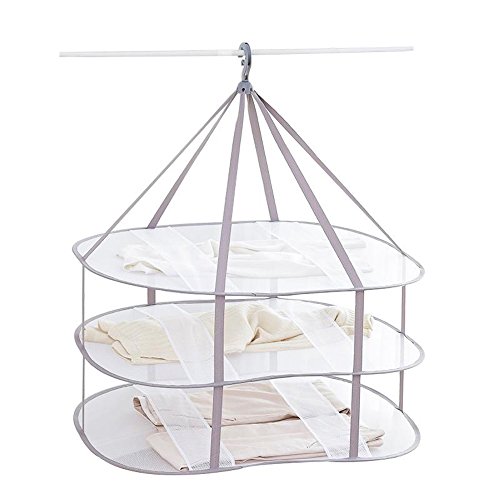
The hanging, multi-tier dryer is an ingenious use of vertical closet or shower space, keeping damp projects well out of the way of household traffic. It works by suspending layers of mesh from a single point, allowing gravity to assist with air circulation.
This is an excellent choice for smaller items like baby mittens, hats, or delicate silk scarves. Because it hangs, it does not require a flat table surface, which is a major benefit in households where counter space is at a premium.
Be cautious with heavy, water-logged wools, as the hanging structure can occasionally swing or tilt if the weight is not balanced properly across the tiers. Distribute the weight evenly to prevent the unit from leaning and potentially causing a wet piece to slide.
Shryoan Tabletop Rack: For Serious Printers
The Shryoan tabletop rack is a professional-grade tool that brings stability and precision to the blocking process. Its rigid frame is designed to support more weight than a standard mesh dryer, making it suitable for heavier garments or dense woolen fabrics.
Knitters who struggle with garments that “grow” too much during blocking will appreciate the fixed, grid-like structure of this rack. It provides a non-slip surface that keeps the fabric exactly where it is placed until dry.
While the size is somewhat fixed, the durability of this unit makes it a long-term investment. It is best suited for the knitter who is committed to a specific scale of projects and wants a reliable, permanent station for finishing work.
Wilton Cooling Grid: A Smart Kitchen Hack
Many seasoned knitters find that a sturdy stainless steel cooling rack, like the Wilton grid, is the most durable tool in their arsenal. The metal wire design is essentially indestructible and provides the maximum amount of airflow possible for any drying surface.
These grids are perfect for drying small, heavy items like wool-blend socks that might be too small for larger racks. The metal does not absorb moisture, which eliminates any risk of a musty smell developing during the drying cycle.
The only drawback is that the grid itself might leave temporary indentations on soft, lofty yarns if left under heavy pressure for too long. If using a wire grid, simply place a piece of breathable cotton or a thin washcloth over the metal to protect the fibers.
How to Choose the Right Drying Tray for You
Choosing the right dryer begins with an assessment of the weight and fiber content of your typical projects. Natural fibers like wool and alpaca absorb significant amounts of water and require excellent airflow, while synthetic or superwash wools dry faster and can handle more compact surfaces.
Consider your available space; if you have a spare guest room, a floor rack is feasible, but if you live in a compact apartment, vertical hanging options are necessary. Always match the tool to the frequency of your blocking to ensure your investment pays off in saved time and better results.
Stackable vs. Hanging: Which Dryer is Best?
Stackable dryers are superior for maintaining the precise dimensions of a knit piece because they keep the fabric perfectly horizontal. This prevents the fabric from stretching or warping due to gravity, which is crucial for sweaters or garments intended to fit specific body measurements.
Hanging dryers offer the best convenience for small accessories where exact shape retention is less critical than speed of drying. If you are blocking a simple beanie or a pair of socks, the airflow in a hanging unit is typically sufficient for excellent results.
Can I Use a Towel Instead of a Drying Tray?
A clean, dry towel is an acceptable temporary solution for blocking small items, but it has significant limitations compared to a dedicated tray. Towels trap moisture against the bottom of the knit fabric, which slows down drying and can lead to uneven drying times.
If you must use a towel, choose one made of high-quality, lint-free cotton or microfiber to prevent fibers from shedding onto the yarn. Always replace the towel halfway through the drying process to ensure the garment finishes evenly on both sides.
Choosing the right blocking tool is the final step in ensuring your hard work truly shines. Whether you prioritize space-saving vertical units, precision pinning mats, or durable wire grids, the right surface will protect the integrity of your stitches. Invest in a system that matches your knitting habits, and you will find that the finishing process becomes just as satisfying as the cast-on.