7 Best Book Light Stands For Bedside Tables Worth Owning
Upgrade your nighttime reading experience with our top 7 best book light stands for bedside tables. Explore our expert recommendations and shop your favorite now.
Stitching in low light is the fastest way to drop a stitch, miss a yarn-over, or lose your place in a complex lace repeat. While the overhead light in a living room might feel sufficient for watching television, it rarely provides the surgical precision required to distinguish between navy blue mohair and black wool. Choosing the right bedside or chairside lamp transforms a frustrating evening of squinting into a productive session of rhythmic, comfortable knitting. The following recommendations focus on color accuracy, stability, and adjustability to ensure every row stays consistent.
Glocusent LED Floor Lamp: Best Overall Value


This lamp bridges the gap between high-end studio lighting and the modest footprint needed for a bedroom. It offers a stable base and an adjustable gooseneck that allows the light source to hover directly over your needles without obstructing your arms.
The dimming functions are particularly useful when transitioning from daytime knitting to late-night sessions. By adjusting the color temperature, a knitter can shift from a bright, cool light that highlights every single ply in a strand to a warmer, softer glow that prevents eye fatigue.
It is an excellent workhorse for those who switch between knitting dark-colored socks and light-colored sweaters. While it lacks some of the premium articulation of expensive drafting lamps, its reliability makes it the most practical choice for daily use.
Brightech Litespan: Top Pick for Crafters
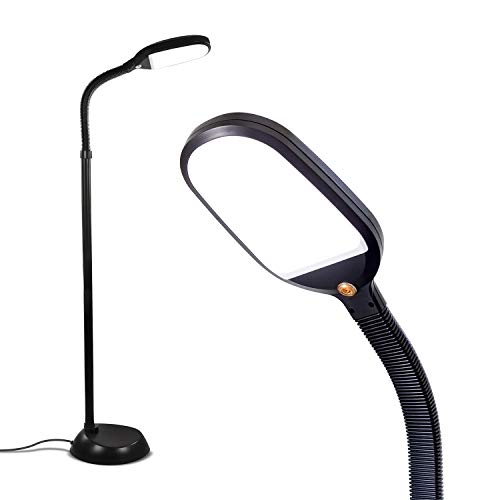
The Litespan excels because it provides a wide, flicker-free beam that covers an entire lap project. When working on a large-format cable-knit blanket or a generous shawl, this lamp ensures that the illumination remains uniform from the center stitches to the edges.
The lamp is designed with long-term eye health in mind, utilizing a lens that reduces glare significantly. This is critical when using needles with high-shine metallic finishes, like nickel-plated or brass, which can bounce light directly into your eyes if the lamp angle is too sharp.
For those who spend hours tackling complex stranded colorwork, this lamp provides the visibility needed to track floats and maintain tension. It is a robust, dependable tool that prioritizes visibility over decorative aesthetic.
Neatfi Magnifying Lamp: For Detailed Stitchwork

If you are working with luxury lace weight yarns or dark, fuzzy fibers where the stitch definition is easily lost, a magnifying lamp is indispensable. This lamp combines powerful, clear light with a high-quality glass lens to turn tiny, invisible stitches into large, manageable targets.
The heavy-duty clamp base is ideal for mounting on a sturdy bedside table, keeping the lamp secure even when extended at extreme angles. This stability is essential; when magnification is involved, any slight vibration or movement can become disorienting.
Consider this investment if you regularly use needles smaller than 2.5mm or if you are repairing dropped stitches in high-twist yarns. It transforms the process of picking up a missed loop from a stressful ordeal into a simple task.
Tomons Swing Arm Desk Lamp: Most Stylish Design

The Tomons lamp leans into a classic, mid-century aesthetic that fits seamlessly into a bedroom space. It relies on a balanced swing arm mechanism, allowing you to move the light source precisely where you need it and then tuck it away when the knitting is finished.
This lamp requires an external bulb, which is actually a significant advantage for fiber artists. You can select a high-CRI (Color Rendering Index) LED bulb to ensure your yarn colors are rendered accurately, rather than being forced to use a pre-installed, proprietary light source.
While it lacks the heavy industrial footprint of studio lamps, it is more than capable of lighting a pair of mittens or a hat project. It serves as a beautiful piece of decor that doubles as a functional tool for the casual and serious knitter alike.
Lepower Metal Desk Lamp: A Classic, Sturdy Choice
There is something to be said for the simplicity of a heavy, metal-weighted base and an adjustable, swivel-head lamp. The Lepower offers a straightforward design that resists tipping, even when the cord is pulled or the neck is fully extended.
This is a perfect lamp for a dedicated knitting station on a bedside table where space is at a premium. It focuses the light into a concentrated pool, which helps isolate your work from the rest of the dark room, creating a cozy “knitting bubble.”
Because it is a basic design, it is less prone to the mechanical failures that can plague complex, multi-jointed lamps. It remains a reliable, no-nonsense choice for anyone who just needs to get their stitches lit properly without fuss or complex controls.
Vekkia Dual-Head Light: Maximum Versatility
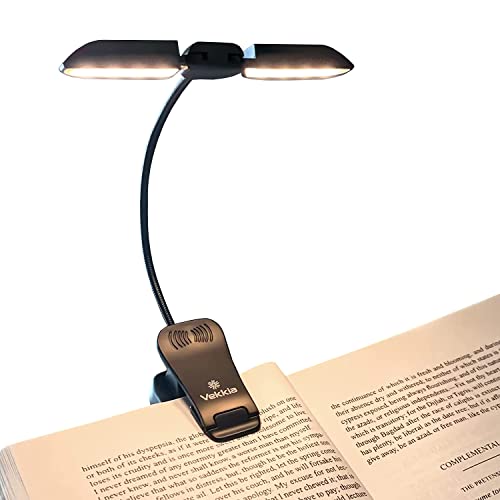
The dual-head design of the Vekkia is a revelation for those who find that shadows are their greatest enemy. By positioning two light sources, you can effectively eliminate the “hand shadow” that occurs when your fingers move while working on a project.
This lamp is particularly adept at illuminating wide projects, such as scarves or back panels, where a single bulb might create a “hot spot” in the center while leaving the edges in dim, blurry darkness. Its flexible arms allow for highly customized positioning around your hands.
If you are a knitter who experiences hand fatigue or eye strain after long sessions, this configuration can make a noticeable difference in comfort. It allows for a more relaxed hand position, as you aren’t fighting to angle your work into a single beam of light.
O’Bright Gooseneck Lamp: Best Minimalist Option
Minimalism is often the key to a clutter-free knitting space, and the O’Bright lamp delivers this in a slim, modern package. Its sleek profile hides a surprising amount of power, providing a focused, steady light that is perfect for close-up work like grafting toe stitches or seaming.
The gooseneck design is inherently more flexible than rigid swing arms, allowing for quick adjustments as you transition from a flat piece to a circular knitting project. It stays exactly where you leave it, a minor feature that becomes major when you are halfway through a Kitchener stitch.
This is the ideal lamp for a knitter who values functionality but prefers a clean, modern bedroom aesthetic. It occupies minimal surface area on a bedside table, leaving more room for your notions case, needle gauge, and yarn bowl.
How to Pick a Light for True-to-Life Yarn Color
When shopping for a lamp, the most important specification is the CRI (Color Rendering Index). You want a light that boasts a CRI of 90 or higher to ensure the yarn color you see at night is the same color you see in the sun.
- Color Temperature: Look for “Daylight” bulbs, which fall between 5000K and 6500K.
- Avoid “Warm” Lighting: Bulbs under 3000K will cast a yellow hue, making it impossible to tell a dark navy from a black or a forest green.
- Flicker-Free: Always verify the light is rated as flicker-free, as standard cheap LEDs can pulse at a rate that causes subtle, exhausting eye strain.
Positioning Your Light to Avoid Knitting Shadows
The placement of your lamp is just as important as the quality of the light itself. To minimize shadows, position the light source slightly behind your non-dominant shoulder or directly above your hands.
If you are left-handed, reverse this logic to ensure your hand doesn’t block the light as you move your needles. Experiment by moving the light closer to the work; closer light creates sharper, more defined shadows, while moving the light slightly further away can soften them.
When working on dark, textured yarns, such as black alpaca or dark charcoal wool, try using an additional side-light to fill in the crevices of the texture. This allows you to see the individual stitches rather than just a silhouette of your work.
Magnifying Lamps: A Knitter’s Secret Weapon?
Magnifying lamps are often misunderstood as tools only for the visually impaired, but they are a massive asset for any knitter working with fine gauges. Using a magnifying lamp can help you spot a twisted stitch or a dropped loop long before it travels down several rows.
They are particularly useful when you are knitting with “fussy” fibers like silk or mohair, where the fibers themselves can obscure the stitch structure. A magnifying glass helps you see the “live” loop clearly, making it easier to reinsert your needle correctly.
However, keep in mind that magnification takes practice; it changes your depth perception. Start with lower magnification levels to get accustomed to the perspective shift before moving to high-powered lenses that might be overkill for standard worsted-weight projects.
Selecting the right light is a fundamental step in building a sustainable and enjoyable knitting practice. By prioritizing color accuracy, stability, and proper positioning, you ensure that every hour spent with your needles is time well invested. These tools are not just accessories, but partners in your creative process, designed to bridge the gap between your vision and the finished garment. Choose the lamp that best fits your specific project needs, and notice how much easier it becomes to keep your stitch count perfect well into the night.