6 Best Craft Lamps For Reducing Eye Strain
Stop struggling with dim lighting. Discover the 6 best craft lamps for reducing eye strain and enjoy sharper focus during your projects. Upgrade your setup today!
Knitting dark-colored lace or maneuvering tiny, lace-weight mohair stitches under dim evening light is a recipe for eye strain and dropped stitches. Quality lighting transforms a frustrating marathon of squinting into a smooth, rhythmic flow of needle and yarn. Choosing the right craft lamp is not merely an aesthetic choice, but a necessary ergonomic investment to protect vision during long sessions of complex colorwork or cabling. This guide explores the best options available for knitters to keep their hands moving comfortably and accurately for years to come.
OttLite 2-in-1 Magnifier Lamp: Best Overall


This lamp serves as a versatile workhorse for knitters who frequently toggle between intricate chart reading and actual stitch manipulation. The 2-in-1 design allows for a quick transition from a sturdy floor-standing unit to a focused desk lamp, offering the flexibility required for varied crafting spaces.
The integrated magnifier is particularly useful when working with high-twist, dark-colored wools where stitch definition can easily disappear. It prevents the habitual hunching forward that leads to neck tension and ensures that every yo (yarn over) is perfectly positioned.
While the base provides solid stability, it can be a bit bulky in tighter corners. However, for the primary knitting chair, it remains the gold standard for clarity and convenience.
Daylight Duo Floor Lamp: Best for Large Projects

When tackling large-scale projects like an oversized blanket or a wide-width shawl, illumination across the entire needle span is critical. The Daylight Duo provides a broad, even spread of light that eliminates the harsh shadows often cast by single-point light sources.
This wide coverage ensures that tension remains consistent across long rows, as the eyes can easily track the yarn as it travels across the needles. It is particularly effective for those working with variegated yarns, where seeing subtle color shifts is necessary to maintain a desired aesthetic flow.
The trade-off for this expansive coverage is a larger footprint. It is an ideal piece of equipment for a dedicated craft room rather than a shared living space.
Brightech Litespan LED Floor Lamp: Best Value
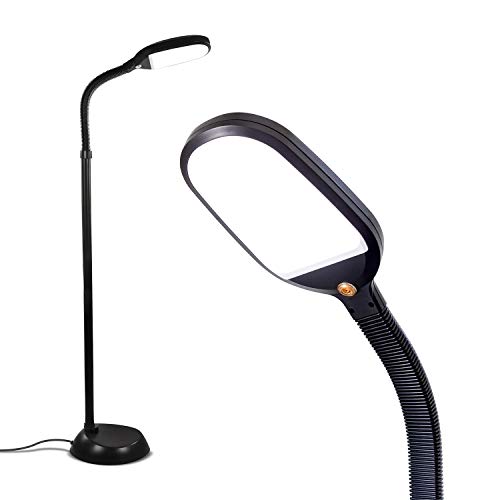
Efficiency meets affordability in this model, which delivers a clean, flicker-free light that mimics natural daylight. It is a perfect solution for the knitter who wants to improve their workspace without a massive financial commitment.
The minimalist design is highly adjustable, allowing for precise positioning over the hands while keeping the lamp head unobtrusive. This is a significant advantage when knitting with long circular needles, as it prevents the yarn from snagging on bulky lamp hardware.
The dimming feature is a standout, providing the ability to lower the intensity during late-night sessions to reduce glare. It is a reliable, no-nonsense tool that simply gets the job done.
BenQ e-Reading Desk Lamp: Premium Choice
The BenQ e-Reading lamp utilizes a specialized curved light bar that distributes illumination across a much wider surface area than standard desk lamps. This wide-angle light is engineered specifically to reduce contrast and glare, which is the primary driver of eye fatigue during prolonged knitting.
Its sensitivity to ambient light allows it to automatically adjust brightness levels, ensuring consistent eye comfort as the sun goes down. For the knitter who spends hours deciphering complex, printed pattern charts or intricate cable sequences, this level of precision is invaluable.
The price tag is higher than most, reflecting its high-end build and specialized optics. It is a serious investment for the dedicated maker who prioritizes ergonomic longevity.
Neatfi Bifocals Magnifier: Best Budget Option

For those who regularly work with fine-gauge needles or delicate silk and lace yarns, magnification is often more important than brightness alone. The Neatfi Bifocals lamp provides a clear, distortion-free view of tiny, intricate stitches at a price that remains accessible.
The bifocal lens option is a clever touch, allowing for a standard view combined with a higher-magnification area for inspecting the most challenging sections of a project. It is perfect for identifying dropped stitches or checking for splits in the yarn ply before moving to the next row.
While the arm mechanism is functional, it lacks the heavy-duty stability of more expensive models. It is best suited for desk-based knitting rather than floor-standing configurations.
Glocusent LED Neck Light: Most Portable Pick
When knitting on the go or moving from the armchair to the porch, a stationary lamp is not always practical. The Glocusent neck light rests comfortably around the neck, directing light exactly where the eyes are looking without requiring constant repositioning.
This is an excellent option for traveling knitters who often find themselves in hotels or poorly lit public spaces. Because the light source moves with the head, it eliminates the need to constantly adjust a lamp arm when shifting position.
The trade-off is battery life and the lack of high-powered, wide-area illumination. It is a secondary light source designed for mobility rather than a replacement for a high-intensity primary lamp.
How to Choose the Best Light for Your Craft Space
Selecting the right light requires an understanding of how your environment interacts with your specific knitting habits. Consider the following factors before making a final decision:
- Placement: Does your chair have room for a floor lamp, or is a desk-mounted unit more practical?
- Color Accuracy: High-CRI (Color Rendering Index) lights ensure that the yarn color you see is the color you get, which is vital when stash-busting or coordinating variegated colorways.
- Flicker-Free Technology: Cheap LEDs can produce a subtle flicker that causes eye strain over time; always look for lights rated as flicker-free.
- Adjustability: Ensure the lamp can reach the specific height of your hands while you sit in your most comfortable, relaxed knitting posture.
Lumens vs. Kelvin: What Do The Numbers Mean?
Understanding light terminology prevents the common mistake of buying a lamp that is either too “yellow” or too “cold” for delicate colorwork. Lumens measure the brightness of the light, while Kelvin measures the color temperature.
- Lumens: Look for higher lumen counts if you are knitting with dark colors like navy, black, or charcoal.
- Kelvin: Aim for a range between 4000K and 5000K for “daylight” quality; this temperature provides the best contrast without the harsh, blueish tinge of clinical-grade lights.
Do You Need a Magnifier on Your Craft Lamp?
Magnification is not just for knitters with vision impairments; it is a specialized tool for fine work. If you frequently find yourself squinting to see the anatomy of a stitch, a magnifier will significantly reduce tension in your facial muscles.
However, be wary of relying on magnification for every stitch, as this can lead to an over-dependence that ignores the tactile feel of the fabric. Use the magnifier for picking up dropped stitches, checking gauge on tiny needles, or untangling yarn, but allow your hands to do the heavy lifting for routine rows.
Floor, Desk, or Neck Light: Which Is For You?
The choice of configuration is entirely dependent on your physical setup. Floor lamps offer the most power and flexibility for armchair knitters, but they require floor space and a stable power source.
Desk lamps are superior for those who knit at a table or workspace where they keep their patterns and tools organized. Neck lights are strictly for portability, making them a poor choice as a primary light source but an essential tool for any traveling knitter’s toolkit.
The right lighting setup is the foundation of a sustainable knitting practice. By investing in a quality light that meets your specific needs, you protect your eyes and ensure that your craft remains a source of relaxation rather than physical strain. Take the time to evaluate your workspace, prioritize high-quality light, and your next project will be as effortless to see as it is to knit.