
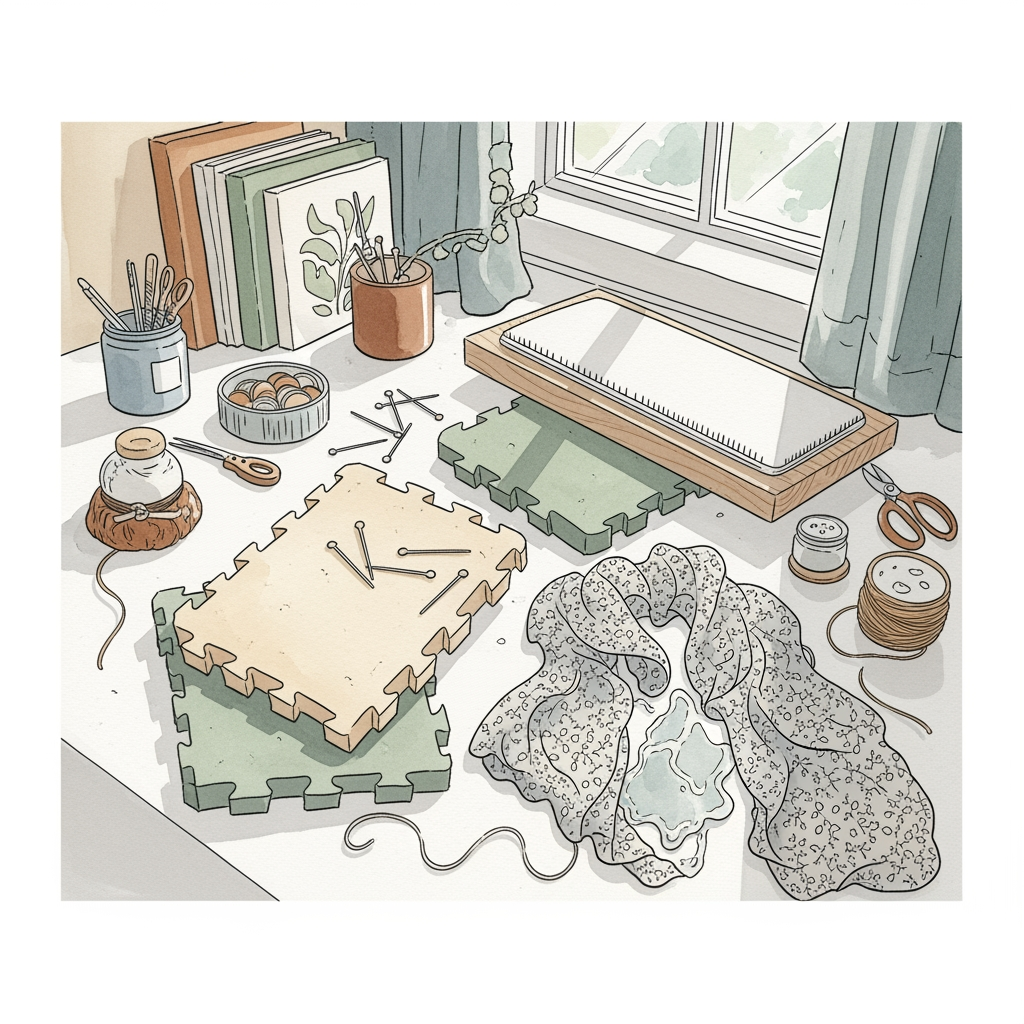
6 Blocking Mats For Shaping Delicate Wool Garments
Keep your knitwear in perfect shape with our top 6 blocking mats for delicate wool garments. Explore our expert recommendations and start blocking today.
Blocking is the final act of any knitting project, the stage where uneven stitches transform into professional-looking fabric. Without a reliable set of mats, a beautiful lace shawl or a structured wool sweater can easily lose its shape during the drying process. Choosing the right surface ensures consistent tension and prevents the frustration of lopsided finished items. This guide explores the best options available to provide stability, accuracy, and ease during this crucial finishing step.
Knitter’s Pride Mats: Your All-Purpose Workhorse


Knitter’s Pride mats are the standard-issue choice for a reason. They balance density and weight, offering enough resistance to keep pins upright without requiring excessive force.
These mats feature a standard interlocking edge that allows for modular expansion. For a large afghan or a full-sized sweater, snapping several sets together creates a vast, uniform pinning surface.
The surface texture is designed to be slightly grippy, which is a significant advantage when working with slippery fibers like silk-wool blends. A more rigid surface often causes delicate yarns to slide, but the Knitter’s Pride material holds the fiber tension exactly where it is placed.

Cocoknits Blocking Kit: For The Discerning Knitter

The Cocoknits approach prioritizes aesthetics and precision. These mats are notable for their clean, minimalist design and their focus on high-quality materials that don’t off-gas or degrade over time.
What sets this kit apart is the integrated grid. By using a consistent measuring system, the knitter can ensure that sleeves match exactly in width and that a sweater back is perfectly symmetrical.
These mats are thinner than industrial-grade options, which makes them easier to store but slightly less capable of holding heavy, soaking-wet garments. This kit is best suited for those who primarily block delicate, lightweight lace or fingering-weight garments where precision outweighs raw pinning depth.
KnitPicks Blocking Mats: The Smart Budget Option
KnitPicks mats provide a straightforward solution for those who need a large surface area without breaking the bank. They are functional, lightweight, and effective for the occasional blocker.
While they lack the ultra-dense foam found in premium versions, they offer plenty of thickness for standard T-pin usage. They are ideal for beginners who are just starting to collect their essential tool kit and need a reliable surface for multiple projects.
Be mindful that these mats may show wear faster if used with extremely heavy wools that require high tension. For everyday garments, however, they perform exactly as expected.
Hephaestus Crafts Mats: The Thickest & Most Rigid

When blocking a heavy Aran sweater or a thick, felted wool piece, standard thin mats often bend or buckle under the weight. Hephaestus Crafts mats address this by offering significant thickness and density.
The extra-thick foam prevents the mat from curving when pinned tightly. This rigidity is essential for creating crisp edges and sharp corners on items that require significant tension to open up the stitch definition.
The tradeoff for this durability is bulk. These mats take up more storage space and are heavier to transport, making them better suited for a permanent studio setup rather than a mobile knitting bag.
Boye Interlocking Mats: A Widely Available Classic
Boye mats are a long-standing staple in local craft stores, recognized for their bright colors and easy availability. They are simple, interlocking squares that get the job done without unnecessary bells and whistles.
They are generally softer than boutique options, which makes inserting pins very easy for those with limited hand strength. This softness is a major benefit for older knitters or those who struggle with the resistance of denser foam.
However, the softer material means pins may wiggle loose over time if the garment is under high tension. Always check the tension of the project after a few hours of drying to ensure the pins have not shifted.
Lindy’s Knits Mats: Best for Precise Grid Lines
Precision is the hallmark of the Lindy’s Knits design. The printed grid lines are exceptionally clear, reducing the need to pull out a measuring tape every time a piece is pinned.
This level of detail is a game-changer for stranded colorwork or complex geometric lace. When blocking a project that relies on specific stitch counts and proportions, having the grid directly on the mat acts as a built-in guide.
It simplifies the process of “blocking to size,” ensuring that the finished garment matches the schematics of the pattern. For anyone who views knitting as a science of measurements, these are a top-tier choice.
What to Look For: Grid Lines, Thickness, and Size
When shopping for mats, ignore the marketing fluff and look at three physical properties. Thickness, grid accuracy, and interlocking stability determine how the mat will function in real-world scenarios.
- Thickness: Aim for at least 0.5 inches. Anything thinner will allow pins to pierce through and damage the surface underneath the mat.
- Grid Lines: Look for high-contrast, permanent ink. Faint lines disappear under a damp garment, making them useless for measurement.
- Surface Texture: A slightly textured top layer prevents the garment from sticking to the mat, while a dense foam core keeps the pins firmly in place.
Do not settle for generic play-mats unless they are specifically heat-resistant and odor-free. Low-quality foam can release chemicals when exposed to the heat of a steam iron, which is something every knitter should avoid.
Wet vs. Steam Blocking: Which is Best for Wool?
Wet blocking involves fully submerging the garment in water with a wool wash before pinning. This is the gold standard for shaping because it allows the fibers to relax completely and settle into their new shape as they dry.
Steam blocking, conversely, uses the heat and moisture from an iron to “set” the stitches. It is faster and excellent for acrylics or delicate fibers that might felt if agitated in a bath, but it can occasionally flatten the loft of high-quality wool if too much heat is applied.
If the project is a complex lace shawl, wet blocking is necessary to stretch the stitches to their full potential. If the project is a finished sweater that just needs a quick touch-up, light steam is often sufficient.
Beyond the Mat: Essential Pins, Wires, and Combs
A mat is only as effective as the tools used to anchor the garment to it. T-pins are the industry standard for most projects because the “T” top makes them easy to insert and remove without pricking the fingers.
Blocking wires are a vital addition for lace projects. By threading these straight, stainless steel wires through the edges of a shawl, the knitter can create perfectly straight lines and smooth curves that are impossible to achieve with individual pins alone.
Blocking combs are another time-saver for long, straight edges. These feature several pins attached to a single base, allowing for large sections of a garment to be pinned down in one swift motion.
Preventing Mat-to-Yarn Color Bleed on Wet Wool
Color bleeding is a common risk when blocking deep-dyed yarns, particularly superwash wools which often hold an excess of dye. If the mat is colored, that dye can transfer directly into the wet fabric.
Always perform a quick “colorfastness check” before blocking a new project. If the yarn bleeds even a little during the initial wash, it is likely to bleed onto the mat.
To prevent this, place a clean, white cotton towel or a piece of parchment paper between the wet garment and the mat. This simple barrier protects the project from potential stains and adds an extra layer of protection for the mat surface.
Investing in a high-quality blocking set is one of the most effective ways to elevate the final look of handmade wool garments. Whether a knitter prefers the precision of grid-lined mats or the structural support of thick, dense foam, the right choice makes the difference between a project that looks store-bought and one that looks like a prototype. Select a surface that fits the scale of typical projects, keep the necessary pins and wires on hand, and treat every blocking session as the final, essential step in the creative process.
