6 Best Glass Bead Assortments For Custom Color Palettes
Discover the 6 best glass bead assortments for your next project. Explore these top-rated sets to curate the perfect custom color palettes for your jewelry design.
Integrating glass beads into a hand-knit garment transforms a simple accessory into a textured, light-catching piece of art. Selecting the right beads requires balancing the weight of the glass against the drape of the yarn while ensuring the colors harmonize with the fiber. These assortments provide a curated starting point for knitters looking to add sophisticated detail without sourcing hundreds of individual tubes. Discovering the perfect match between bead quality and knitting technique is the key to creating professional, heirloom-quality results.
Toho Treasure Chest: Ultimate Colorwork Palette


Toho Treasure Chests are designed for the maker who demands uniformity in every stitch. These sets feature cylinder-shaped beads that sit perfectly flush against the yarn, making them ideal for complex stranded colorwork where precision is non-negotiable.
Because these beads are highly consistent in size, they prevent the unsightly “lumpy” appearance that can occur when uneven beads pull at the stitches. When used in a Fair Isle yoke, the beads maintain an even tension that mimics the surrounding yarn loops.
The range of colors in these chests often follows a seasonal or thematic narrative. This makes them a reliable choice for knitters who prefer a cohesive, designer-curated look without the guesswork of color matching.
Miyuki Delica Painter’s Mix: For Pro-Level Detail
Miyuki Delicas are widely regarded as the gold standard for bead knitting due to their extreme precision and wide, stable apertures. The Painter’s Mix collections offer a spectrum of nuanced shades, perfect for creating subtle gradients or delicate embroidery-like highlights on cuffs and collars.
The cylindrical shape allows these beads to stack tightly. This is critical for projects like beaded lace shawls, where the weight must be distributed evenly across the yarn to prevent sagging.
One vital consideration is the fragility of certain metallic finishes in these mixes. If the garment will see heavy daily wear, prioritize the matte or opaque finishes to ensure the color remains vibrant against the friction of sleeves or jewelry.
Preciosa Ornela Rocaille Set: Best Value Option
For those working on larger-scale projects like beaded throws or heavily embellished evening wraps, buying individual tubes is rarely cost-effective. The Preciosa Ornela Rocaille sets provide a high-volume, budget-friendly solution without sacrificing structural integrity.
Rocailles, or round beads, offer a classic, organic texture that contrasts beautifully with smooth, high-twist merino yarns. While they are slightly less uniform than cylinder beads, this variability adds a charming, rustic aesthetic to casual knitwear.
These sets are excellent for beginners who want to experiment with different color placements without worrying about the cost of wasted beads. Just ensure the gauge of the yarn matches the hole size, as round beads can occasionally vary in their interior diameter.
Artbeads Designer Blends: For Unique Projects
Artbeads Designer Blends move away from standard palettes to offer custom-mixed textures and finishes. These collections often pair transparent glass with opaque or metallic finishes, providing an immediate solution for adding visual “pop” to plain-stockinette sweaters.
These blends are best suited for projects where the beads serve as the primary focus rather than a secondary accent. When paired with a variegated yarn, they can pull out hidden tones in the wool, creating a highly polished, boutique look.
Be aware that these mixes are often limited-run. If planning a large project, purchase enough from the same lot to ensure the finish consistency across the entire garment.
Beadsmith Mix Tubes: Perfect for Beginners
Beadsmith Mix Tubes are the quintessential starting point for a knitter’s first foray into beaded knitting. These tubes offer smaller quantities that are manageable, organized, and focused on functional, everyday color combinations.
The primary advantage here is accessibility. Because the beads are clearly labeled and consistently sized, the learning curve for incorporating them into a standard knit stitch is significantly reduced.
Avoid using these on heavy-weight, non-elastic fibers. For the best experience, start with a fingering-weight superwash wool, which offers enough grip to hold the beads in place while providing the necessary stretch to keep the fabric supple.
Mill Hill Glass Bead Collection: Best for Lace
Mill Hill beads are technically seed beads but are prized in the knitting world for their superior sparkle and distinct hexagonal or cube shapes. They are the go-to for delicate, fine-gauge lace where light reflection is the primary design goal.
Because these beads are slightly heavier, they work best on silk-blend or mohair-silk lace yarns. The natural grip of the mohair helps lock the beads in place, preventing them from sliding or distorting the lace motifs during blocking.
Always consider the weight of the finished project when working with these dense beads. A massive amount of Mill Hill glass can cause a delicate lace shawl to grow in length; account for this by swatching the bead-to-yarn ratio beforehand.
How to Match Bead Size to Your Yarn Weight
The golden rule of bead knitting is that the bead hole must be large enough to slide over the yarn without friction, but the bead itself must not be so large that it flops around the stitch. A 6/0 bead is generally suitable for sport or DK weight yarn, while an 11/0 or 15/0 is best for fingering or lace weight.
If the bead hole is too small, the yarn will fray as it passes through the eye of the needle or hook. Conversely, if the bead is too heavy for the yarn, it will distort the stitch, causing the fabric to look uneven and “sagging” in sections.
Always test your chosen yarn by threading it through a single bead before casting on. If the yarn catches or the needle used to thread it struggles to pass through, the bead is too small for that specific fiber.
Adding Beads: Crochet Hook vs. Superfloss Method
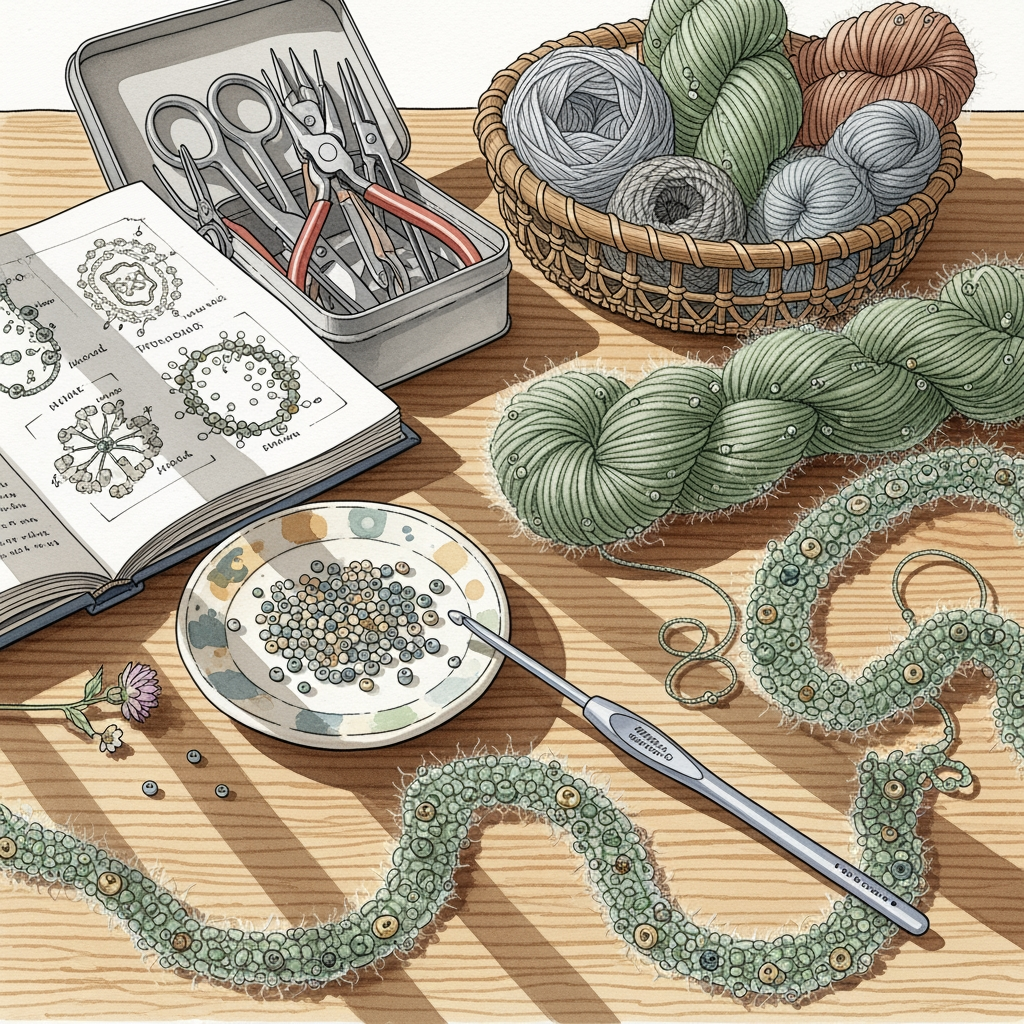
The crochet hook method is the most efficient technique for experienced knitters. Using a tiny steel crochet hook (typically 0.5mm to 0.75mm), you pull a loop of the live stitch through the bead before returning it to the knitting needle.
The superfloss method, which involves using a piece of stiffened, dental-style floss, is often easier for beginners or those who find handling a tiny hook frustrating. The floss acts as a flexible needle, allowing the bead to slide onto the yarn with minimal handling of the live stitch.
Choose the hook method for high-speed production during large, repetitive patterns. Use the superfloss method when working with delicate or multi-ply yarns that might snag on the tip of a crochet hook.
Understanding Bead Finishes: Matte, Luster & More
Bead finishes dramatically alter how light interacts with a knit garment. Matte beads offer a soft, sophisticated glow that blends into the fiber, while luster or metallic finishes create high-contrast highlights that pop off the surface of the knitting.
Be mindful of “silver-lined” beads, as the lining can sometimes wear off if exposed to harsh detergents or constant abrasion. When knitting a garment intended for long-term use, prioritize high-quality glass where the color is infused into the glass itself rather than painted onto the surface.
Think about the environment where the garment will be worn. Shiny, reflective beads look best under indoor, low-light settings, whereas matte beads maintain their integrity in bright, outdoor daylight.
How to Care for and Wash Your Beaded Garments
Washing beaded knitwear requires a delicate touch to protect both the beads and the fiber. Never machine wash or tumble dry beaded items, as the agitation can chip the glass or, worse, snap the yarn anchoring the beads.
Always hand-wash in cool water using a gentle wool soak, and never wring the garment. Instead, roll it in a thick towel to remove excess moisture and lay it completely flat to dry, ensuring the beads are not pressed into the surface of the wool if the drying rack has rigid wires.
When storing, fold the item loosely to prevent the weight of the beads from causing structural stress on the knitted fabric. If the garment is heavy, avoid hanging it entirely, as the gravity will inevitably distort the stitch definition over time.
Selecting the right glass bead assortment is the final, transformative step in creating a piece that balances technical skill with aesthetic elegance. By understanding the interplay between bead weight, finish, and yarn choice, the results will remain beautiful for years to come.