6 Best Swatch Gauges For Tension Testing Essential Tools
Struggling with uneven knitting? Discover the 6 best swatch gauges for tension testing and ensure your projects fit perfectly every time. Shop our top picks today.
Gauge is the bridge between a beautiful skein of yarn and a wearable, well-fitting garment. Without accurate measurement, hours of meticulous work can result in a sweater that hangs like a sack or socks that slip off at the heel. Investing in a reliable swatch gauge removes the guesswork from tension testing and ensures your project dimensions align with the intended pattern. This guide evaluates six essential tools designed to bring professional precision to every stitch count.
Clover Swatch Ruler: The Essential All-in-One


The Clover Swatch Ruler is a workhorse found in almost every well-stocked knitting bag for good reason. It combines a standard measuring square with a built-in needle sizer, making it a highly functional multitasker.
Its primary strength lies in the clear, high-contrast markings that prevent eye strain during long sessions. For those who frequently switch between project types, the ability to confirm both your needle size and stitch count with one tool is a significant efficiency gain.
While it lacks the decorative appeal of artisan tools, its durability and clear layout make it an ideal choice for the practical knitter. Choose this if you prefer a no-nonsense tool that reliably performs two essential tasks at once.
Susan Bates Knit-Chek: Best Budget-Friendly Tool
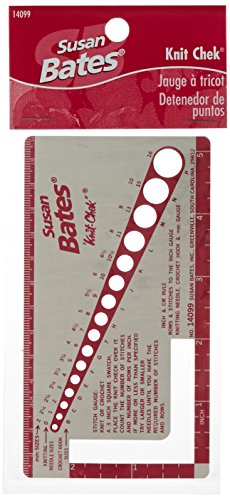
The Susan Bates Knit-Chek is a classic, lightweight plastic tool that has been a staple in the knitting community for decades. Its compact design allows it to slip easily into the smallest notions pouch, making it perfect for knitting on the go.
Despite its low price point, it provides accurate needle sizing and a helpful two-inch cut-out for measuring stitches per inch. It is particularly useful for travelers or those who prefer to keep a separate set of essential tools in every project bag.
Because it is plastic, it may show wear over time or bend if stored under heavy books. It remains the best value for money, serving as a dependable backup or a primary tool for those just starting their knitting journey.
KnitPicks View Sizer: Best for Quick Gauge Checks

The KnitPicks View Sizer is designed specifically to make reading your stitch count across a four-inch swatch easier than ever. The open frame allows you to see the stitches clearly without the distraction of a cluttered ruler background.
This is an excellent tool for those struggling to keep their eyes on the line while counting. By placing the sizer directly over the fabric, you minimize the risk of miscounting rows or stitches due to an unsteady hand.
It is particularly effective when working with darker yarns where visibility is low. If you find manual counting tedious or prone to error, this sizer provides the clarity needed to ensure accuracy.
Knitter’s Pride Mindful: Most Elegant Swatch Tool

The Knitter’s Pride Mindful collection offers a sophisticated, minimalist aesthetic that turns a routine chore into a more enjoyable ritual. Crafted with a focus on clean lines and calming colors, this tool sits beautifully alongside high-end needles and notions.
Beyond the visuals, the weight and texture of the material offer a tactile experience that plastic tools lack. It is a sturdy, well-engineered instrument that resists warping and remains legible through years of heavy use.
While it serves the same functional purpose as cheaper alternatives, its quality elevates the craft experience. This is the perfect gift for the dedicated knitter who values beauty alongside functionality.
Akerworks Swatch Gauge: The Most Versatile Option

The Akerworks Swatch Gauge stands out by offering a unique, modular approach to measuring. It is often favored by advanced knitters who work with a vast array of stitch patterns and need more than a standard square.
Its robust construction allows for precise measurements even when dealing with highly textured fabrics, such as cables or lace. The tool provides a level of stability that makes it easier to measure “in-pattern” rather than just stockinette.
Because of its specialized design, it may have a steeper learning curve than a simple ruler. Consider this option if you frequently tackle complex patterns that require nuanced gauge monitoring beyond basic row and stitch counts.
Cocobolo Smart Stix: Premium Heirloom Quality Tool
Cocobolo Smart Stix represents the pinnacle of premium knitting accessories, crafted from high-quality wood that feels organic and balanced in the hand. Wood tools offer a warmer, non-slip interaction with your knitting that metal or plastic simply cannot replicate.
These tools are not just functional; they are built to last a lifetime, often developing a rich patina with age. They are less likely to snag delicate yarns and offer a gentle, tactile grip that makes measuring feel seamless.
Like all wooden tools, they require a bit of care to prevent moisture damage or splintering. For the knitter who treats their gear as an investment, the Smart Stix offers unparalleled quality and long-term utility.
How to Properly Use Your New Swatch Gauge Tool
Accuracy begins with a properly blocked swatch. Measure your gauge only after the fabric has been washed and dried according to the fiber’s requirements, as this allows the yarn to relax and find its true “settled” size.
Place your gauge tool flat against the fabric without stretching or compressing the stitches. Use a contrasting pin to mark your start and end points if you are having trouble keeping the tool aligned over a four-inch square.
Always measure in multiple places across the swatch to account for variations in tension. Averaging these numbers ensures that the data you use to adjust your pattern is statistically sound rather than based on a single, potentially anomalous section of knitting.
Why Swatching Is a Non-Negotiable Step for Fit
Swatching is often viewed as a chore, but it is the only way to predict how your specific tension interacts with a chosen yarn. A difference of even half a stitch per inch can lead to a garment that is several inches too large or too small by the time you reach the armholes.
Different fibers behave differently under the weight of a finished project. For instance, superwash wool tends to grow significantly when wet, while cotton may shrink or tighten; your swatch provides the vital, real-world data needed to adjust before you commit to the full project.
Think of the swatch as a small-scale prototype for the entire garment. Spending one hour to swatch can save you forty hours of ripping out a finished project that does not fit.
What to Do When Your Gauge Swatch Doesn’t Match
If your stitch count is too low, you have too many stitches per inch, meaning your fabric is too tight. The solution is to go up a needle size to allow the yarn more room to breathe and relax.
Conversely, if your stitch count is too high, your fabric is too loose and likely to lose its shape. Try dropping down a needle size to create a tighter, more cohesive structure that will hold its form over time.
Don’t be afraid to change your needles or even your yarn brand if the desired gauge remains elusive. Sometimes a specific yarn and pattern combination simply are not compatible, and catching that mismatch early is the mark of an experienced maker.
Wood vs. Plastic vs. Metal: Which Is Best?
Metal gauges are incredibly durable and offer the thinnest, most precise edges for accurate measurement. They are excellent for heavy-duty use but can be cold to the touch and occasionally slippery on delicate surfaces.
Plastic gauges are lightweight, inexpensive, and often translucent, which can help with counting stitches against a dark background. Their downside is a tendency to warp over time or develop cracks in the measuring holes, which can lead to imprecise needle sizing.
Wooden gauges provide a beautiful, natural grip and are gentle on the hands, but they can be thicker than their metal counterparts. Choose based on your environment: use metal for professional-grade accuracy, plastic for portability, and wood for a premium, tactile experience.
Precision in gauge is the hallmark of professional-level work. By selecting a high-quality swatch gauge and committing to the process of testing, you ensure every stitch serves a purpose in the final, well-fitting result.