6 Best Magnifying Headsets For Intense Puzzle Focus
Boost your precision and comfort with our top 6 magnifying headsets for intense puzzle focus. Find the perfect pair for your hobby and shop our top picks today.
When working with fine lace weight mohair or intricate cable patterns on dark yarn, standard room lighting often fails to reveal dropped stitches or subtle tension inconsistencies. A quality magnifying headset bridges the gap between straining tired eyes and maintaining consistent, professional-grade gauge. By providing both magnification and targeted illumination, these tools allow for hours of comfortable stitching even during late-night craft sessions. Selecting the right model requires balancing weight, lens clarity, and the specific visual demands of the project at hand.
Carson Pro Series MagniVisor: Best Overall


The Carson Pro Series MagniVisor stands out because it balances structural integrity with a remarkably comfortable fit. For knitters tackling long-duration projects like an oversized stranded colorwork sweater, the weight distribution is critical to avoiding neck strain.
It features a dial-adjustable headband that secures the visor firmly without the need for constant readjustment. The lenses are crisp, providing the high-definition clarity needed to differentiate between similar dark-toned wools or tricky black mohair.
This is the reliable choice for those who want a “set it and forget it” tool that performs consistently. While the price point sits higher than basic models, the comfort and optical quality pay dividends in reduced fatigue.
Yoctosun LED Head Magnifier: Best Budget Pick
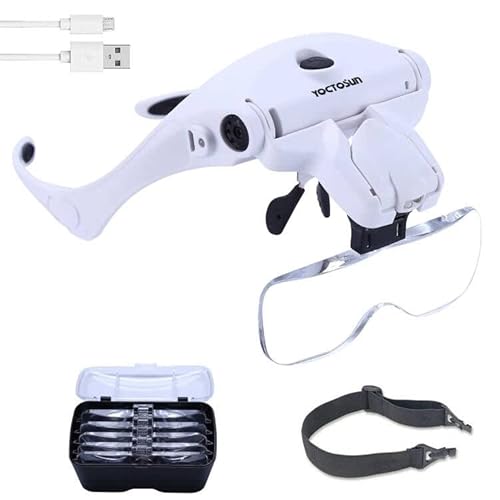
The Yoctosun LED Head Magnifier offers essential magnification for knitters who need a functional solution without a significant investment. It is particularly effective for troubleshooting gauge issues or identifying tiny debris caught in delicate fibers like silk or alpaca.
It comes with a set of interchangeable lenses that snap in and out with minimal effort. While the plastic construction lacks the ruggedness of professional-grade optics, it is lightweight and easy to wear for shorter sessions.
This model serves as an excellent entry point for those unsure if they will use a magnifier regularly. Expect acceptable optical performance that clears up the fog of close-up work without breaking the bank.
Donegan OptiVISOR: The Most Durable Option

The Donegan OptiVISOR is widely regarded as the gold standard for long-term reliability in the hobbyist and professional worlds. If the goal is a tool that survives years of being tossed into a knitting bag, this is the definitive choice.
The build quality is industrial-grade, featuring glass lenses that resist the scratching often associated with plastic alternatives. Because fiber arts tools can be prone to collecting oil and lint, the ease of cleaning these glass lenses is a significant practical advantage.
The trade-off here is weight; it feels substantial on the head. Knitters with sensitivity to pressure on the forehead may find it requires some break-in time to find the perfect fit.
SE LED Head Magnifier: Brightest Illumination

Good lighting is just as vital as magnification when working with deep-toned yarns or intricate lace motifs. The SE LED Head Magnifier provides exceptionally bright, focused illumination that acts like a personal spotlight for the needle tips.
Having an ultra-bright light source allows for precise navigation of complex lace charts or chart-based intarsia. It cuts through shadows that often hide dropped stitches within busy, high-ply textures.
This model is ideal for environments where overhead lighting is poor or when working with dark, light-absorbing fibers. The illumination is bright enough to make the work pop, though users should ensure the batteries are kept fresh to maintain peak output.
Yoctosun Rechargeable: Best Cordless Option
Fumbling with cables or dealing with dead batteries mid-row is a frustration every knitter wants to avoid. The Yoctosun Rechargeable model eliminates the need for external power sources, offering a streamlined, portable experience.
This headset is perfect for knitters who take their projects on the go, whether to a local guild meeting or on a long-distance commute. A simple USB charge ensures that the magnifier is ready whenever a moment of inspiration strikes.
Because there is no battery box attached to the back of the headset, it is often better balanced than its disposable-battery counterparts. It represents the modern standard for convenience and recurring cost savings.
Beileshi 5-Lens Set: Most Versatile Lenses
Different knitting tasks—from counting stitches per inch (SPI) to examining lace symmetry—require varying levels of detail. The Beileshi 5-Lens Set provides an array of magnification powers, allowing the user to adapt the tool to the specific task.
Changing lenses is straightforward, allowing a switch from lower magnification for general knitting to higher powers for fixing a mistake in a complex cable crossing. This versatility makes it a catch-all solution for a multi-craft maker.
While the sheer number of lenses might seem like overkill, having options is a luxury for those who switch between large-needle bulky projects and micro-needle lace. It is a highly practical choice for the diverse maker.
Choosing Your Magnifier: A Buyer’s Guide
When choosing a headset, prioritize comfort over fancy features. A heavy magnifier that slides down the nose every time the head tilts is more distracting than helpful.
- Weight: Lighter frames are better for sessions longer than an hour.
- Adjustability: Look for knobs or ratchet-style headbands rather than elastic straps.
- Lens Material: Glass offers superior clarity and scratch resistance, while acrylic is lighter and cheaper.
- Balance: A center-mounted battery pack can help distribute the weight across the crown of the head.
Before purchasing, consider where the magnifying work will take place. A brightly lit studio requires less focus on built-in lighting, whereas a dimly lit living room makes the LED feature mandatory for preventing eye strain.
Decoding Magnification: Which Power Do You Need?
Magnification power is usually measured in “diopters” or “X” strength. For general knitting, 1.5X to 2.5X is usually sufficient for checking stitch definition and tension.
Anything higher, such as 3X or 5X, is intended for high-precision tasks like unpicking complex duplicate stitches or working with invisible thread. Too much magnification can actually make it harder to coordinate hand movements, as it drastically reduces the depth of field.
Start with a lower, more natural magnification. The goal is to assist the eyes, not to replace the ability to see the work in its natural scale.
Can You Wear a Headset Over Your Glasses?
Most high-quality magnifying headsets are designed to be worn over standard prescription eyewear. This is a crucial feature for the vast majority of knitters who already rely on glasses to see clearly at arm’s length.
Look for models that offer “flip-up” lenses, allowing the magnification to be lifted out of the way without removing the entire head unit. This is essential when transitioning from looking at the work to looking up at a pattern or a television screen.
If the headset frame presses the glasses into the bridge of the nose, discomfort will set in quickly. Choose models with generous clearance to ensure that the two pieces of equipment coexist without friction.
Lighting Your Work: Is a Built-in LED Worth It?
A built-in LED light is arguably the most valuable feature for a dedicated knitter. Even if the room is well-lit, the head itself often casts a shadow over the knitting needles.
A dedicated light source solves the “shadow problem” by aligning the illumination with the line of sight. This is invaluable when working with navy, black, or deep jewel-toned yarns that blend into the background.
While some worry about the weight of the LED housing, the benefits far outweigh the minor increase in heft. For anyone working with dark fibers or fine-gauge lace, an LED-equipped model is a non-negotiable upgrade for eye health and project accuracy.
Investing in a proper magnifying headset is the most significant step a knitter can take to protect their long-term ability to enjoy their craft. By reducing eye fatigue and sharpening the view of every stitch, these tools transform tedious repair work into a satisfying, clear, and manageable process. Finding the right balance of weight, magnification, and lighting will ensure that the tools disappear, leaving only the joy of the yarn and the satisfaction of a perfectly completed row.