7 Best Rollers For Securing Beads To Try Now
Discover the 7 best rollers for securing beads to improve your jewelry-making process. Read our expert guide and find your perfect tool to start creating today.
Adding beads to a delicate lace shawl or a pair of sparkling beaded socks transforms a simple knit into an heirloom piece. However, the tedious process of sliding beads onto yarn by hand often discourages makers from incorporating them into larger projects. Bead spinners offer a mechanical solution, drastically reducing the time spent on preparation so more energy stays focused on the stitches themselves. Selecting the right tool depends on the volume of beads needed and the frequency of planned beaded projects.
Darice Bead Spinner: An Excellent Starter Option


The Darice Bead Spinner is a lightweight, entry-level tool perfect for those unsure if they will frequently incorporate beads into their fiber work. Its compact design occupies very little space in a knitting bag, making it a convenient choice for occasional crafters.
Because it is constructed from basic plastic, it may lack the weight needed for ultra-smooth, long-term operation. However, for a test run on a single beaded project, it serves its purpose well. It is an affordable investment that teaches the fundamental mechanics of centrifugal loading without requiring a significant financial commitment.
Beadalon Spin-N-Bead: Most Reliable Manual Tool

Widely recognized for its consistency, the Beadalon Spin-N-Bead features a weighted base that provides essential stability during rotation. When loading hundreds of size 8/0 or 11/0 seed beads for a beaded lace border, this stability prevents the device from wobbling or tipping.
Reliability is the primary draw here, as the movement remains fluid even during extended use. This tool bridge the gap between hobbyist craft supplies and professional-grade equipment. It remains a staple for those who value performance and durability in their knitting toolkit.
The Beadsmith Spin & String: Best All-in-One Kit
For knitters who prefer to buy a complete system rather than piece together individual components, this kit offers a cohesive experience. It typically includes the spinner, curved needles, and sometimes a selection of high-quality thread, ensuring everything needed is ready upon opening.
The inclusion of specifically designed needles is a significant advantage, as standard sewing needles often struggle with the curvature required for effective loading. By providing the full ecosystem of tools, this kit eliminates the guesswork for beginners. It is a practical solution for anyone looking to start a new beaded project immediately.
Vervaco Wooden Bead Spinner: Top Aesthetic Pick
The Vervaco Wooden Bead Spinner appeals to makers who value tools that are as beautiful as they are functional. Beyond its classic appearance, the wood grain provides a slight, natural texture that can sometimes offer better balance than slick plastic alternatives.
Wooden tools tend to be more durable and hold up better to the wear and tear of a busy studio. While they may carry a higher price point, the aesthetic appeal is a factor for those who keep their supplies on display. If the workspace is a shared living area, a wooden tool blends seamlessly into a home’s decor.
Cousin Craft & Jewelry Spinner: Widely Available
Cousin Craft spinners are found in most local craft retailers, making them the most accessible option for someone needing a tool on short notice. Accessibility is a major advantage when a deadline for a gift or a specific KAL (Knit-Along) is approaching quickly.
While these models are often basic, they are highly functional for standard bead sizes. They represent a “get the job done” philosophy. If a project requires a quick start, this brand is a reliable standby that fulfills its primary function without unnecessary complexity.
Art-c Wooden Bead Spinner: The Best for Gifting
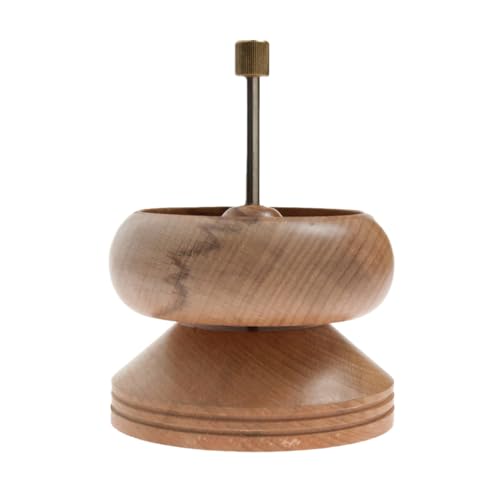
The Art-c Wooden Bead Spinner stands out for its high-quality finish and solid construction, making it an ideal gift for a fellow knitting enthusiast. The weight of the wood provides an excellent center of gravity, which minimizes the effort required to keep the unit spinning steadily.
Knitting is often a social craft, and high-quality, thoughtful tools are a hallmark of a serious maker’s collection. Gifting this spinner provides the recipient with a tool that feels substantial and professional in the hand. It is a perfect choice for birthdays, holidays, or celebrating the completion of a major project.
Beadaholique Electric Spinner: For High-Volume Use

When a project calls for thousands of beads, manual spinning becomes physically taxing on the wrists and forearms. The Beadaholique Electric Spinner removes the manual effort, allowing for a continuous, motorized flow that maintains speed and accuracy.
This is a specialized piece of equipment for advanced crafters who produce high-volume beaded work, such as bridal veils or heavily embellished garments. While it requires a power source and more space, the time savings on large-scale projects are immense. It is the ultimate tool for those who have moved past occasional beading into serious ornamentation.
Choosing the Right Bead Roller For Your Project
Selecting a spinner should be dictated by the scale of the knitting project. If the task involves only a dozen beads for a decorative edge, manual dexterity and a simple hook are sufficient. Large, multi-repeat lace patterns, however, justify the investment in a spinner that reduces eye strain and repetitive motion.
- Low Volume: Basic plastic spinners or simple hook-loading suffice.
- Medium Volume: Weighted manual spinners offer the best balance of cost and efficiency.
- High Volume: Electric spinners prevent fatigue and save hours of prep time.
Consider how often the tool will be used before settling on a price point. A durable, wooden manual spinner is often the “sweet spot” for most dedicated knitters.
Mastering the Technique: Tips For Easy Bead Loading
The secret to success with any bead spinner lies in the angle of the needle and the speed of the bowl. Hold the needle at a 45-degree angle against the inner wall of the bowl, allowing the beads to catch the point naturally. Avoid pushing the needle into the center of the beads, as this causes resistance.
The speed of the rotation should be steady rather than fast. Too much speed will cause the beads to jump out of the bowl entirely. Practice with a small amount of beads first, and slowly increase the volume as the technique improves.
What Needles Work Best With a Bead Spinner?
The choice of needle is just as important as the spinner itself. Curved beading needles are essential because they maintain the correct angle against the rotating beads in the bowl. Straight needles simply will not catch the beads effectively, leading to frustration.
Ensure the needle diameter is slightly smaller than the bead hole but sturdy enough to hold the weight of the loaded beads. For extremely fine silk yarn or delicate laceweight, use a flexible needle that allows the yarn to pass through the eye without adding too much bulk. Always check that the needle eye is smooth to prevent snagging on the yarn’s ply as it moves from the needle onto the fiber.
Integrating beads into knitting projects once seemed like a daunting task, but the right equipment makes it both accessible and enjoyable. By choosing a spinner that matches the scale and complexity of the intended work, the process of loading becomes a rhythmic part of the craft. With the right tools and techniques in hand, the possibilities for adding texture and shimmer to knitting are virtually endless.