6 Crochet Gauge Rulers For Size Accuracy That Help
Struggling with inconsistent projects? Discover 6 reliable crochet gauge rulers to ensure perfect size accuracy in every stitch. Shop our top picks and start today.
Nothing kills the joy of a finished garment faster than realizing it fits a doll instead of a human. Gauge is the invisible foundation of every project, yet it remains the most misunderstood aspect of needlework. A few misplaced loops can mean the difference between a perfectly draped sweater and a stiff, boxy disaster. Using the right tool to measure these stitches ensures that time spent at the hooks translates into a wearable result.
The Crochet Dude Gauge: Best for Versatility


The Crochet Dude Gauge is designed for those who need a comprehensive tool that handles both hook sizing and stitch counting in one sturdy package. It eliminates the guesswork of matching a hook to a specific millimeter size when the factory markings have inevitably rubbed off.
This tool is particularly helpful when working with imported or vintage hooks that don’t follow standard sizing conventions. Having a clear, reliable reference ensures that the foundation chain is worked with the correct tension from the very first stitch.
Because it is made of rigid material, it remains flat against the fabric for consistent, repeatable measurements. It is the practical choice for a crafter who values efficiency and wants a tool that won’t flex under pressure.
KnitPro View Sizer: Best for Magnification

The KnitPro View Sizer addresses the eye strain that often accompanies measuring fine-gauge work. By incorporating a magnifying lens into the frame, it allows for precise identification of individual thread paths within a stitch.
For projects using dark, high-twist, or mohair yarns, seeing the edges of a stitch is notoriously difficult. The magnification helps identify exactly where one stitch ends and the next begins, preventing the common error of counting a loop twice.
If a project involves complex textures or dark colors, this tool provides the clarity needed to ensure accuracy. It transforms a frustrating task into a manageable one, ensuring that the gauge swatch is as accurate as the final garment.
Clover Swatch Ruler: Best Budget-Friendly Pick

The Clover Swatch Ruler is a no-nonsense instrument that prioritizes clarity and ease of use. Its transparent design allows the texture of the fabric to remain visible through the ruler, making it easier to align rows and stitches.
It is an ideal entry-level tool for beginners who are just learning the importance of gauge. The markings are sharp and high-contrast, which reduces the chance of misreading a quarter-inch as a half-inch.
While it lacks the bells and whistles of high-end artisan tools, it performs the essential job of measurement perfectly. It is the most reliable option for the crafter who wants a dedicated tool without a significant financial investment.
Katrinkles Wooden Ruler: Best Artisan Choice

Katrinkles wooden rulers offer a tactile, aesthetically pleasing alternative to plastic measuring tools. They provide a warm, grippy surface that holds steady on slick, slippery fibers like bamboo or silk blends.
These tools are often laser-cut with precision, providing a distinct advantage for those who appreciate craftsmanship in their workspace. The wooden construction also makes them lighter in the hands, which is a subtle benefit for those with wrist fatigue or limited dexterity.
Beyond utility, these rulers are designed to be heirloom-quality pieces that stand up to years of frequent use. They are the perfect selection for the maker who views their tools as an extension of their creative practice.
Susan Bates Knit-Chek: The All-in-One Classic
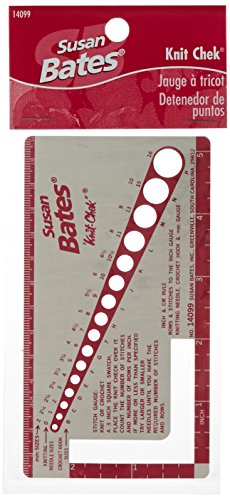
The Susan Bates Knit-Chek is a long-standing staple in fiber arts kits, and for good reason. It combines a hook/needle sizer, a stitch gauge ruler, and a point gauge into a single, compact metal plate.
The metal construction ensures that it will not warp or bend over time, even if tossed into a crowded project bag. It is a workhorse tool designed for the crafter who frequently switches between different hook sizes and wants to check their tension on the fly.
Because it includes so many functions in one tool, it minimizes the number of items needed in a notions pouch. It remains a definitive choice for those who value tradition and the reliability of a tried-and-true mechanical design.
Akerworks Swatch Gauge: Best for Modern Makers

The Akerworks Swatch Gauge approaches measurement with a focus on geometric precision and customizability. Its design allows the user to isolate a specific square inch or two-inch area without the distraction of peripheral stitches.
This is highly effective for projects that require a specific stitch count within a small, defined space, such as intricate lace or tight amigurumi. The frame locks the fabric in place, which prevents the stretch-bias common with looser crochet stitches.
It is a sophisticated tool for the technical crafter who treats gauge as an exact science rather than an estimation. For those tackling complex patterns where a single stitch per inch could alter the entire structure of the piece, this tool is indispensable.
How to Properly Measure Your Crochet Gauge Swatch
A gauge swatch must always be blocked before it is measured to mimic the final state of the garment. Pin the swatch flat without over-stretching it, as tensioning the fabric artificially will result in an inaccurate, misleading count.
Place the ruler on the fabric and count the stitches in a central area, avoiding the edges where tension naturally fluctuates. Use a straight pin to mark the beginning and end of a four-inch span to ensure the count is perfectly aligned.
Always count half-stitches if the pattern requires them, as rounding up or down can lead to significant sizing errors in a sweater body. Precision at this stage is the only way to guarantee that the final piece fits the intended measurements.
Why Getting Crochet Gauge Right Is So Important
Crochet gauge determines the total physical dimensions of the finished item. If the swatch shows five stitches per inch but the pattern demands four, the finished garment will be significantly smaller and less functional than intended.
Beyond fit, gauge also affects the drape and weight of the fabric. Fabric worked at the wrong gauge may be too stiff for a garment or too loose for a durable accessory, fundamentally changing the performance of the chosen yarn.
Failure to match gauge often leads to projects that sit unfinished in a bin. Taking the time to verify tension at the start of a project is the most effective way to protect the investment of time and expensive fibers.
What to Do When Your Crochet Gauge Is Too Tight
If a gauge is too tight, the fabric will be dense, stiff, and lack the necessary fluidity for comfortable wear. The most direct fix is to increase the hook size, which allows for more space between the loops and naturally loosens the tension.
Alternatively, examine the grip on the hook. Beginners often hold the hook with a “death grip,” which pulls the yarn tight with every cycle; relaxing the hands and holding the yarn with less resistance can often correct the issue without changing hooks.
Sometimes, the culprit is the yarn choice itself, as fibers with high elasticity can “snap back” and tighten the gauge. If changing hook sizes doesn’t yield the desired drape, consider switching to a different yarn base with more cotton or silk content.
FAQs About Crochet Gauge Rulers and Tools
Does a metal gauge ruler change if it gets hot? Metal rulers remain stable under normal conditions, though it is best to store them out of direct, extreme heat to ensure the markings remain perfectly accurate.
How often should a gauge be checked? Tension often changes based on mood, time of day, and fatigue; it is wise to re-check the gauge every few inches or whenever a session is resumed.
Are plastic rulers prone to warping? Low-quality plastics can warp over time if stored in a heavy bag, so choosing a rigid, high-quality acrylic or wooden ruler is recommended for long-term consistency.
Can I just use a regular sewing tape measure? A flexible tape measure is useful for body measurements, but for a gauge swatch, a rigid ruler is superior because it prevents the fabric from being accidentally pulled or distorted during counting.
A well-calibrated crochet gauge tool is not merely a convenience, but a critical piece of diagnostic equipment for any serious fiber artist. By selecting the tool that aligns with personal tension habits and project needs, the frustration of poorly fitting projects can be replaced with the confidence of professional-grade results.