6 Best Knitting Instruction Booklets For Advanced Techniques
Master intricate patterns with our top 6 knitting instruction booklets for advanced techniques. Level up your craft and order your copy of these guides today.
Reaching the plateau of intermediate knitting often leads to a desire for greater complexity and structural refinement. Moving beyond basic stockinette and simple ribbing requires a shift in how one interacts with yarn tension, stitch manipulation, and garment architecture. The right instructional resources act as a map, turning daunting techniques into manageable, logical sequences of movements. Investing in specialized literature is the most effective way to transition from following patterns to truly understanding the mechanics of the craft.
Knitting Brioche by Nancy Marchant: Best for Brioche


Brioche knitting creates a fabric defined by its squishy, reversible, and deep-ridged texture. It is a technique that rewards patience, as the rhythm of yarn-overs and slipped stitches can initially feel counterintuitive to the brain. Nancy Marchant’s work remains the definitive authority for mastering this stitch, specifically for its clear breakdown of the two-color method.
When tackling brioche, the primary challenge is identifying “the pair”—the stitch and its associated yarn-over that must be worked together. If these are separated, the entire fabric structure compromises, leading to holes that are notoriously difficult to fix. Marchant’s approach emphasizes visual recognition of these elements rather than rote memorization of written steps.
The trade-off with brioche is significant yarn consumption; expect to use 20% to 30% more yarn than a standard stockinette project of the same size. Always pair this technique with a round or bouncy wool, as slippery fibers like silk or bamboo will cause the stitches to slide out of alignment. If the yarn is too slick, it will not hold the airy structure that makes brioche desirable.
The Colorwork Bible: Best for Modern Stranded Knitting
Stranded colorwork, often called Fair Isle, involves carrying multiple colors across the back of the work. The struggle for most knitters is maintaining consistent tension, which often leads to “puckered” fabric where the floats are too tight. The Colorwork Bible addresses these technical hurdles by focusing on the mechanics of tensioning two strands of yarn simultaneously.
Mastering this requires practice with different holding styles, such as the Norwegian method, where yarn is held in both hands, or the stranded method, where both colors are held in one hand. It is essential to understand that colorwork fabric is inherently thicker and less elastic than single-color knitting. Because of this, one may need to increase the needle size for the stranded sections to ensure the garment retains its intended drape.
Common mistakes include trapping floats too infrequently, resulting in long loops that snag on fingers or jewelry. Conversely, trapping them too often can create an uneven, bulky appearance on the right side. The bottom line is that practice swatches are non-negotiable; they allow the knitter to find the “sweet spot” of tension before committing to a larger project.
Knitted Lace of Estonia: For Heirlooms and Nu-Purls

Estonian lace is characterized by its use of “nupps”—small, popcorn-like bobbles—and distinct botanical motifs. This style is not merely about beauty; it is about the structural integrity of lace that must be aggressively blocked to reveal its true form. The techniques detailed in this resource focus on creating crisp, defined stitch patterns that survive the blocking process.
Nupps require a specific approach to tension, as they involve knitting into a single stitch multiple times and then purling them all together. If the yarn is pulled too tightly during this process, the result will be a dense, unattractive lump rather than an open, decorative cluster. Choosing the right fiber is paramount; select a high-twist wool or wool-blend that can withstand the tension of the knitting and the stress of wet-blocking.
When working these patterns, remember that lace is delicate. Use blunt-tipped needles to prevent splitting the yarn, and consider using a lifeline—a piece of waste yarn threaded through your live stitches—every few repeats. This provides a safety net if a mistake occurs, allowing the knitter to rip back with total confidence.
Short-Row Knits by Carol Feller: Master of Shaping
Short rows allow for the creation of curves, darts, and contoured shapes without the need for traditional increases or decreases. Carol Feller’s approach demystifies the various methods, such as wrap-and-turn, German short rows, and yarn-over short rows. Understanding the difference between these methods is critical for achieving a seamless finish.
Wrap-and-turn is a traditional method, but it can leave small, noticeable gaps in the fabric if the wraps are not picked up correctly. German short rows are generally preferred for a cleaner, “invisible” result, making them ideal for the shoulder shaping of sweaters or the heels of socks. However, they can be slightly more fiddly to work back into.
Do not overlook the importance of the stitch count when working these sections. It is incredibly easy to lose track of where the turning point occurred, so using locking stitch markers to denote the start and end of each row is highly recommended. The ultimate goal is a smooth transition that mimics a natural garment curve without visible tension changes.
Vogue Knitting’s Guide to Steeking: Cut With Confidence
Steeking involves cutting your knitting to create an opening, such as for a cardigan front or armholes. This practice typically triggers anxiety, as it feels counterintuitive to cut through hours of hard work. The Vogue Knitting guide provides the necessary technical scaffolding, emphasizing the use of reinforcement stitches before the shears come out.
The technique requires a fiber that “grips”—100% non-superwash wool is the gold standard because the scales of the fiber naturally felt together to prevent unraveling. Superwash wools or plant fibers like cotton or silk are poor choices for steeking because they lack the friction necessary to hold the cut edge securely. The guide stresses that preparation, including the crochet or sewing reinforcement, is more important than the actual cut.
Once the reinforcement is in place, the cut itself is a moment of controlled precision. If you are nervous, practice on a small, sacrifice swatch first to get a feel for the resistance of the yarn. Mastering this technique opens up the world of circular knitting for garments, allowing the knitter to work exclusively on the right side of the fabric.
Knitted Cable Sourcebook: Reinventing Cable Designs

Cabling is the art of moving a group of stitches to the front or back of the work to create twisted designs. While beginners learn basic four- or six-stitch crossovers, this sourcebook explores complex, interlocking cables that change the very geometry of the fabric. It encourages knitters to move away from standard layouts and toward custom, textured structures.
The key to success here is needle choice. Cables draw the fabric inward, making the piece much narrower and denser than standard stockinette. This means that a project with heavy cabling may require a significantly larger needle size to maintain a comfortable, wearable gauge. Additionally, a cable needle with a small groove or a “hook” shape can help prevent the stitches from sliding off mid-twist.
Many knitters struggle with “tugging” at the cables, which can cause the stitches to become distorted. Keep the tension relaxed when performing the cross; the yarn needs a moment to travel the extra distance across the cable. If the work feels too tight, it is a sign that the needle size or the cable technique needs adjustment.
How to Choose Your Next Advanced Knitting Skill
Choosing a new technique should be based on the specific garment or project you want to create, rather than just abstract interest. Look at your wardrobe and identify where a new skill could add value, such as adding better shoulder shaping to a sweater or exploring different textures in winter accessories. Skill acquisition is most effective when it is tied to an immediate, tangible goal.
Start by evaluating the yarn you already have or are planning to purchase. Certain techniques, like delicate lace or sharp-angled cables, require high-definition yarns with good stitch definition. If the fiber is fuzzy or dark in color, the nuances of your new technique will be lost, leading to frustration rather than satisfaction.
Finally, consider the time commitment required. Techniques like brioche and complex stranded colorwork require a higher level of concentration, meaning they cannot be done while distracted. If you are looking for a project to knit while listening to a podcast or watching television, choose a more repetitive skill, such as lace or simple colorwork, that allows for “muscle memory” to take over.
Reading Advanced Charts for Lace and Colorwork
Charts are the shorthand of advanced knitting, offering a bird’s-eye view of the fabric’s design. Unlike written instructions, which can become cluttered with repetitive phrases, charts show the spatial relationship between stitches. Learning to orient yourself on a chart—usually reading from the bottom right for the right side and bottom left for the wrong side—is a fundamental skill.
One common mistake is losing one’s place within a repeating section. Utilizing magnetic boards or highlight tape to mark the current row is a simple, effective solution that prevents common errors like skipping a stitch or misaligning a motif. It is also vital to understand that a blank square on a chart does not always mean “knit”; it often indicates a change in stitch pattern or a specific texture.
Take the time to learn the symbols used by your specific designer, as they can vary between publications. If a symbol is unclear, create a small cheat sheet to keep next to you while you work. This reduces cognitive load and allows you to focus on the tension and stitch execution, rather than decoding the page.
Why Swatching for Advanced Techniques is Different
Swatching for advanced projects goes beyond simple gauge checks. You are testing how the yarn interacts with the technique, how the tension changes over time, and how the final piece will react to washing and blocking. A swatch for stranded colorwork, for example, must be washed and blocked to see how the two colors interact and whether the floats tighten or loosen during the process.
For advanced projects, the swatch should be large enough to represent the pattern repeat multiple times. If you only knit a tiny square, you may miss how the fabric drapes or how the cables pull the fabric inward over a longer distance. Treat the swatch as a laboratory to test different needle materials—like bamboo for stability or stainless steel for speed—to see which produces the best result for the specific pattern.
Always document your findings, noting the needle size, fiber content, and whether the swatch shrunk or grew after blocking. This information is invaluable when you encounter similar projects in the future. The time spent swatching is never wasted; it is an investment in ensuring the final project is a success rather than an expensive, frustrating experiment.
Must-Have Notions for Advanced Knitting Projects
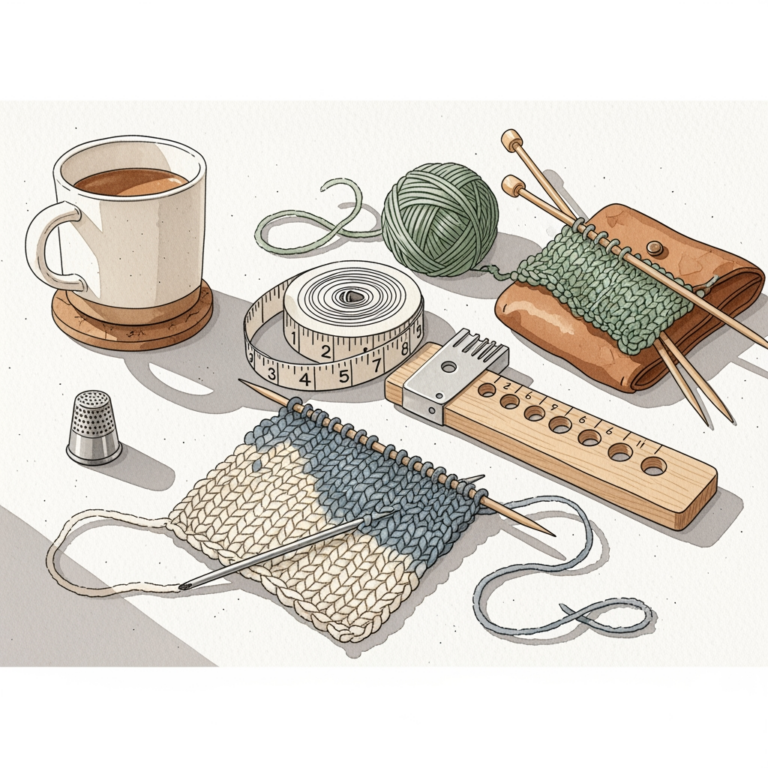
Advanced knitting requires more than just high-quality needles; it demands precision tools that assist with complex manipulation. A set of high-quality, locking stitch markers in different colors is essential for tracking pattern repeats and short-row turns. Having a range of sizes—from small for fingering weight to large for bulky—prevents the markers from distorting your stitches.
A dedicated row counter, either digital or manual, is indispensable for keeping track of long, complex pattern sequences. For those doing lace or steeking, a set of blocking pins and a flexible blocking mat are mandatory to force the fabric into its intended final dimensions. These tools turn a loose, puckered piece of lace into a sharp, professional-looking heirloom.
Lastly, keep a small, sharp pair of embroidery scissors and a set of tapestry needles with bent tips. The bent tip makes it significantly easier to weave in ends behind cables or within dense, stranded fabric. Investing in these small, professional-grade notions will streamline your process and elevate the quality of your finished work.
Selecting the right instructional literature is the first step toward mastering the intricate details that define professional-grade knitting. Whether you are cutting into a sweater with confidence or crafting an heirloom lace shawl, the mastery of these techniques lies in the balance between precision, material knowledge, and consistent practice.