6 Best Paper Storage Racks For Organized Supplies
Stop cluttering your workspace with piles of paper. Discover the 6 best paper storage racks to keep your supplies perfectly organized. Shop our top picks today!
Paper storage is often overlooked in the fiber arts studio, yet it is essential for keeping knitting patterns, schematics, and design sketches organized. Whether managing a library of vintage lace patterns or keeping a printed chart clean for a complex cables project, having an accessible system prevents lost documentation. Investing in quality storage keeps reference materials crisp and free from the creases that occur when papers are shoved into project bags. A well-organized workspace reduces stress, allowing for total focus on stitch tension and row counts.
We R Memory Keepers Trays: Best Stackable Pick


These stackable trays offer a modular solution for those with growing pattern collections. Because they nest securely, they minimize the footprint on a desk or craft table, making them ideal for small studio spaces where every inch is precious.
The sturdy construction handles heavy-weight cardstock, which is frequently used for printing colorwork charts or intricate cable instructions. When a project requires multiple reference sheets, these trays keep them flat and prevents edge curling.
Tradeoffs involve the footprint size, which is designed for standard 12×12 scrapbook paper. While excellent for oversized charts, they may feel like overkill if the goal is only to store standard letter-sized printouts.
Totally-Tiffany Paper Handler: Top Portable Choice

For the knitter who participates in local meetups or retreats, the Paper Handler provides a rigid, portable solution. This system excels at keeping patterns upright and accessible, mirroring the efficiency of a well-organized needle case.
It functions best for those who need to move between the living room and the dedicated craft room. By keeping instructions vertical, it eliminates the need to dig through loose stacks of paper while in the middle of a complex row.
The main consideration is the open-top design, which provides quick access but leaves patterns exposed to dust. Use this for active projects rather than long-term archival storage.
Scrapbook.com Clear Paper Trays: Best for Visibility
Clear acrylic trays allow for an instant inventory of what patterns or design sketches are currently in the queue. Visibility is crucial when working on multiple projects simultaneously, as it prevents the “out of sight, out of mind” issue that often leads to unfinished objects.
These trays are sleek and unobtrusive, blending well into any home aesthetic. They provide a rigid structure that prevents delicate paper edges from fraying, which is a common problem with thin, printed pattern PDFs.
Be mindful that acrylic can be brittle if dropped or handled roughly. If the workspace is chaotic or shared with pets, consider the long-term durability of clear plastic versus more robust molded options.
Advantus 12×12 Paper Holder: Great Budget Option
The Advantus holder is a cost-effective workhorse that provides essential organization without unnecessary features. It is the perfect choice for organizing printed stitch dictionaries or expansive sweater pattern collections.
The simple design is easy to clean and requires no assembly, making it a “buy once and forget it” tool. It serves the specific need of keeping paper flat and sorted by project type or difficulty level.
Because it lacks the bells and whistles of modular systems, it is best suited for stable, permanent placement. It will not offer the same portability as higher-end, handled storage options.
ArtBin Semi-Satchel: Most Versatile Organizer
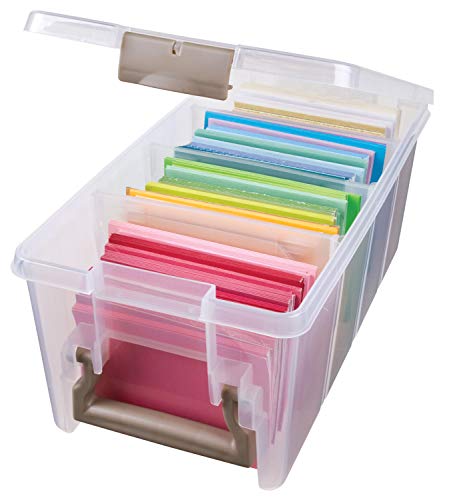
The Semi-Satchel stands out because it balances portability with high-capacity storage. It is essentially a secure vault for paper, protecting contents from the accidental spills or yarn fuzz that inevitably accumulate in a craft room.
Its interior dividers allow for custom categorization, such as grouping all “sock patterns” in one section and “cables and lace” in another. This level of granular control is perfect for those who maintain an extensive physical library of patterns.
The latch mechanism is secure, which prevents accidental opening during travel. However, the thickness of the case can be cumbersome, so ensure there is adequate shelf depth before purchasing.
IRIS USA Project Cases: Best for Project Kits
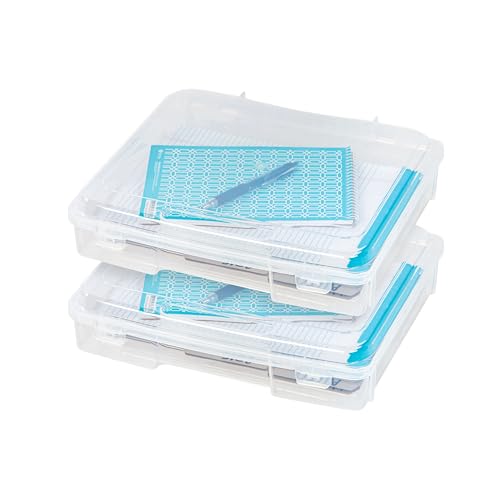
Project cases are arguably the best way to store a pattern alongside the relevant yarn, needles, and stitch markers. By placing a pattern inside an IRIS case, everything stays together, ensuring that the next time the project is picked up, no time is wasted hunting for the instruction sheet.
These are acid-free, which prevents the yellowing of vintage patterns or delicate sketches. This is a critical feature for knitters who collect historical patterns or hand-drawn schematics that they wish to preserve for years.
The shallow depth is perfect for a single project kit but may limit the amount of paper held per box. Use these to streamline the “queue” and keep active designs pristine.
How to Choose The Best Paper Storage For You
Start by auditing the current collection size and the frequency of use. If the library consists of hundreds of printed PDFs, modular stackable systems offer the best scalability.
Consider the environment in which the knitting happens. If the craft space is also a high-traffic family area, choose enclosed cases to protect against spills and dust. If the space is a dedicated, quiet studio, open trays provide faster, more convenient access.
Finally, prioritize material quality. Acid-free plastics are vital for long-term storage, while robust hinges are necessary for items that will be opened and closed daily.
Vertical vs. Horizontal Racks: Which Is Better?
Vertical storage acts like a bookshelf, allowing for a quick scan of labels or sheet protectors. This is generally more space-efficient and makes it easier to remove a single item without disturbing the rest of the stack.
Horizontal storage, or stacking trays, is better for deep, flat storage of large charts. This prevents the “droop” that can occur with heavy, oversized papers when stood on their ends.
Choose vertical for daily reference materials and horizontal for long-term archiving or delicate oversized designs. Mixing both approaches often creates the most functional studio workflow.
Organizing Knitting Patterns: A Simple System
A simple system begins with clear categorization by project type or garment size. Use colored tabs or labeled dividers to separate lace, colorwork, cables, and basic stockinette patterns.
Include a “notes” sheet in the front of each pattern to track needle sizes used, gauge achieved, and any modifications made to the original design. This transforms a simple printout into a valuable project log.
Keep current “on the needles” patterns in a separate, easily accessible location from the archives. This keeps the workspace clear and ensures that focus remains on the stitches in hand.
Protecting Paper From Light, Dust, and Pests
Direct sunlight is the enemy of paper, causing brittleness and fading over time. Always store paper-based materials away from windows to maintain the integrity of printed text and diagrams.
Dust acts as an abrasive, especially when paired with the natural oils from the hands of the knitter. Enclosed storage, such as the IRIS project cases, provides the best barrier against environmental contaminants.
Avoid storing patterns in basements or attics, as moisture invites silverfish and other pests that thrive on paper fibers. Keep the storage climate-controlled and elevated off the floor to ensure the longevity of a lifetime of knitting patterns.
An organized collection of patterns is as important to a successful project as the perfect yarn choice and the right needle material. By choosing the right storage solution, the focus can shift away from managing clutter and toward the meditative joy of the craft itself. Invest in a system that fits the current knitting pace, and the entire creative process will become significantly more efficient.