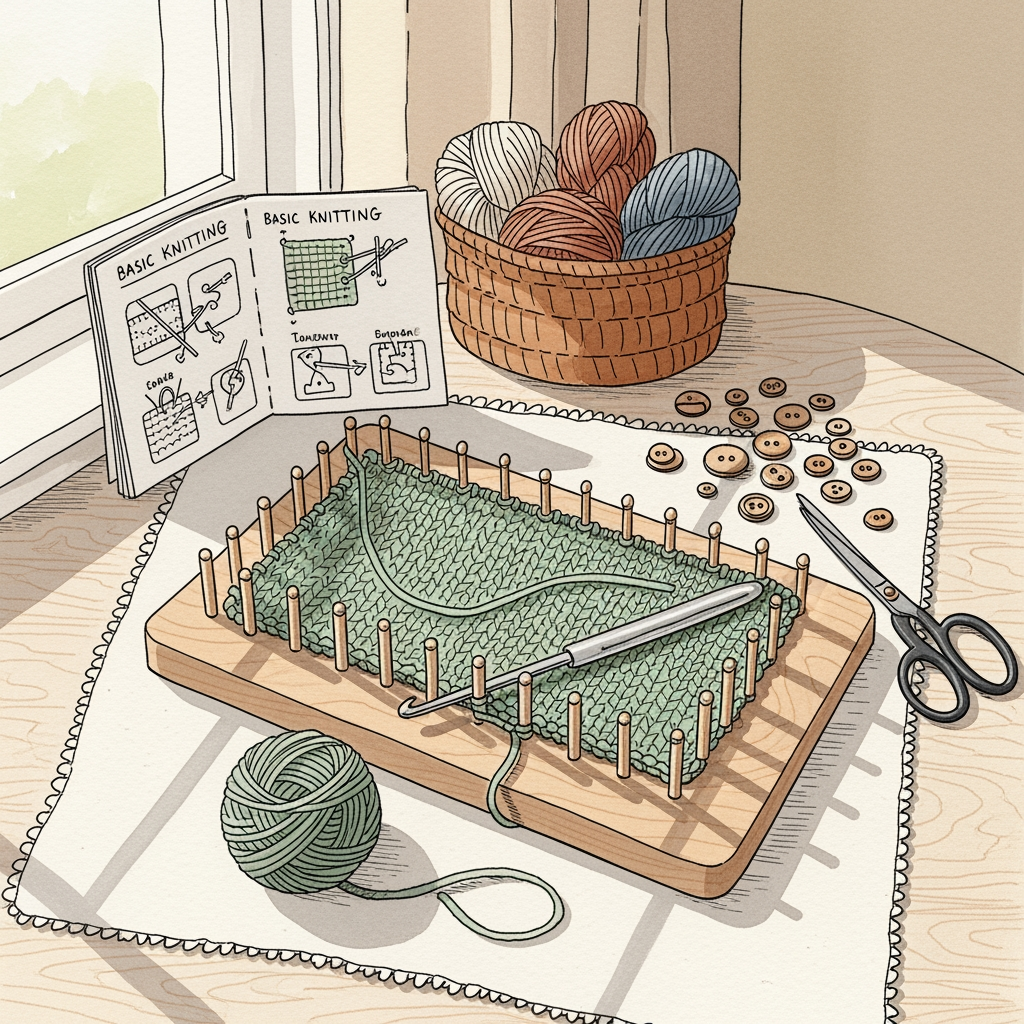
6 Best Knitting Looms For Fashion Accessory Design
Discover the 6 best knitting looms for fashion accessory design. Choose the perfect tool for your next creative project and start crafting professional pieces today.
Loom knitting offers a rhythmic, accessible entry point into fiber arts, transforming simple yarn into professional-grade garments without the steep learning curve of needles. Whether crafting intricate lace or sturdy winter wear, the tool itself dictates the tension, drape, and ultimate success of a project. Choosing the right loom requires balancing the structural needs of the design against the physical mechanics of the pegs. This guide explores the premier options available to help align your creative vision with the most effective equipment.
KB All-in-One Loom: Best for Versatile Design


The KB All-in-One Loom stands out as the ultimate multi-tasker for the designer who refuses to be pigeonholed into a single project type. Its adjustable configuration allows for the creation of everything from narrow scarves and hats to full-width blankets.
By shifting the slider settings, the loom accommodates various project widths, effectively acting as multiple looms in one package. This saves both storage space and budget, making it a staple for those who frequently transition between different accessory styles.
The tradeoff for this versatility is the setup time required to configure the sliding rails. It lacks the immediate sturdiness of a fixed-shape loom, meaning the rails must be securely tightened to prevent shifting during intensive work.
Bottom line: Choose this if you value flexibility over simplicity and plan to rotate between diverse projects regularly.
CinDWood Loom: Best Premium Accessory Loom

CinDWood looms are defined by their rock-solid construction, typically crafted from high-quality wood that provides a level of durability plastic alternatives cannot match. These looms offer a superior tactile experience, as the precision-turned pegs hold yarn securely without the snagging common in mass-produced molds.
For the serious designer, the consistency of these looms is unmatched. The peg spacing remains perfectly uniform, which ensures that stitch tension—the most critical element for professional-looking accessories—stays even across the entire project.
While the price point is significantly higher than plastic sets, the investment pays off in the longevity of the tool. These are professional instruments designed to handle high-tension projects without warping or peg breakage over years of use.
Bottom line: Invest in a CinDWood if you are a dedicated maker looking for an heirloom-quality tool that won’t require replacement.
KB Flexee Loom: Best for Custom Sized Projects

The KB Flexee Loom utilizes a unique interlocking link system that moves away from the traditional rigid frame. This allows for circular or flat knitting in virtually any circumference, offering unparalleled freedom for custom-fit designs.
Because each link can be added or removed individually, it is perfect for precise sizing requirements, such as custom-fit cuffs or headbands. If you struggle with standard loom sizes that always seem slightly too loose or too tight, the granular control here solves that problem entirely.
The primary disadvantage is the management of the links themselves, which can feel fiddly to assemble for those with dexterity issues. Additionally, the lightweight plastic requires a steady hand to keep the tension consistent, as the structure does not have the rigid weight of a wooden base.
Bottom line: This is the top choice for precise sizing where the standard “small, medium, large” options fall short.
Boye Round Loom Set: Best Budget Starter Kit
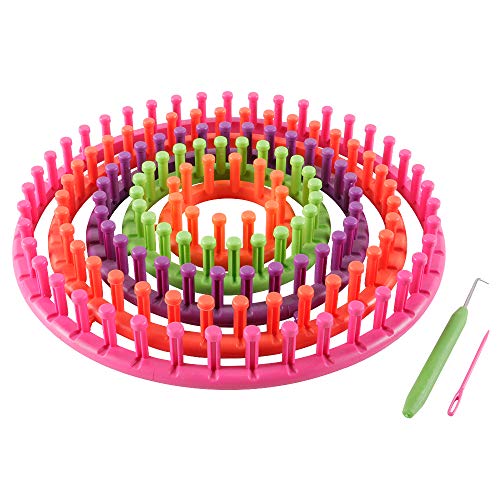
The Boye Round Loom set is an industry standard for a reason: it is affordable, widely available, and incredibly intuitive to use. These looms are the classic entry point for beginners who want to knit hats and cowls immediately without deciphering complex technical manuals.
These looms are forgiving, making them ideal for learning how to control yarn tension. While they lack the professional-grade precision of premium wooden looms, they are more than capable of producing high-quality wearable accessories.
The limitation of these sets is the fixed spacing and lack of adaptability for flat-panel knitting. They are best suited for round-work projects where the circumference remains constant, as they do not easily accommodate creative shaping or complex adjustments.
Bottom line: If you are new to the craft, start here to master the basics without a significant financial commitment.
KB Rotating Double Knit Loom: For Reversible Fabric

The KB Rotating Double Knit Loom is a specialized tool designed to create double-thick fabric that looks identical on both sides. By using two parallel rows of pegs, the loom creates a tube of fabric that acts as a natural insulator, perfect for heavy winter scarves and thick, structural cowls.
Because this loom stitches two layers simultaneously, the final accessory is exceptionally warm and avoids the “curling” effect common in single-bed, stockinette-stitch knitting. It effectively mimics the appearance of hand-knitted ribbing or double-knit patterns with significantly less effort.
The learning curve is steeper than a standard round loom, as the knitting process involves moving yarn between both the front and back rows. Precision is vital, as a single missed loop can ruin the structural integrity of the reversible fabric.
Bottom line: Choose this if your goal is high-performance, reversible cold-weather accessories that look professionally finished.
KB His & Her Sock Looms: Best for Making Socks
Sock knitting on a loom requires specific, fine-gauge spacing to ensure the fabric isn’t overly bulky or loose. The KB His & Her Sock Looms are engineered with tighter peg spacing to accommodate sock-weight (fingering) yarn, which is essential for creating footwear that actually fits inside a shoe.
These looms provide the necessary tension control for heel and toe shaping, which are the most technical parts of sock construction. The inclusion of an adjustable slider allows the user to change the gauge, providing a custom fit for different foot widths.
While these are designed for socks, they are also excellent for fingerless gloves and delicate lace cowls. However, the tighter spacing makes them slower to work than standard looms, requiring more patience and smaller yarn gauges.
Bottom line: Essential for those who want to transition from hats to fine-gauge garments like fitted socks.
How to Choose the Right Knitting Loom for You
Selecting a loom begins with identifying the final garment, as the shape of the loom determines the shape of the finished item. Consider whether the project is meant to be a flat piece, like a scarf, or a tubular piece, like a hat.
Always check the peg spacing (gauge). A tighter spacing is required for thinner, delicate yarns, while wider spacing works best with bulky or super-bulky wool.
- Fixed vs. Adjustable: Choose adjustable looms for multi-project utility.
- Material: Wood offers durability and grip; plastic offers affordability and ease of use.
- Peg Count: Ensure the loom has enough pegs to accommodate your intended project width.
Ultimately, your choice should reflect your knitting frequency and specific project goals. A casual hobbyist may find more value in a plastic set, while a boutique accessory designer will likely require the precision of a wooden system.
Understanding Loom Gauge and Yarn Weight
Loom gauge is the distance between the center of one peg to the center of the next. Matching your yarn weight to this gauge is the single most important factor in preventing “holey” fabric or fabric that is too stiff to drape.
For delicate lace or socks, use a fine-gauge loom with thin, high-twist yarns. If the yarn is too thick for the gauge, the project will be impossible to knit, as the pegs will be overcrowded and the yarn will snap or cause severe hand fatigue.
- Fine Gauge (Under 1/4 inch): Use fingering or lace weight yarn.
- Medium Gauge (approx. 3/8 inch): Use sport or DK weight yarn.
- Large Gauge (1/2 inch or larger): Use worsted, chunky, or super-bulky yarn.
If your swatch feels like armor rather than fabric, your yarn is too heavy for your chosen loom. Always err on the side of a lighter yarn when you are unsure, as it is easier to hold two strands together than it is to force a heavy yarn onto a tight-gauge loom.
Round vs. Long Looms: What’s the Difference?
The fundamental difference lies in the direction of the knit. Round looms are built for continuous circular knitting, which is perfect for items that do not require side seams, such as hats, cowls, and mittens.
Long looms, or rake looms, are designed for flat panels. They are the only choice for blankets, rectangular scarves, or the back-and-forth pieces required to assemble a sweater.
While some round looms can be used for flat knitting by working back and forth, they are rarely as ergonomic for this task as a dedicated long loom. If you primarily want to make garments that involve sewing pieces together, prioritize a high-quality long loom.
Bottom line: Choose based on seam preference; round looms eliminate them, while long looms allow for complex structural shaping.
Finishing Techniques for Loom Knit Accessories
Finishing is the difference between a homemade item and a professional accessory. The most vital technique is blocking, which involves wetting or steaming the finished piece and pinning it into the desired shape to even out stitches and set the dimensions.
For edges, learn the difference between a simple bind-off and a stretchy bind-off. A standard bind-off can be too tight, causing the brim of a hat or the edge of a scarf to pucker, whereas a looser bind-off maintains the natural elasticity of the knit.
- Blocking: Essential for natural fibers like wool to bloom and settle.
- Weaving Ends: Always weave ends in the direction of the knit for a seamless look.
- Matting/Pilling Prevention: Choose high-twist, smooth plied yarns for accessories that will see heavy wear.
Never skip the finishing steps. Taking the time to properly bind off and block a project will elevate the visual quality of the work significantly, ensuring it lasts through years of use.
Choosing the perfect knitting loom is an exercise in balancing your creative ambitions with the practical mechanics of the tool. Whether you prioritize the versatility of an all-in-one system or the specialized precision of a sock loom, the right equipment will make the difference between a project that stays in a drawer and one that becomes a wardrobe staple. Start with the project in mind, respect the requirements of your yarn, and enjoy the meditative process of building fabric one stitch at a time. With these tools and techniques as a foundation, you are well-equipped to master the art of loom knitting and create professional-quality accessories.