
6 Best Small Scale Irons For Lace Pressing
Discover the 6 best small scale irons for lace pressing to achieve crisp, professional results. Read our expert guide and find your perfect tool for crafting.
Blocking intricate lace requires a delicate touch that full-sized household irons often lack. Precision, weight, and consistent heat distribution determine whether a knitted garment reaches its full potential or suffers from flattened, lifeless stitches. Selecting the right small-scale iron transforms the final stages of a project, ensuring that yarn fibers bloom without being scorched. This guide explores the most effective tools for achieving professional, crisp results on your most delicate lace work.
Oliso M2 Pro: The Premium Crafter’s Choice


The Oliso M2 Pro stands out for its patented iTouch technology, which lifts the iron automatically when the handle is released. This feature is a game-changer for lace, as it eliminates the need to constantly stand the iron upright, preventing accidental scorching of delicate fibers like mohair or laceweight silk.
Its heavy, tapered soleplate provides enough weight to press down on blocking wires without constant manual pressure. The consistent heat settings ensure that temperature-sensitive fibers receive exactly the warmth required to relax the ply without destroying the fiber integrity.
While the price point is significantly higher than basic travel irons, the precision offered is unmatched for those who regularly block large, complex shawls. It is an investment in the longevity of the final product and the ease of the blocking process.
Dritz Petite Press: Best for Small Projects
The Dritz Petite Press is purpose-built for the narrow, awkward spaces often found in lace edging or small geometric patterns. Its small, pointed tip is ideal for pressing delicate points on a starburst lace motif without catching on neighboring loops.
Because it lacks the bulk of a standard iron, it allows for high-maneuverability when working on a blocking board. This is particularly useful when individual lace points need to be tugged into place and pressed down immediately to set their shape.
Be aware that this iron is best suited for targeted pressing rather than general steaming of an entire garment. It serves as an auxiliary tool for finishing touches rather than a replacement for a full-sized steam source.
Clover Mini Iron II: Top Pick for Detail Work
The Clover Mini Iron II is essentially a precision wand for fabric and yarn. It features interchangeable tips, including a slim, iron-like head that can navigate between the most intricate stitch patterns where a wider soleplate would simply overlap too much fabric.
It excels when dealing with lace that has been worked in thin, delicate yarns like fingering or cobweb weight. The smaller surface area ensures that only the intended stitches receive heat, leaving the surrounding yarn undisturbed.
If you enjoy knitting lace with complex 3D elements, this tool provides the control necessary to coax those stitches into their intended form. It is the closest thing to using a stylus to sculpt your knitting.
Sunbeam Hot-2-Trot: Best Budget Travel Iron
The Sunbeam Hot-2-Trot is a reliable entry-level option for those who do not want to spend heavily on specialized equipment. Despite its label as a travel iron, it performs surprisingly well for standard lace blocking because it provides a genuine, consistent steam output.
It hits the necessary temperatures for cotton or linen lace effectively, though it lacks the fine-tuned temperature sensors of higher-end models. Use it with caution on synthetics, as the heat can be aggressive if left stationary on the fabric for too long.
For the knitter who only blocks lace occasionally, this provides the best balance of functionality and affordability. It is a sturdy workhorse that performs the job without unnecessary bells and whistles.
Steamfast SF-717: Best Mini Steam Option
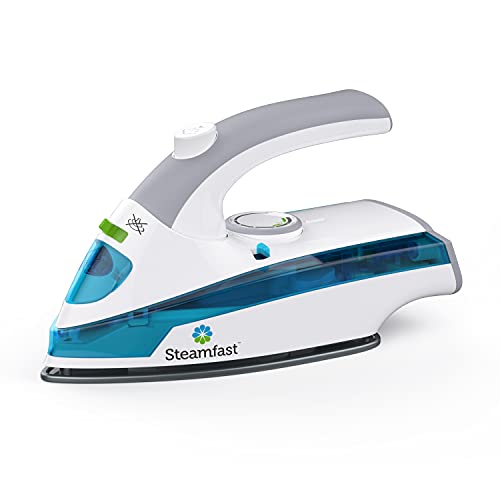
The Steamfast SF-717 is widely considered the gold standard for compact, steam-heavy blocking tools. It produces a significant volume of steam for its small footprint, which is crucial for hydrating fibers before they are pinned into place.
Many knitters find that the steam output is superior to larger irons, allowing for a deep “relaxing” of the yarn. This is essential for natural fibers like wool and alpaca, which need moisture to expand and reveal their true stitch definition.
Because it is small, the water reservoir is limited, meaning you will need to refill it during large projects. However, the performance in terms of steam consistency makes this a minor inconvenience for the quality of the finish.
Rowenta First Class: A Powerful Compact Iron
The Rowenta First Class bridges the gap between a travel iron and a professional garment press. It features a high-quality soleplate that glides effortlessly over yarn without snagging on the delicate lace “pico” or decorative eyelets.
The heat distribution is exceptionally even, a critical factor when working with protein fibers that might react differently to uneven surface temperatures. It provides enough steam power to act as a proper blocking assistant for medium-to-large shawls.
While larger than the other options on this list, it remains compact enough for most crafting kits. If you want one iron that handles both your regular sewing and your intricate lace projects, this is the most versatile choice.
What to Look for in a Lace Pressing Iron
When evaluating a tool for lace, ignore typical laundry-day features like self-cleaning cycles or extra-long cords. Instead, focus on the weight, soleplate shape, and temperature control.
- Weight: A slightly heavier iron helps set the lace without requiring you to apply excessive downward pressure, which can crush the loft of the yarn.
- Pointed Soleplate: A sharp, tapered tip is essential for reaching into the corners of intricate lace points and motifs.
- Steam Quality: Look for consistent, steady steam rather than bursts that may sputter water onto your delicate work.
- Temperature Stability: You need an iron that maintains a constant temperature to prevent sudden spikes that could singe silk or wool.
Avoid irons that do not have adjustable heat settings; one-size-fits-all heat is a fast track to ruining high-end luxury yarns.
How to Safely Steam Block Lace with an Iron
Steam blocking is not the same as ironing; never drag the iron across your knitting. Instead, use the “hover” method or a gentle press-and-lift motion to introduce heat and moisture without flattening the stitch structure.
Lay the lace piece flat on your blocking mat, pinning it to the desired dimensions with rust-proof stainless steel pins. Hover the iron about half an inch above the yarn, allowing the steam to penetrate the fibers and relax them into their pinned position.
If you must touch the yarn, use a press cloth, such as a thin cotton muslin, between the soleplate and your lace. This acts as a barrier, protecting the fiber from direct contact with the metal and preventing the dreaded “shiny spot” that occurs when animal fibers are overheated.
Heat Settings for Wool, Silk, and Plant Fibers
The fiber content of your lace dictates the temperature setting. Misjudging the heat can result in permanent damage, especially with delicate natural proteins or heat-sensitive synthetics.
- Wool/Animal Fibers: Use the lowest steam setting. High heat can cause felting or permanent loss of the fiber’s natural elasticity.
- Silk/Rayon: Use a cool, dry iron or a very light steam. Silk is notoriously prone to water spotting and burning, so a press cloth is mandatory here.
- Plant Fibers (Cotton, Linen): These fibers benefit from higher temperatures and stronger steam. They are more robust and require heat to help the yarn soften and settle into the pattern.
Always test your iron settings on a swatch before applying it to the finished garment. If in doubt, start lower and work your way up to the temperature required to bloom the yarn.
Iron vs. Steamer: Which is Better for Blocking?
A handheld steamer is excellent for refreshing a finished garment, but it often lacks the precision required for initial blocking. A steamer provides a broad, diffuse mist, which is wonderful for “waking up” yarn but doesn’t offer the structural control needed to pin-set a complex lace border.
An iron allows you to combine moisture with the precise, physical placement of stitches. By pressing gently near the pins, you are essentially “training” the fibers to hold their new shape once they cool.
Most expert knitters keep both tools in their arsenal. The iron is for the heavy lifting of the initial block, while the steamer is perfect for later maintenance and quick touch-ups before gifting or wearing.
Careful selection of your pressing tool ensures that hundreds of hours of knitting culminate in a piece that looks as professional as it feels. By prioritizing heat precision and steam quality, you elevate your lace from a simple knitted object to a structured work of art. May your stitches bloom beautifully in every project.

