6 Best Knotting Tweezers For Silk Cord Jewelry
Discover the 6 best knotting tweezers for silk cord jewelry to secure your designs with professional precision. Browse our top expert-rated tools and buy today.
Silk cord jewelry relies on the precision of each knot to maintain the drape and durability of the piece. When working with delicate natural fibers, the difference between a secure knot and a slipping one often comes down to the tool used to guide the cord. Choosing the right knotting tweezer prevents fraying, ensures consistent spacing, and protects the integrity of the silk. This guide explores the most effective tools to help achieve professional results in fine jewelry assembly.
Beadalon Knotter Tool: The All-In-One Classic


The Beadalon Knotter functions as a mechanical bridge between the bead and the cord. It is designed to take the guesswork out of spacing, effectively acting as a third hand during the knotting process.
This tool is particularly useful for those who struggle with maintaining uniform distance between beads on a strand. By capturing the cord precisely, it prevents the over-tightening that often leads to silk cord snapping or premature stretching.
While effective, this tool requires a learning curve. Expect to practice on scrap cord before moving to high-quality silk, as the mechanics can feel stiff for those accustomed to manual knotting.
The Beadsmith Knot-A-Bead: For Consistent Knots
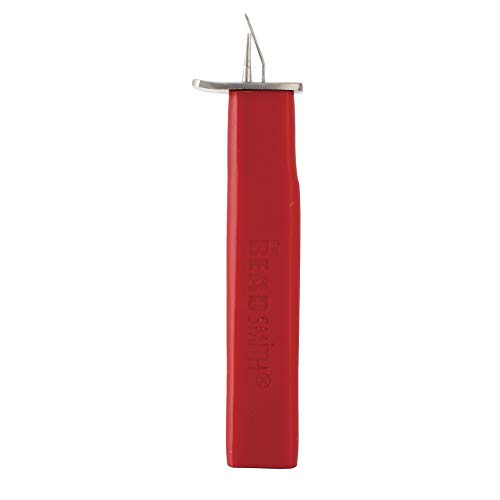
The Knot-A-Bead is built for makers who demand high-speed repetition without sacrificing uniformity. It features a specialized channel that guides the needle and cord, ensuring every knot sits exactly where intended.
This tool shines when producing multi-strand necklaces or long strands where knot spacing must be identical across dozens of beads. The internal mechanism holds tension steady, reducing the risk of uneven gaps that can make a piece look amateurish.
The trade-off is size; this is a desktop tool, not a portable accessory. If the workspace is limited, the footprint of this device may require clearing away other jewelry-making supplies.
Eurotool Knotting Tweezers: Best Budget Choice

Eurotool provides a straightforward, no-frills option that serves as a reliable workhorse. These tweezers are designed with a tapered, non-serrated tip, which is essential for working with silk without snagging the fibers.
Simplicity is the primary advantage here. There are no complex springs or levers to master, making these an excellent choice for a beginner who wants to build manual dexterity before investing in specialized hardware.
The lack of a complex mechanism means the user must provide the tension control. For those with steady hands, these offer the best tactile feedback of any tool on this list.
Griffin Silk Cord Tool: Made for Griffin Cord
Griffin silk is often sold pre-threaded on a needle, and this tool is engineered to interface directly with that system. It allows for tight, close-to-the-bead knotting that is difficult to replicate with generic tweezers.
The design emphasizes the protection of the cord’s finish. Because silk can lose its sheen if handled too roughly, this tool uses a specialized grip that minimizes friction while maximizing leverage.
This is a specialized investment. It is best suited for those who primarily use Griffin products, as the geometry may not be as effective when used with different brands of silk or nylon cords.
Xuron TweezerNose Pliers: The Precision Pro Pick
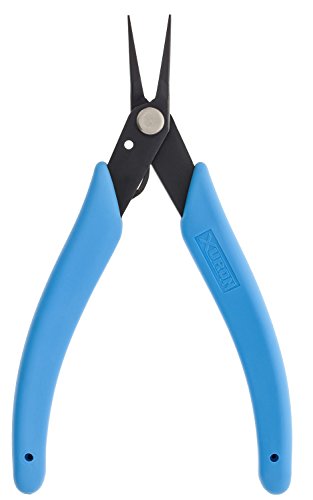
Xuron tools are widely respected for their ergonomic design and clean, precise action. While these are technically pliers, they are frequently used in the fiber arts for their ability to exert controlled pressure on fine knots.
The strength of the Xuron lies in the bypass cutter-style alignment of the tips. This ensures that the pressure is applied exactly where intended, allowing the user to cinch a knot down against a bead with surgical accuracy.
The handles are designed to reduce hand fatigue during long sessions. For makers prone to cramping, this ergonomic benefit is a significant upgrade over standard, straight-handled tweezers.
Beadsmith Cross-Lock Tweezers: Multipurpose Use
Cross-lock tweezers, or “reverse action” tweezers, remain clamped shut until the handle is squeezed. This feature is a game-changer for anyone who finds that holding a knot in place while tightening is physically straining.
These tools allow the user to lock the knot in the desired position and then release the hand to adjust the cord or move the next bead. It essentially removes the need to maintain constant finger pressure on the silk.
These are versatile tools that double as excellent holders for small components, such as crimp covers or tiny jump rings. They offer a great balance between dedicated knotting tools and general-purpose pliers.
How To Choose Your First Knotting Tweezers
Begin by identifying the weight of the silk cord being used. Thinner cords (Size 0 to 2) require smooth, high-precision tips to prevent damage, while thicker cords (Size 4 and up) can handle the slightly sturdier grip of pliers.
Consider the intended project volume. If the goal is a single piece of jewelry, a simple pair of precision tweezers is sufficient. If production runs are planned, the mechanical efficiency of an all-in-one tool becomes a worthwhile investment.
Finally, assess manual dexterity. Those who prefer tactile control should choose manual tweezers, whereas those who struggle with hand strain should prioritize spring-loaded or cross-lock models.
Tweezers vs. All-in-One Knotting Tools
Manual tweezers offer a direct connection to the material. This allows for nuanced adjustments and a “feel” for the tension that is often lost when using a mechanical device, which is vital when working with delicate, high-twist silk.
All-in-one tools provide consistency. They remove the human error factor, ensuring that the distance between every single bead is mathematically identical, which is the hallmark of professional-grade silk knotting.
The trade-off is cost and versatility. Mechanical tools are expensive and project-specific, while a good pair of precision tweezers can assist with knotting, threading, and general wire manipulation.
Getting Tighter Knots With Your New Tool
Tension management is the secret to a secure knot. Always use a toothpick or a fine needle to guide the knot as it tightens, using the tweezers only to finalize the position against the bead.
Avoid “stretching” the silk while knotting. If the cord is pulled too hard while the knot is being set, it will eventually slacken, leaving an unsightly gap between the knot and the bead.
Instead, create the loop, position it firmly against the bead with the tool, and draw the ends away from each other slowly. This ensures the knot sits flush without compromising the elasticity of the fiber.
Matching Your Tool to Silk Cord Thickness
Silk cord thickness is usually measured in standard sizes (0, 2, 4, 6, 8, etc.). A tool that works perfectly for a Size 2 cord will often be too clunky to seat a knot on a Size 0, while a tool for Size 0 may be too fragile for a heavy Size 8 cord.
Use the following guidelines for best results: * Fine cords (Sizes 00-2): Use non-serrated, ultra-fine point precision tweezers. * Medium cords (Sizes 4-6): Use cross-lock tweezers or standard knotting tools. * Heavy cords (Sizes 8+): Use robust tweezer-nose pliers with a reliable grip.
Always test the tool on a length of spare cord before beginning the final assembly. If the tool leaves indentations or crushes the silk fibers, it is likely too heavy-handed for that specific diameter.
Mastering the use of knotting tweezers transforms the often-tedious process of silk stringing into a rhythmic, rewarding experience. By selecting the tool that aligns with personal style and project requirements, clean and professional jewelry finishes become the standard. Take the time to practice with each tool, and the knots will soon be as secure as they are beautiful.