6 Best Swivel Bases For Yarn Cakes Worth Trying
Enhance your knitting with our top 6 swivel bases for yarn cakes. Discover how these smooth-spinning tools prevent tangles and improve your crafting efficiency.
Every knitter knows the frustration of a yarn cake that decides to tip over or roll across the floor mid-row. A quality swivel base transforms your winding and knitting experience by ensuring your yarn feeds consistently without catching or dragging. Choosing the right tool depends on your specific winding habits and the types of fiber you most frequently use. Here are six reliable options that will bring stability and ease to your fiber arts practice.
Stanwood Needlecraft Yarn Ball Winder Base


Stanwood has long been the gold standard for many home studios, and their winder bases reflect that reputation. These bases are built with a heavy-duty focus, designed to handle the torque generated by large, multi-strand cakes.
If you are a fan of winding your own gradient sets or bulky weight yarns, the stability here is unmatched. It minimizes the vibration that often causes cheaper winders to "walk" across your table during a long winding session.
The trade-off is the footprint; this isn’t a tool you can easily tuck into a small project bag. However, for the serious knitter who wants a consistent, professional-looking cake every time, it is a sound investment.
Knit Picks Yarn Swift and Ball Winder Base
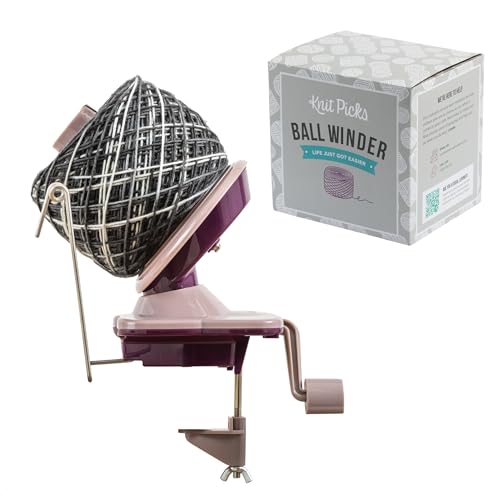
This setup is frequently the first "upgrade" for knitters moving beyond hand-wound balls. It is designed to work in tandem with their signature umbrella swift, creating a cohesive workstation.
The base provides a reliable pivot point that allows the yarn to flow freely without the tension spikes that lead to uneven gauge. When you are working with delicate lace-weight silk or mohair, this smoothness is essential to prevent fiber breakage.
Be mindful that this system works best when the components are properly aligned on a level surface. If your table is slightly uneven, you may find the rotation becomes sluggish, so keep a small shim handy just in case.
Lacis Yarn Ball Winder Swivel Accessory

Lacis offers a more specialized approach for those who already own a winder but need better rotation. This swivel accessory is a fantastic add-on that turns a stationary winder into a dynamic, free-rotating unit.
It is particularly useful for knitters who find that their yarn cakes collapse because they were wound too tightly. By allowing the cake to swivel as you pull, you reduce the internal tension that often causes the center of the cake to pull out prematurely.

This is a great "middle-ground" solution for someone who doesn’t want to replace their entire winder setup. It is compact, unobtrusive, and gets the job done without unnecessary bells and whistles.
Nostepinne Style Wooden Rotating Base

There is something deeply satisfying about using a wooden nostepinne-style base, especially for those who appreciate traditional tools. These bases rely on a simple, elegant pivot mechanism that feels more like an extension of your hands than a machine.
Because these are often handcrafted, they offer a tactile experience that plastic winders simply cannot replicate. They are ideal for delicate, hand-spun yarns where you want to maintain the integrity of the twist without mechanical interference.
The downside is that they require a bit more manual coordination to get a perfectly uniform cake. If you enjoy the meditative process of hand-winding your yarn, this is a beautiful and functional choice.
Nancy’s Knit Knacks Heavy Duty Spinner
When you are working with massive, one-pound cones of yarn, standard winders often buckle under the weight. This heavy-duty spinner is engineered for the production-level knitter who needs industrial-grade reliability.
It features a robust ball-bearing mechanism that ensures a smooth, silent spin regardless of how much yarn is left on the cone. This is a game-changer for those who knit large-scale items like afghans or sweaters where you don’t want to stop to re-center your yarn.
While it is certainly an investment, the longevity of this tool is impressive. It is built to last for decades, making it a "buy it once" item for your studio.
Fiber Artist Supply Co. Swivel Base
This base is a favorite among those who prioritize artisan-made equipment that looks as good as it performs. The craftsmanship is evident in the smooth rotation and the high-quality wood finish.
It is particularly effective at preventing the "yarn barf" that happens when a cake rolls over and pulls a knot from the center. The base is weighted perfectly to provide resistance without being difficult to spin.
If you have a dedicated knitting nook, this piece adds a professional touch to your setup. It is a perfect marriage of form and function for the discerning fiber artist.
Why Yarn Cake Stability Matters for Knitters
The stability of your yarn cake directly influences the evenness of your stitches. If your yarn catches or drags because the base isn’t spinning freely, you will inadvertently pull tighter on your needles.
This leads to "tension rowing," where your gauge fluctuates across the fabric. Over the course of a large project, these tiny inconsistencies become visible once the piece is blocked.
A stable base ensures that the yarn is delivered to your needles with consistent tension. This is especially critical when working with non-elastic fibers like linen or cotton, which don’t "hide" tension errors as well as wool.
How to Prevent Yarn Tangling During Projects
Even with the best base, how you orient your yarn cake matters. Always pull from the center of the cake, but ensure the cake itself is allowed to rotate freely on its base.
If you pull from the center and the cake stays stationary, you are adding a twist to every single loop of yarn. This can lead to your yarn becoming "cabled" or kinked, which ruins the drape of your finished fabric.
- Check the orientation: Ensure the cake isn’t sitting on its side.
- Clear the workspace: Keep other notions away from the rotation path.
- Monitor the center: If the "yarn barf" starts to pull out, gently tuck it back in before it creates a tangle.
Maintenance Tips for Your Yarn Winder Base
Most swivel bases are low maintenance, but they aren’t immune to dust and fiber debris. Over time, loose fibers can get caught in the ball bearings or pivot points, causing the rotation to become jerky.
Every few months, use a soft brush or a can of compressed air to clear out the base. If your base uses a metal bearing, a tiny drop of sewing machine oil can keep it spinning like new.
Avoid using harsh cleaners on wooden bases, as these can dry out the material and lead to cracking. A simple wipe-down with a slightly damp cloth is usually all that is required.
Essential Accessories for Smooth Yarn Flow
Beyond the swivel base, consider adding a few other tools to your station to improve your flow. A yarn tensioner or a simple yarn guide can help keep your yarn moving in a straight line toward your needles.
If you are working with multiple strands, a yarn bowl can act as a secondary stabilizer. It keeps the yarn contained while allowing it to feed smoothly into the winder or directly to your needles.
- Yarn Bowl: Keeps cakes from rolling away.
- Yarn Guide: Prevents tangles between the cake and your project.
- Non-slip Mat: Provides extra grip for the base on slick surfaces.
Investing in a quality swivel base is one of the quickest ways to elevate the quality of your finished hand-knits. By removing the physical struggle of managing your yarn, you free up your mental energy to focus on complex stitch patterns and tension control. Choose a tool that matches your volume of knitting and the types of fibers you love most. Happy knitting, and may your yarn always flow as smoothly as your stitches.