
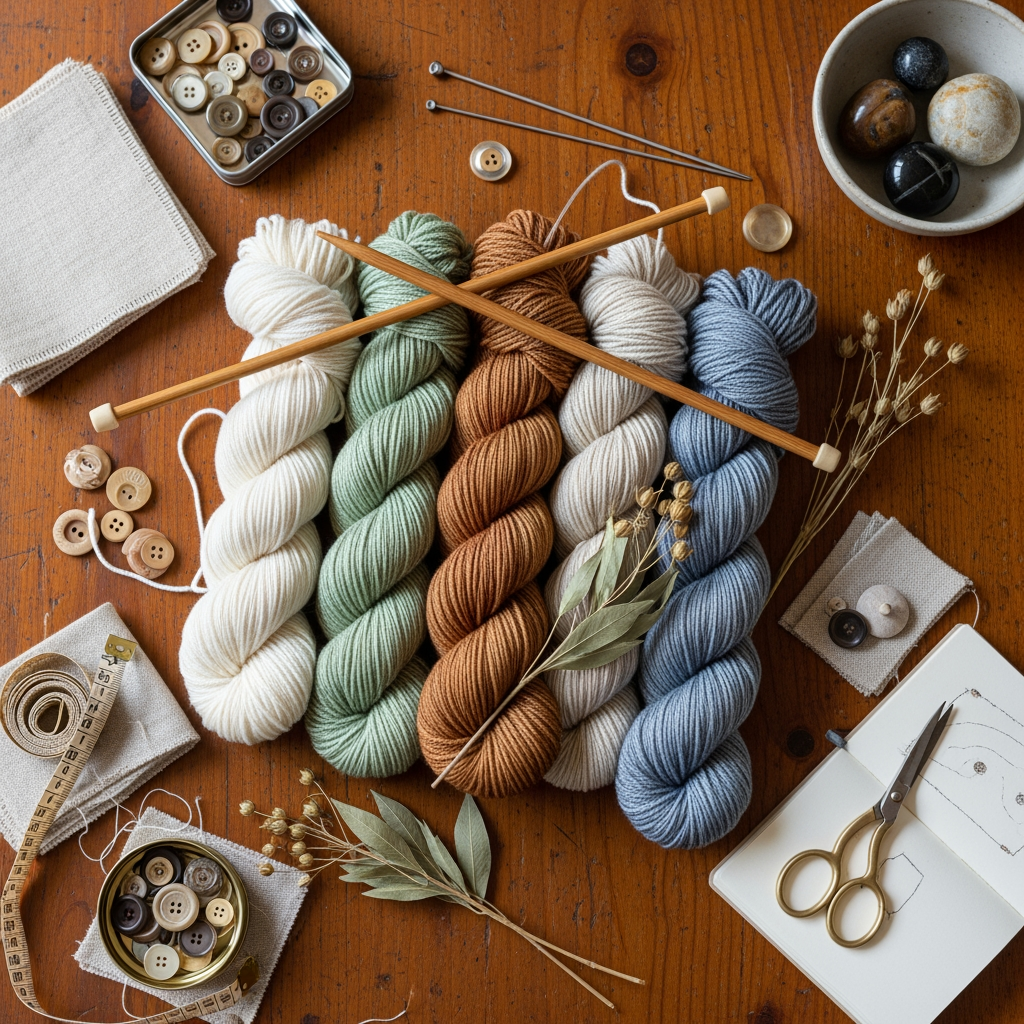
6 Best Cotton Yarn Hanks For Practice Swatches
Master your crochet or knitting skills with these six top-rated cotton hanks. Discover durable, affordable yarns perfect for creating flawless practice swatches.
Mastering a new stitch pattern requires a yarn that behaves predictably and shows off every loop with clarity. Cotton is the gold standard for practice because its lack of elasticity forces you to maintain consistent tension throughout your swatch. Choosing the right hank ensures that you are focusing on your technique rather than fighting the fiber. These six selections offer the best variety for developing your skills.
Pima Cotton by Knit Picks: Best Overall Choice


Pima cotton is renowned for its long staple length, which results in a smoother surface and less pilling than standard cotton varieties. When you are learning a new cable or lace motif, you need a yarn that won’t obscure the stitch definition with excess fuzz.
This yarn sits at a perfect middle ground for weight, making it versatile enough for almost any practice project. Because it is a plied yarn, it holds its structure well, allowing you to see exactly where your needle enters the stitch.
The trade-off here is that it can feel slightly firmer than wool, which might be a shock if you are used to springy animal fibers. For the best results, pair this with wooden needles to provide just enough grip to keep the stitches from sliding off too easily.
Lily Sugar’n Cream: Best Budget Cotton Option

If you are practicing a stitch that requires aggressive ripping and re-knitting, this is your best friend. It is an inexpensive, sturdy workhorse yarn that can handle being worked and unworked dozens of times without fraying.
The texture is quite rustic and can feel a bit stiff on the hands during long sessions. However, this rigidity is actually a benefit for beginners who struggle with loose, uneven tension.
Don’t expect the softest drape, as this yarn is designed for durability rather than luxury. Use it to master the fundamentals of increases and decreases where you need a yarn that stays exactly where you put it.
Rowan Handknit Cotton: Best for Stitch Texture

This yarn features a unique matte finish and a substantial weight that makes every stitch pop. It is an excellent choice for learning complex textures like bobbles, popcorn stitches, or intricate moss stitch variations.
Because it is a thicker, non-mercerized cotton, it has a distinct "grab" that helps keep your stitches aligned. This makes it much easier to spot a dropped stitch before it travels down several rows.
Be aware that the weight can lead to hand fatigue if you are not accustomed to working with heavier fibers. Take frequent breaks and focus on keeping your shoulders relaxed while you work through your practice swatches.
Scheepjes Catona: Best for Precise Colorwork
When you move into stranded knitting or intarsia, you need a yarn that is consistent in thickness and color saturation. Catona is a mercerized cotton, meaning it has undergone a process to make it stronger and more lustrous.
The mercerization gives the yarn a sleek, smooth finish that allows strands to glide past one another effortlessly. This is essential when you are managing two colors at once and need to prevent tangling.
Because it is a finer weight, it is perfect for creating small, portable swatches that you can carry in your bag. It is also remarkably resistant to splitting, a common frustration when learning to carry floats across the back of your work.
Blue Sky Fibers Organic: Best Soft Cotton Feel
Not all cotton has to feel like a dishcloth, and this organic option proves that luxury and practice can coexist. If you find that the stiffness of other cottons discourages you from practicing, this is the remedy.
It has a soft, almost velvety hand that makes the process of knitting feel indulgent rather than like a chore. This is the ideal choice for swatching stitch patterns intended for baby garments or lightweight summer tops.
The trade-off for this softness is that it can be slightly more prone to splitting if you are a fast, aggressive knitter. Focus on using a needle with a slightly blunter tip to help guide the yarn cleanly through each loop.
Cascade Yarns Ultra Pima: Best for Easy Stitching

This yarn is a dream for those who are just starting to experiment with tension control. It is incredibly smooth and has a subtle sheen that makes it easy to read your knitting, even in low light.
The consistency of the twist means that your stitches will look uniform even if your tension is still developing. It is a forgiving fiber that doesn’t punish the knitter for minor variations in loop size.
If you find yourself struggling with "rowing out"—where your purl rows look different than your knit rows—this yarn will help you identify the issue quickly. It is a reliable, high-quality staple that belongs in every knitter’s stash.
Why Cotton Is Ideal for Learning New Stitches
Cotton is a non-elastic fiber, which means it does not "bounce back" the way wool does. While this can be challenging for garments, it is perfect for learning because it provides immediate, honest feedback on your tension.
If your stitches are uneven, the cotton will show it clearly, allowing you to adjust your grip or needle size in real-time. Wool often masks these minor inconsistencies through its natural ability to bloom and fill in gaps.
By training your hands on cotton, you are effectively "leveling up" your muscle memory. Once you return to more forgiving fibers, your tension will be noticeably more balanced and professional.
How to Properly Wash Your Cotton Practice Swatches
Cotton swatches should be washed to see how the fabric behaves after the manufacturing oils are removed. Fill a basin with lukewarm water and a gentle wool wash, then let the swatch soak for about fifteen minutes.
Gently squeeze the water out—never wring or twist the fabric, as this can distort the stitches. Lay the swatch flat on a towel, roll it up like a sleeping bag to absorb excess moisture, and then unroll it to air dry.
This process is critical for understanding the "drape" of your chosen stitch pattern. Cotton tends to grow slightly when wet, so washing your swatch is the only way to know the true final size of your project.
Understanding Fiber Memory in Cotton Yarn Types
Fiber memory refers to a yarn’s ability to return to its original shape after being stretched. Cotton has almost zero memory, which is why it is prone to sagging in large garments.
When practicing, keep this in mind: your swatch will show you the "worst-case scenario" for your stitch pattern. If a lace pattern looks good in cotton, it will look spectacular in a fiber with more elasticity like wool or alpaca.
Treat your cotton swatches as a stress test for your stitch patterns. If the pattern holds its shape well in cotton, you can be confident it will be a success in almost any other fiber.
Tips for Preventing Hand Fatigue With Cotton Yarn
Because cotton lacks the natural "give" of animal fibers, it can be taxing on the small muscles in your hands. To combat this, try switching to ergonomic needles with a cushioned grip.

Pay attention to your knitting style; if you are a "tight" knitter, move up one needle size to compensate for the lack of fiber elasticity. This small change can make a massive difference in how much pressure you apply to your joints.
Finally, incorporate simple hand stretches into your knitting routine. A few minutes of wrist rotations and finger extensions between swatches will keep you knitting comfortably for years to come.
Choosing the right cotton yarn for your practice swatches is an investment in your growth as a knitter. By selecting a fiber that matches your specific learning goals, you turn every swatch into a valuable lesson. Keep your needles clicking, stay curious about how different fibers behave, and remember that every stitch is a step toward mastery. Happy knitting!
