6 Best Knit Stitch Counters for Cable Work to Use
Mastering complex cable patterns requires precision. We review the 6 best knit stitch counters to help you track rows accurately and simplify your craft.
Cable knitting is a beautiful, structural art form that demands absolute precision to maintain the integrity of your pattern’s repeat. Losing your place in a complex cable chart can lead to hours of tedious tinking, making a reliable row counter an essential part of your toolkit. Whether you prefer a tactile clicker or a high-tech wearable, the right tool acts as your safeguard against common mistakes. Here are six top-tier row counters that will help you keep your stitches organized and your cables perfectly aligned.
Knitter’s Pride Rainbow Row Counter: Best Overall
This counter is a staple in many project bags because it strikes the perfect balance between simplicity and functionality. Its vibrant, color-coded design makes it easy to spot even in a cluttered workspace, while the smooth dial movement prevents accidental clicks.


The primary advantage here is the consistent tension of the dial. Unlike cheaper plastic models that may spin freely, this counter stays exactly where you set it, even if it gets tossed into your knitting bag between sessions.
If you are working on a multi-part cable project, the clear, legible numbers are a lifesaver. It is a straightforward, no-nonsense tool that does exactly what it promises without requiring a manual.
Clover Kacha-Kacha Click Counter: Most Reliable

The "Kacha-Kacha" is legendary among knitters for its satisfying, audible click that confirms your row has been recorded. This tactile feedback is vital when you are deep in a cable repeat and don’t want to look down at your hands.
Reliability is its core feature, as the locking mechanism is exceptionally robust. You won’t find yourself wondering if you actually advanced the counter or if your thumb just grazed the button.
This is the ideal choice for knitters who suffer from "counter anxiety"—the fear that they’ve accidentally bumped their counter and lost their place. It is a sturdy, dependable workhorse that withstands years of heavy use.
Cocoknits Maker’s Keep: Best Wearable Solution
This is more than just a counter; it is a magnetic wristband that keeps your essential tools within reach. By incorporating a small, sliding row counter onto a wrist-mounted magnet, you eliminate the need to hunt for your counter on the couch or under your pattern.
For knitters who move around or work on large blankets, having the counter literally attached to your body is a game-changer. It keeps your workflow fluid, allowing you to track rows without putting your needles down.
The trade-off is the initial investment, as it is a premium accessory. However, for those who value ergonomics and organization, the seamless integration into your knitting rhythm is well worth the price.
Susan Bates Digital Ring Counter: Easiest to Read

Digital counters are fantastic for those who struggle with small, printed numbers on manual dials. The Susan Bates digital ring counter sits comfortably on your finger, allowing you to check your row count with a quick glance at the LCD screen.
The large display is particularly helpful if you are knitting in low light or working with dark-colored yarns that strain the eyes. You simply press the side button to advance, and the screen resets with a clear, tactile push.
Keep in mind that digital counters rely on batteries, which can eventually die. It is always wise to keep a spare battery in your knitting kit so you aren’t left guessing your row count mid-project.
Boye Plastic Dial Counter: Best Budget Friendly
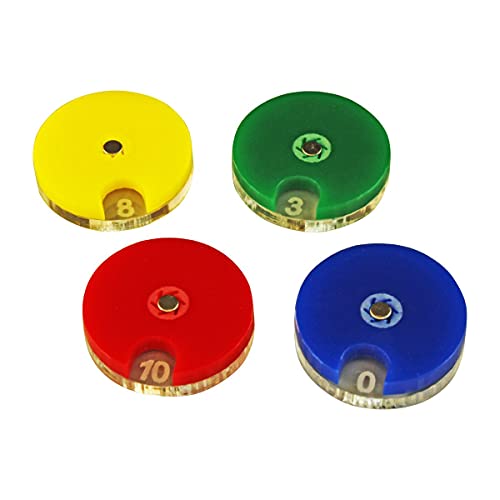
If you are just starting your journey into cable knitting, you don’t need to break the bank to get accurate tracking. The Boye plastic dial counter is an affordable, lightweight option that attaches directly to your knitting needle.
Because it sits on the needle, it is always right there as you work. It is particularly useful for circular knitting, where you are constantly moving around the circumference of the project.
While the plastic construction is less durable than metal alternatives, it is perfectly adequate for most projects. It is a humble tool that gets the job done without any unnecessary bells or whistles.
ChiaoGoo Needle Gauge Counter: Best Dual Purpose

This tool is a brilliant space-saver, combining a needle gauge with a manual row counter. When you are working on a project that requires multiple needle sizes or you are prone to losing your tools, this two-in-one solution is incredibly practical.

The row counter dial is integrated into the gauge, making it sturdy and easy to manipulate. It is excellent for knitters who prefer to keep their kit minimal and organized.
Because it is a bit bulkier than a simple ring counter, it works best for people who keep their tools on a table rather than in a pocket. It is a smart, multifunctional investment for the organized maker.
Why Cable Knitting Requires Precise Row Tracking
Cables are essentially stitches being rearranged in a specific sequence over a set number of rows. If you miss a row or add an extra one, the entire twist of the cable will look distorted or "off" compared to the rest of the fabric.
Unlike stockinette stitch, where a mistake is easily spotted and corrected, cable errors often require you to rip back to the very start of the cable cross. This can mean losing hours of progress, which is why a counter is not a luxury, but a necessity.
Consistent tracking allows you to trust your work. When you know exactly which row of the chart you are on, you can knit with confidence and speed, knowing the final result will be symmetrical and professional.
How to Choose the Best Counter for Complex Cables
When selecting a counter, consider your personal knitting environment. If you usually knit in a quiet, stationary chair, a table-top counter might work fine; if you knit on the go, a wearable or needle-mounted counter is superior.
Think about your "knitting personality." Are you someone who forgets to click the counter, or someone who clicks it twice by accident? If you are forgetful, a wearable counter that stays on your wrist is a constant visual reminder to track your progress.
Finally, consider the complexity of the cable chart. If your project involves multiple different cable types occurring on different row frequencies, you might even benefit from using two counters simultaneously to track different sections.
Digital vs. Manual Counters: Which Suits You?
Manual counters are favored for their simplicity and lack of reliance on batteries. They offer a satisfying mechanical feel that many knitters find comforting, and they are generally very durable over the long term.
Digital counters excel in visibility and ease of use. They are perfect for knitters who find tiny dials difficult to read or manipulate, especially if you have arthritis or limited dexterity in your fingers.
The choice ultimately comes down to your comfort level with technology versus traditional tools. Neither is objectively "better," but the one that ensures you actually remember to track your rows is the one that will make you a better knitter.
Essential Tips for Tracking Rows in Cable Charts
- Always click at the same time: Make it a habit to click your counter immediately after finishing a row, before you even put your needles down.
- Use a highlighter: If you are using a paper chart, keep a highlighter or a magnetic chart keeper board to mark your place in addition to the row counter.
- Verify with the fabric: Occasionally, count the number of rows between your cable crosses to ensure your counter matches the physical reality of your knitting.
- Reset with care: Always double-check your counter before starting a new project to ensure it is set to zero.
Tracking your rows is the secret to moving from "learning" cables to mastering them with ease. By choosing a counter that fits your personal knitting style, you remove the guesswork and allow yourself to focus on the rhythm of the work. Remember that even the best tools are only as effective as the habits you build around them. Happy knitting, and may your cable crosses always be perfectly aligned.