7 Best Swivel-head Stitch Markers for Snag-free Knitting
Discover the 7 best swivel-head stitch markers for seamless, snag-free knitting. These essential tools prevent yarn damage while keeping your rows organized.
Few things disrupt the rhythmic flow of a complex lace project like a stitch marker that catches on your yarn. As a knitter, your tools should be invisible facilitators of your craft, not obstacles that force you to stop and untangle. Investing in high-quality swivel-head or snag-free markers is the simplest way to protect your delicate fibers and maintain your tension. Here are seven top-tier options to keep your needles moving smoothly through every row.
Cocoknits Colorful Nylon Stitch Markers


These markers are a staple in my knitting bag because they are incredibly lightweight and flexible. Because they are made of nylon, they won’t leave permanent indentations on your needles, which is a common issue with heavier metal rings.
The primary benefit here is the seamless design. Since there is no metal seam or sharp edge, you don’t have to worry about your yarn fibers snagging as you transition from the marker to the next stitch.
They are particularly excellent for those working with fine, splitty yarns like silk or high-twist merino. If you are struggling with markers that feel "heavy" or drag on your needles, these nylon rings will feel like they aren’t there at all.
Clover Locking Stitch Marker Set Review

Clover’s locking markers are the industry standard for a reason, specifically for marking the beginning of a round or identifying specific pattern repeats. They function like a tiny safety pin, which keeps them securely anchored in your fabric.
The "locking" mechanism is robust, meaning they won’t pop open mid-row and disappear into your project. However, because they are plastic, they are gentle on your fingers and won’t snag on your yarn like a cheap metal safety pin might.
These are essential for complex colorwork or cables where you need to track your progress over many inches. Just be mindful that the plastic can occasionally catch on very fuzzy mohair; in those instances, make sure the locking tab is fully clicked into place.
Knitter’s Pride Mindful Collection Markers

The Mindful Collection is designed with a focus on ergonomics and aesthetic calm, which translates well into their marker sets. These are often metal-based, making them feel sturdy and substantial in your hand without being bulky.
What sets these apart is the smooth, rounded finish on the metal. They glide over bamboo and metal needles with equal ease, reducing the friction that often leads to hand fatigue during long knitting sessions.
I recommend these for knitters who appreciate a more "premium" feel to their tools. While they are slightly heavier than nylon, they are perfectly balanced for most worsted or aran-weight projects where a little weight helps keep the marker in place.
Tulip Heart-Shaped Swivel Stitch Markers
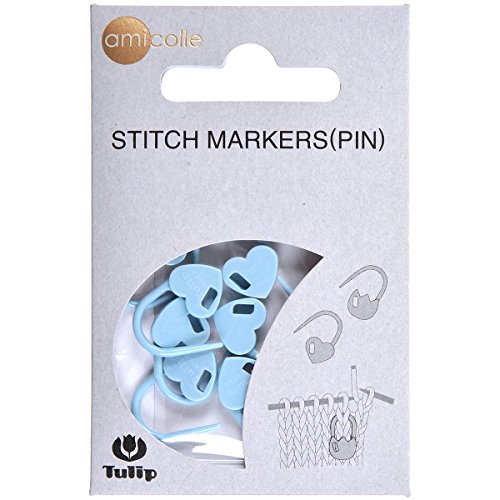
Tulip is famous for their precision engineering, and these heart-shaped markers are no exception. The swivel feature is the star here, as it allows the marker to rotate freely as you knit, preventing the yarn from twisting around the ring.
The heart shape isn’t just for aesthetics; it provides a natural grip for your fingers when you need to move the marker from the left needle to the right. It’s a subtle ergonomic advantage that saves time during rapid-fire row repeats.
These are a fantastic gift for yourself or a fellow knitter who struggles with dexterity. They are exceptionally smooth and work well with almost any needle material, from slick nickel-plated tips to grippy wooden ones.
Katrinkles Wooden Swivel Stitch Markers

For those who prefer natural materials, Katrinkles offers beautiful wooden markers that feel warm and organic. Wood has a unique property: it doesn’t conduct heat or cold the way metal does, making it very comfortable for long sessions.
The swivel mechanism on these is expertly integrated, ensuring that the marker doesn’t snag on the join of your circular needles. They are incredibly lightweight, which is a huge plus when you are knitting a large sweater and don’t want the extra drag of heavy metal markers.
Keep in mind that wood can be slightly more porous than metal, so avoid getting them wet or leaving them in a damp project bag. They are best suited for wool or plant-based fibers that aren’t overly abrasive.
DPN-Friendly Susan Bates Split Markers

If you work primarily with double-pointed needles (DPNs), you know the frustration of markers falling off the ends. Susan Bates split markers are designed to slide onto the needle and stay put, or be placed into a stitch to mark a specific location.
The "split" design allows you to remove them mid-row without having to knit to the end of the round. This is a lifesaver when you realize you’ve made a mistake and need to drop down to fix a stitch.
These are a classic for a reason: they are simple, effective, and nearly indestructible. While they lack a fancy swivel, their low profile makes them a "set it and forget it" tool for sock knitters and mitten makers.
HiyaHiya Assorted Locking Stitch Markers
HiyaHiya is a brand that understands the mechanics of circular knitting better than most. Their locking markers are small, unobtrusive, and come in a variety of bright colors that make them easy to spot against dark yarns.
The locking mechanism is thinner than the Clover version, which makes them ideal for tight gauges where you don’t have much room to maneuver. They lock securely but open with a gentle squeeze, which is helpful if you have limited grip strength.
These are the ones I reach for when I’m working on intricate lace patterns. They are small enough that they won’t distort your stitch gauge, yet strong enough to stay in place through hundreds of rows of movement.
Why Swivel Features Prevent Snagging Issues
The primary cause of snagging is a marker that stays rigid while the yarn moves around it. When a marker doesn’t swivel, the yarn can get caught in the "neck" or the join of the marker, leading to pulled stitches and frustration.
A swivel-head marker acts like a ball-and-socket joint, allowing the ring to rotate as the needle passes through the stitch. This dynamic movement ensures that the marker is always oriented in the path of least resistance.
By reducing the tension at the point of the marker, you also prevent those annoying "laddering" effects that happen when a marker forces the yarn to stretch too far. It’s a small mechanical change that yields a much cleaner, more professional-looking fabric.
How to Choose the Right Size for Your Needles
Choosing the wrong size marker is the most common mistake knitters make. If your marker is too small for your needle, it will sit tightly against the shaft, creating unnecessary friction and slowing down your knitting speed.
Conversely, if the marker is too large, it can get tangled in your yarn overs or create an uneven tension at the point where the marker sits. A good rule of thumb is to choose a marker that is at least 1-2mm larger than the diameter of your needle.
If you are a tight knitter, lean toward a slightly larger, smoother marker to compensate for your tension. If you are a loose knitter, a smaller, more snug-fitting marker can help keep your stitch definition consistent.
Tips for Organizing Your Stitch Marker Collection
Stitch markers have a habit of disappearing into the abyss of a knitting bag. I keep mine in a small, compartmentalized tin, separated by type: locking, fixed-ring, and swivel.
Labeling your containers by size is also a game-changer. I use a simple permanent marker on the bottom of my tins to note the maximum needle size each marker can accommodate, which saves me from testing five different rings before finding the right fit.
Finally, keep a "go-bag" set of your favorites. Having a small, portable tin with a mix of locking and ring markers ensures you are always prepared, whether you are casting on at home or finishing a project in a coffee shop.
Finding the perfect stitch marker is a journey of trial and error, but it is one that pays dividends in the quality of your finished work. By prioritizing swivel features and proper sizing, you eliminate the mechanical friction that often turns a relaxing hobby into a chore. Experiment with these seven options to find the ones that best complement your unique knitting style and fiber preferences. Happy knitting, and may your needles always glide through your projects with ease.