7 Best Felted Project Kits For Beginners To Try
Discover the joy of needle felting with these 7 beginner-friendly kits. Learn essential techniques and create unique crafts with our curated expert picks.
Needle felting is the sculptural cousin to knitting, transforming loose wool fibers into dense, three-dimensional art using only a barbed needle. Much like choosing the right needle size for your yarn weight, selecting a beginner kit requires balancing ease of use with the quality of your materials. These seven kits offer a structured entry point into the craft, helping you master the fundamentals of fiber manipulation. Whether you are looking for a quick weekend project or a new creative hobby, these selections will set you up for success.
Dimensions Needle Felting Kit: Best for Beginners


Dimensions kits are the standard-bearers for craft store accessibility, and for good reason. They provide a highly structured, step-by-step experience that mirrors following a well-written knitting pattern for the first time.
The included instructions are incredibly granular, which is vital when you are learning how to gauge the "density" of your felt. Just as you might struggle to achieve the correct stitch gauge on your first sweater, beginners often under-felt their projects. These kits prevent that by providing clear visual milestones.
The tradeoff here is the quality of the wool and the needles. The fiber is often a bit coarser than boutique options, and the needles may dull faster, but they are perfectly serviceable for learning the mechanics. If you want a low-stakes way to see if you enjoy the rhythmic motion of felting, this is your starting point.
Woolbuddy Animal Felting Kit: Easiest to Follow

Woolbuddy kits excel because they prioritize the "sculpting" phase over complex assembly. They focus on simple, geometric shapes that you then join together, which is conceptually similar to knitting a hat in the round versus knitting flat and seaming.
The wool provided is generally softer and easier to manipulate than mass-market craft store brands. This makes the "tacking" process—where you first bind the loose fibers—much faster. You won’t spend hours fighting with fibers that refuse to mat.
If you are a knitter who prefers the ease of a simple garter stitch project, you will appreciate the straightforward nature of these kits. They remove the intimidation factor of free-form sculpting. The bottom line: this kit is for the maker who wants a guaranteed cute result without the headache of complex shapes.
Bear Creek Felted Soap Kit: A Practical Project

Felting soap is a brilliant bridge for knitters because it utilizes the same principles as fulling a knitted wool garment. You are essentially using friction and water to shrink and lock the wool fibers around a bar of soap.
This is a fantastic "functional" project. Unlike a decorative figurine that might collect dust, a felted soap bar is a useful item that improves with use. It acts as a gentle exfoliant, and the wool helps the soap last longer.
The kit provides everything you need to understand how fibers behave when wet. It’s an excellent lesson in fiber density and shrinkage, concepts that are crucial if you ever plan to felt your own knitted wool bags or slippers. It’s a messy, tactile, and thoroughly satisfying process.
Felted Sky Starter Kit: Best Wool Quality Tools

When you move from cheap needles to high-quality tools, the difference is as stark as switching from plastic needles to smooth, polished carbon fiber. Felted Sky offers a premium experience that respects the integrity of the wool.
The needles included are generally sharper and more durable, meaning you experience less resistance when piercing the fiber. If you have ever used a blunt needle on a tight cable project, you know how much extra force is required; these needles eliminate that strain.
The wool is high-quality, allowing for a much smoother finish. If you are serious about pursuing felting, invest in this kit. It avoids the frustration of broken needles and patchy, uneven textures that often plague cheaper starter sets.
Hamanaka Felted Mascot Kit: Best for Precision

Hamanaka is a Japanese brand that emphasizes the "kawaii" aesthetic with incredible attention to detail. These kits are for the knitter who loves the precision of lace work or intricate cables where stitch count is everything.
The wool is exceptionally fine, allowing for tiny, delicate details that other kits simply cannot achieve. You will be working with small amounts of fiber, requiring a steady hand and a light touch. It is very much like working with lace-weight yarn on tiny needles.
Be warned: this kit requires patience. If you are the type of crafter who likes to finish a project in an hour, this might feel too tedious. However, if you enjoy the meditative precision of a complex colorwork chart, you will find this deeply rewarding.
Living Felt Beginner Kit: Best Value for Money

Living Felt provides a comprehensive kit that feels like a professional toolkit rather than just a hobby box. It includes a variety of wool types, which is essential for learning how different breeds of sheep behave under the needle.
Think of this like a "yarn sampler" for felting. You get to feel the difference between coarse, sturdy wool and soft, fine roving. This is a critical education for any fiber artist, as understanding your material is the key to selecting the right fiber for the right project.
The value proposition here is unmatched for the amount of material you receive. You won’t run out of wool halfway through, which is the most common frustration with smaller kits. It is a robust, well-thought-out collection for the serious beginner.
Crafty Wool Felted Ornament Kit: Quick Results
Sometimes you just want a quick win, much like knitting a simple headband between larger, more daunting projects. These ornament kits are designed for speed and immediate gratification.
They rely on simple shapes and basic color blocking. Because they are meant to be ornaments, they don’t require the structural integrity of a toy or a garment, which means you can finish them in a single sitting.
These are perfect for practicing your needle angles without the pressure of a complex design. If you are a beginner, use these to build muscle memory before moving on to more intricate, multi-part sculptures. They are low-risk, high-fun projects.
Understanding Wool Fibers for Felting Success
Not all wool is created equal, and understanding fiber properties is just as important as knowing your yarn weight. For felting, you generally want wool that has "scales" on the fiber surface, which allow the fibers to lock together when agitated or pierced.
- Corriedale: A great all-around wool that is sturdy and holds its shape well.
- Merino: Extremely soft but can be "fussy" to felt because the fibers are so fine and slippery.
- Batts vs. Roving: Batts are carded into a chaotic cloud, making them easier to felt quickly, while roving is combed into parallel lines, which is better for spinning or specific sculptural textures.
If you are struggling to get your project to firm up, your fiber might be too "slick." Try blending in a bit of a coarser wool to provide more "grip." Much like adding a strand of mohair to a yarn for strength, mixing fibers can solve structural issues in your felting work.
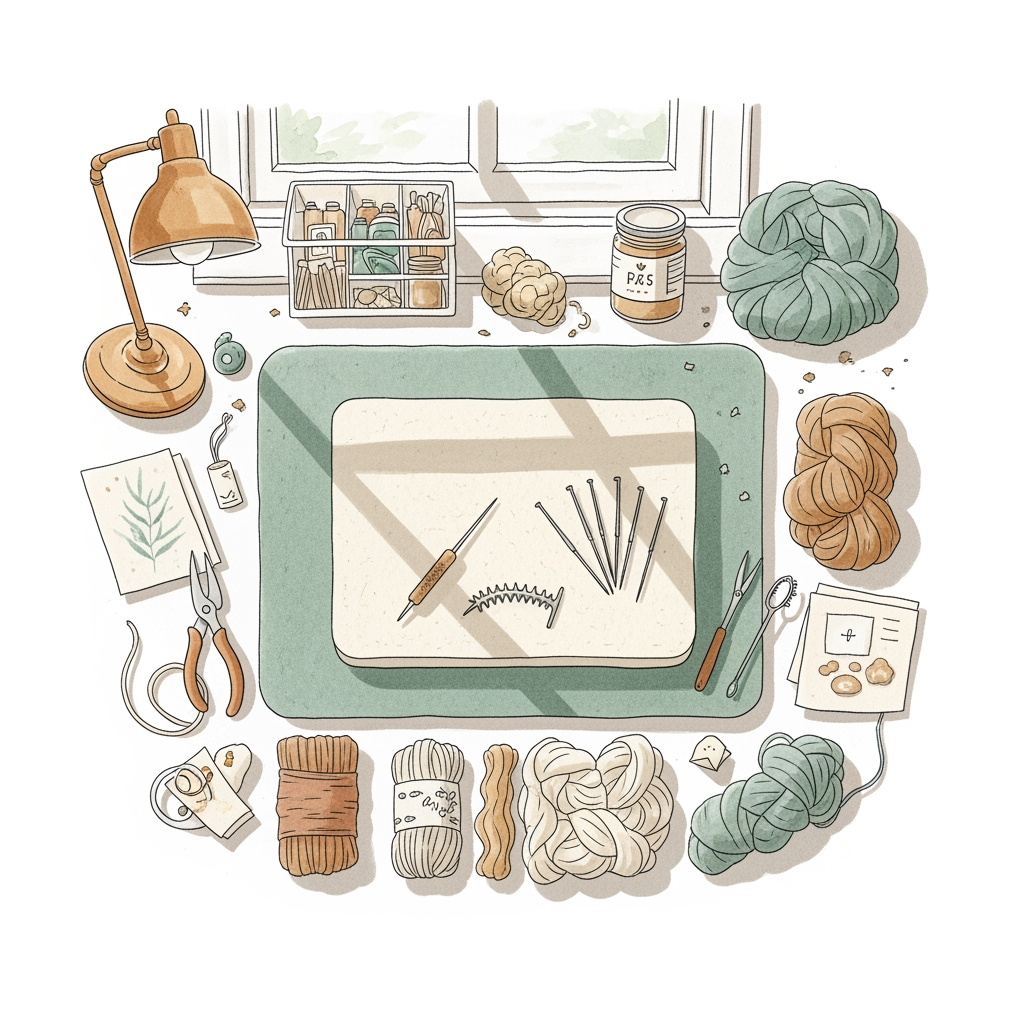
Essential Tools for Every New Felting Project
To felt effectively, you need more than just a needle and wool. Your workspace setup dictates your comfort, just as your chair and lighting affect your knitting posture.
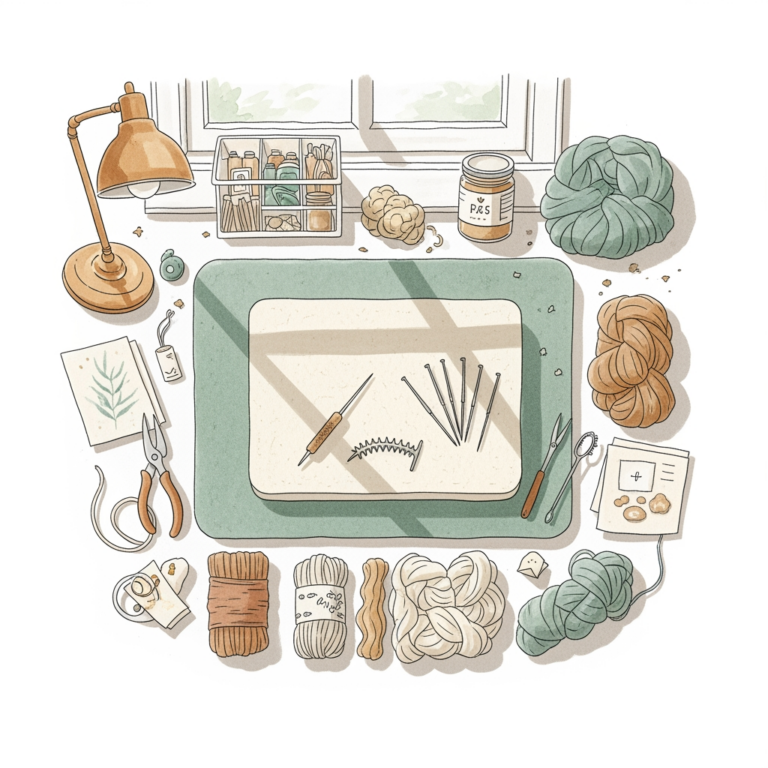
- Felting Pad: Use a dense foam pad or a wool-filled mat. A soft, thin pad will ruin your needles and force you to push too hard.
- Needle Gauge: Start with a "medium" gauge needle. Like a size US 8 (5mm) needle, it’s the perfect middle ground for most tasks.
- Finger Protectors: These are the "thimbles" of the felting world. Do not skip them; those barbs are incredibly sharp and will find your fingers eventually.
A multi-needle tool can speed up the "blocking" or initial shaping phase, similar to using a larger needle to get through a long row of stockinette. However, always finish your details with a single needle for precision. Never rush the final surface smoothing; that is where the real "fabric" is created.
Tips for Troubleshooting Common Felting Errors
If your project feels "mushy" or soft, you haven’t felted it enough. You need to keep stabbing until the fibers have migrated and interlocked completely. It’s like fulling a sweater—if it doesn’t hold its shape, it needs more agitation.
Are your needles breaking constantly? You are likely twisting the needle while it is still inside the wool. Always pull the needle out at the exact same angle you pushed it in. Think of it like knitting—if you twist your stitches, you create structural weakness.
If your surface looks "hairy" or fuzzy, you are likely using a needle that is too thick for the final detail work. Switch to a fine-gauge needle to "tame" the surface fibers. With practice, you will develop a feel for the resistance of the wool, just as you develop a feel for tension in your hands while knitting.
Needle felting is a deeply tactile craft that rewards patience and a keen eye for form. By starting with a high-quality kit, you bypass the common frustrations that turn many beginners away from the fiber arts. Remember that every poke of the needle is a lesson in how fibers interact, much like every row of knitting teaches you about your own tension. Take your time, protect your fingers, and enjoy the process of sculpting something beautiful from a simple pile of wool.