7 Best Bead Looms For Tapestry Projects Worth Trying
Discover the top 7 bead looms for tapestry projects. We compare features and ease of use to help you find the perfect tool for your next creative endeavor.
Entering the world of bead weaving is a natural progression for those of us who have spent years perfecting our tension with yarn and needles. Much like choosing between bamboo or carbon fiber needles, selecting the right loom dictates the rhythm and success of your project. Whether you are creating delicate jewelry or expansive wall hangings, the mechanics of your loom will either support your flow or hinder your progress. Here are seven exceptional looms that cater to the specific technical needs of the modern fiber artist.
Mirrix Saffron Loom: Best Professional Choice
The Mirrix Saffron is the gold standard for those who treat their craft with the same seriousness as a master weaver tackling a complex lace shawl. Its heavy-duty construction ensures that your warp threads remain perfectly taut, which is non-negotiable when you are working on a multi-day, intricate tapestry.
If you have ever struggled with a flimsy frame that warps under the tension of your warp, you will immediately appreciate the stability here. The shedding device is a standout feature, allowing you to lift your warp threads with ease rather than manually picking through them. It mimics the mechanics of a floor loom, making it an investment piece for the dedicated maker.
The tradeoff is the learning curve and the initial price point. This is not a "pick up and play" tool; it requires an understanding of loom mechanics that might feel daunting to a total beginner. However, if your goal is professional-grade results, the durability and precision of the Saffron are unmatched.
Beadsmith Jeweler’s Loom: Best for Beginners
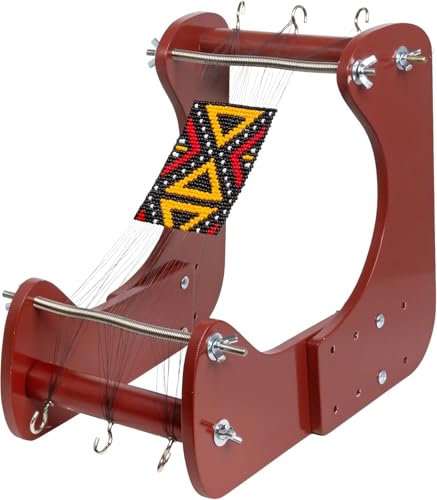

When you are just starting to bridge the gap between knitting and beadwork, you don’t need a complex piece of machinery. The Beadsmith Jeweler’s Loom is approachable, intuitive, and perfectly suited for those first practice pieces.
Think of this like a beginner’s set of bamboo needles; it’s forgiving, easy to handle, and won’t overwhelm you with unnecessary features. It is lightweight, which makes it easy to stow away in your project bag alongside your current knitting WIP. It is the ideal tool for learning how to manage tension without the stress of a high-stakes, expensive frame.
The limitation here is the lack of a shedding device, meaning you will be doing more manual labor to pass your needle through the warp. For smaller projects like bracelets, this is perfectly fine, but it can become tedious for larger tapestries. Start here to learn the rhythm of the weave before deciding if you need to upgrade.
Rick’s Beading Loom: Best for Large Projects

Rick’s Beading Loom is a favorite for those who want to create long, continuous pieces without the constant hassle of re-warping. Its unique design allows for significant length, which is a game-changer if you are interested in creating belts or long table runners.
This loom excels because it allows you to wind your finished work onto a rod as you go, much like advancing a project on a large knitting frame. This keeps your working area consistent and prevents the "drag" that often happens when a long project hangs off the edge of a table. It provides a clean, clear workspace that is essential for maintaining even tension.
However, the sheer size can be a bit of a commitment. It requires a dedicated table space, so it isn’t the best choice if you are a "knit on the couch" type of crafter. If you have the space, the efficiency it brings to large-scale projects is worth every square inch.
Baby Big Sister Loom: Best Portable Option

The Baby Big Sister loom is the perfect companion for the knitter who loves to craft while traveling or during long commutes. It is compact, lightweight, and surprisingly sturdy for its size, making it the ultimate "project bag" loom.
The beauty of this loom lies in its simplicity and portability. If you are used to packing a lightweight pair of circular needles for a flight, you will find this loom equally unobtrusive. It is designed to be taken apart or carried easily, ensuring you never have to put your creative flow on pause.
The tradeoff is that it is strictly for smaller, more focused projects. You won’t be weaving massive wall hangings on this, but for earrings, bands, and small decorative pieces, it is a dream. It’s the perfect tool for the maker who values mobility above all else.
Endless Loom by Deb Moffett-Hall: Versatility

The Endless Loom is a clever piece of engineering that solves the age-old problem of how to make a seamless, continuous piece of beaded fabric. It uses a unique tensioning system that allows you to work in a circle, essentially creating a tube of beads.
This is a fantastic option if you are interested in creating cuffs or necklaces that lack a bulky seam. It functions with the same ingenuity as a circular needle, allowing you to move through your project without stopping to turn or finish edges. It is a highly specialized tool that opens up design possibilities that flat looms simply cannot touch.
Because of its unique circular nature, it does take a moment to wrap your head around the warping process. It is not necessarily difficult, but it is different from the standard rectangular loom. If you want to expand your repertoire beyond flat tapestries, this is a must-have addition to your toolkit.
Miyuki Beading Loom: Best for Intricate Work

If you are a fan of micro-knitting or working with extremely fine lace weight yarns, the Miyuki Beading Loom will feel right at home in your hands. It is built for precision and is specifically designed to handle the tiny, uniform beads that require a steady, delicate touch.
The hardware on this loom is exceptionally fine, which helps keep your warp threads tightly spaced. This is crucial when working with high-count bead patterns where any slippage would ruin the design. It is a professional-grade tool that rewards patience and a steady hand.
The tradeoff is that it is quite small and requires a very specific setup. It is not the loom you want if you are working with chunky beads or wide, rustic tapestries. If your passion is high-detail, intricate beadwork, this loom provides the control you need to execute your vision perfectly.
Schacht Cricket Loom: Best for Wide Tapestry
While primarily known as a rigid heddle loom for weaving yarn, the Schacht Cricket is a powerhouse for wide, beaded tapestries. If you are looking to create a substantial wall hanging, the width and stability of this loom are hard to beat.
Using a loom designed for yarn weaving for beadwork is a pro-level move. It provides a massive surface area, allowing you to work on multiple sections of a design simultaneously. The built-in heddle makes raising your warp threads a breeze, significantly speeding up your project time.
Be aware that you will need to adapt your warping technique slightly, as it is designed for yarn. However, the space it offers is unparalleled. If you are ready to move from jewelry to art pieces, this is the tool that will allow you to scale up.
Essential Factors for Choosing a Bead Loom
- Project Scale: Are you making jewelry or wall art? Choose a loom width that fits your largest intended project.
- Tensioning Mechanism: Look for a loom with a metal gear or high-quality tensioning knob; plastic parts often wear down under constant pressure.
- Shedding Device: If you plan on doing long-term projects, a shedding device will save your wrists and speed up your weaving time.
- Portability: Consider whether you need to store your loom in a project bag or if it will have a permanent spot on your desk.
Understanding Warp Tension for Bead Weaving
Just as in knitting, where the tension of your yarn determines the drape of your fabric, the warp tension in bead weaving determines the integrity of your piece. If your warp is too loose, your beads will shift and your design will look uneven or "gappy."
The goal is to have the warp threads taut enough to "ping" when lightly touched. If you are a tight knitter, you might naturally over-tighten your warp; be mindful of this, as excessive tension can cause your loom to bow or your warp threads to snap. Always test your tension with a small swatch before committing to a large project.
Tips for Finishing Your Beaded Tapestry Ends
Finishing your ends is the most critical step to ensuring your work lasts for years. Much like weaving in ends on a sweater, the technique you choose will depend on the weight and type of your thread.
- Weaving In: Always weave your thread back through the last two or three rows of beads to secure it.
- Knotting: A small surgeon’s knot hidden within the beadwork is often more secure than just weaving alone.
- Adhesives: For heavy-duty projects, a tiny drop of high-quality jewelry cement can secure the final knot, but use it sparingly to avoid stiffness.
- Blocking: While not always necessary, gently steaming your finished tapestry can help the beads settle into place and ensure the edges are perfectly straight.
Finding the right bead loom is a journey of trial and error, much like finding your favorite needle brand after years of testing different materials. Remember that the best tool is the one that fits your specific project and your personal weaving style. Take your time to experiment with the tension and the mechanics, and don’t be afraid to start small. Your patience and attention to detail will shine through in every finished piece, regardless of the loom you choose.