7 Best Magnifying Lamps For Inspecting Fiber Quality
Discover the 7 best magnifying lamps for fiber inspection. Learn how these precision tools enhance clarity and accuracy for high-quality connectivity tasks.
Precision is the silent partner of every beautiful stitch, especially when you are working with dark yarns or intricate lace patterns. A high-quality magnifying lamp transforms your workspace, turning eye-straining sessions into comfortable, productive hours of crafting. These tools allow you to spot dropped stitches or uneven tension before they become permanent flaws in your project. Investing in the right lighting is just as critical as choosing the perfect set of needles.
Brightech LightView Pro: Best Overall Magnifier
The Brightech LightView Pro strikes the perfect balance between magnification strength and illumination coverage. For the knitter working with fine cobweb-weight lace or dark, navy alpaca, the 2.25x magnification provides just enough clarity to see every individual ply without distorting the overall fabric.
The spring-loaded arm is its standout feature, allowing you to move the lens exactly where you need it without it drooping mid-row. When you are deep into a complex cable chart, having a stable, hands-free view is a game-changer for maintaining your rhythm.
However, keep in mind that the lens is glass, which adds weight to the arm. Ensure your desk surface is sturdy enough to handle the clamp, or you might find the lamp wobbling during intense knitting sessions.
Neatfi XL 2,200 Lumens LED Magnifying Lamp
If you find yourself squinting at black mohair under dim living room lighting, the Neatfi XL is your best friend. This lamp offers an incredibly wide viewing area, which is essential when you are checking the consistency of your gauge across a wide swatch.
The massive 2,200 lumens output mimics daylight, making it much easier to distinguish between similar color tones in stranded colorwork. You won’t have to worry about color shifting, which is a common frustration when trying to match dye lots under warm household bulbs.
The tradeoff here is the sheer size of the lamp head. It is quite large and can feel a bit intrusive if your knitting space is limited to a small side table or a cramped corner of the sofa.
Carson DeskBrite 200 LED Magnifier for Detail


Sometimes you don’t need a full-desk overhaul, just a focused look at a stubborn dropped stitch. The Carson DeskBrite 200 is a compact, portable option that sits neatly on your lap table or side desk.
It is particularly useful for those moments when you need to perform "fiber surgery," such as picking up a stitch that has traveled down several rows. The magnification is crisp, and the LED ring light prevents the harsh shadows that often make dropped stitches impossible to locate.
Because it is smaller, it lacks the reach of a swing-arm lamp. It is a specialized tool for detailed inspection rather than a primary light source for long-form knitting.
OttLite Dual-Shade LED Magnifying Lamp
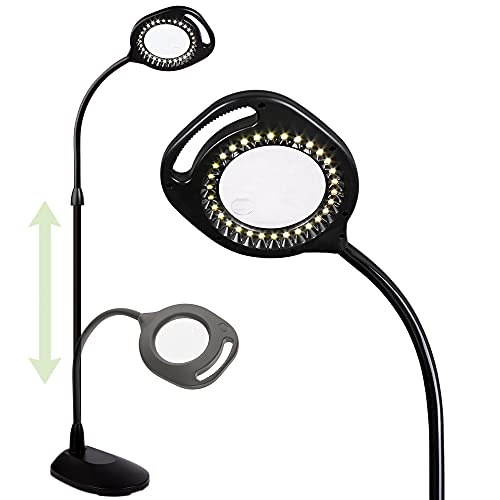
OttLite has long been the gold standard for crafters because of their proprietary lighting technology that reduces eyestrain. This dual-shade model is excellent for knitters who need to illuminate both their hands and their pattern chart simultaneously.
The dual-shade design allows you to pivot light exactly where it is needed, which is helpful when you are toggling between reading a complex lace diagram and working the stitches on your needles. It effectively eliminates the "blind spots" that occur with single-source lighting.
While the illumination is top-tier, the magnification power is more modest compared to industrial-style lamps. It is better suited for general visibility than for inspecting the microscopic integrity of high-twist yarns.
VLT 2-in-1 LED Magnifier With Clamp Base

The VLT 2-in-1 provides versatility that is hard to beat for the multi-crafting knitter. It can be used as a traditional desk lamp or converted into a smaller, portable unit, which is perfect if you move between your desk and your favorite armchair.
The clamp is robust, and the light quality is consistent, offering a clean white light that helps you see the twist of your yarn clearly. This is vital when working with single-ply yarns, where seeing the structure helps you avoid snagging the fibers with your needle tips.
The assembly can be a bit fiddly, so it isn’t the best choice if you plan on taking it apart frequently. Once you have it set up in your preferred spot, however, it remains a reliable workhorse.
Tomons Swing Arm LED Magnifying Desk Lamp

The Tomons lamp leans into a more aesthetic, classic design that fits beautifully into a home studio. Beyond its looks, it offers smooth adjustability that allows you to position the lens at the perfect angle for long, repetitive knitting sessions.
The light temperature is adjustable, which is a rare and welcome feature. I prefer a cooler light for checking for moth damage or yarn breakage in my stash, and a warmer light for evening knitting when I want to avoid harsh blue-light glare.
The lens magnification is moderate, so it won’t replace a high-powered jeweler’s loupe. It is designed for the knitter who wants a comfortable, well-lit environment for hours of steady progress.
Fancii Extra Large LED Magnifying Lamp
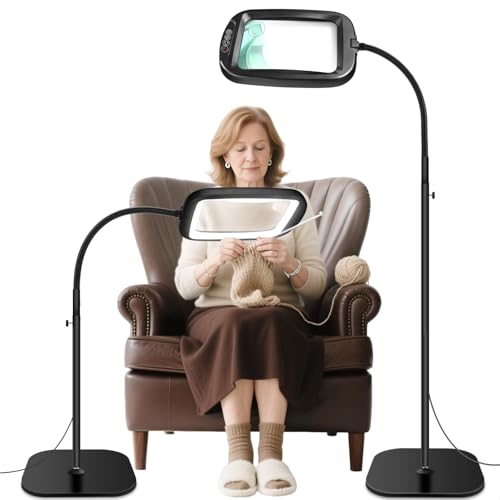
The Fancii lamp features a massive, distortion-free lens that is perfect for those who wear progressive lenses or have trouble focusing on small movements. The large field of view means you can see your entire needle width without constantly shifting the lamp.
It is particularly effective for knitters working on large-scale projects like blankets or oversized sweaters. Being able to see a large section of the fabric at once helps you spot tension irregularities that might otherwise be missed.
Because of the size of the lens, it requires a bit more desk space and careful positioning to ensure it doesn’t get in the way of your arm movements. It is an investment in comfort that pays off if you knit for several hours every day.
Why Fiber Artists Need High-Quality Lighting
Good lighting is not a luxury; it is a tool for maintaining the health of your eyes and the quality of your work. Knitting requires constant focus on fine details, often in low-contrast environments like working with dark, fuzzy, or highly textured yarns.
- Color Accuracy: Essential for identifying subtle variations in dye lots.
- Stitch Definition: Critical for spotting errors in lace, cables, or brioche.
- Eye Health: Reduces the fatigue that leads to headaches during long sessions.
- Fiber Integrity: Helps you spot potential weak points or pilling in delicate fibers.
Without proper light, you are more likely to miss small errors that become magnified once the project is blocked. Proper illumination ensures your hard work remains consistent from the first cast-on to the final bind-off.
Magnification Power and Focal Length Explained
Understanding magnification is crucial to choosing a lamp that doesn’t actually make your job harder. A higher "x" number isn’t always better; in fact, the higher the magnification, the shorter the focal length.
- 1.75x to 2.25x: The sweet spot for most knitting; provides a clear view with a comfortable working distance.
- 3x and above: Usually too strong for knitting; the focal length is so short that your needles will constantly hit the lens.
- Focal Length: This is the distance between the lens and your work; you need enough space to move your hands and needles freely.
If you choose a lamp with too high a magnification, you will find yourself hunched over in an uncomfortable position. Always prioritize a comfortable working distance over raw power.
Essential Features for Fiber Inspection Lamps
When shopping for a lamp, look past the marketing and focus on the mechanics that impact your knitting flow. The base and arm construction are just as important as the light quality itself.
- Swing Arm Stability: Ensure the joints are tight enough to hold position but loose enough to adjust without a struggle.
- Lens Material: Glass lenses offer better clarity and scratch resistance, while acrylic is lighter but prone to clouding over time.
- Dimmable Settings: Being able to adjust brightness is vital for different times of day and different yarn colors.
- Clamp vs. Base: A clamp saves desk space, but a heavy weighted base is better if you move your lamp around the house.
Ultimately, the best lamp is the one that disappears into the background, leaving you to focus entirely on your stitches. Choose a model that supports your posture and your specific project needs.
Finding the right magnifying lamp is a personal journey that depends on your eyesight, your space, and the types of projects you love most. By prioritizing adjustable arms, clear lenses, and appropriate focal lengths, you can protect your eyes and elevate the quality of your finished garments. Don’t settle for "good enough" lighting when a simple upgrade can make your favorite hobby so much more enjoyable. Happy knitting, and may your stitches always be even and your light always bright.