7 Best Project Planners For Organizing Future Designs
Streamline your creative workflow with our top 7 project planners. Discover tools that boost organization, track future designs, and enhance team productivity.
Every knitter eventually hits that point where the stash outgrows the memory and the project queue becomes a tangled mess of half-remembered ideas. Whether you are juggling three pairs of socks or planning a complex stranded colorwork sweater, organization is the difference between a relaxing hobby and a stressful chore. Finding the right system isn’t just about pretty stationery; it’s about creating a roadmap that keeps your hands on the needles and off the search bar. Here are seven of the best tools to help you manage your creative life with the precision of a master maker.
The KnitCompanion App: Best Digital Organizer


If you’ve ever lost your place in a complex lace chart while knitting in a dimly lit room, you know the value of KnitCompanion. It transforms your tablet or phone into an interactive pattern reader that tracks your row count and highlights your current stitch position.
The real power here lies in the ability to zoom in on intricate charts without losing your place. For those working with long, repetitive repeats, the custom markers ensure you never miss a yarn-over or a decrease again.
However, the learning curve is steeper than a simple PDF reader. You must be willing to spend time setting up your files, but for complex projects, the payoff in accuracy is immense.
Cocoknits Maker’s Planner: Best Paper Choice
The Cocoknits Maker’s Planner is built for the knitter who values structure and tactile feedback. It functions as a comprehensive command center, offering dedicated pages for project tracking, yarn inventory, and even needle size conversions.
It shines because it acknowledges that our projects aren’t just about knitting; they are about the logistics of stash management. The inclusion of clear sleeves for swatches is a brilliant touch, as it reminds you to actually record your gauge before you dive into a sweater.
The trade-off is its size; it is a substantial book that isn’t meant to be tossed into a small project bag. If you want a permanent record of your evolution as a knitter, this is your best bet.
Mindful Making Knitting Journal: Best for Notes
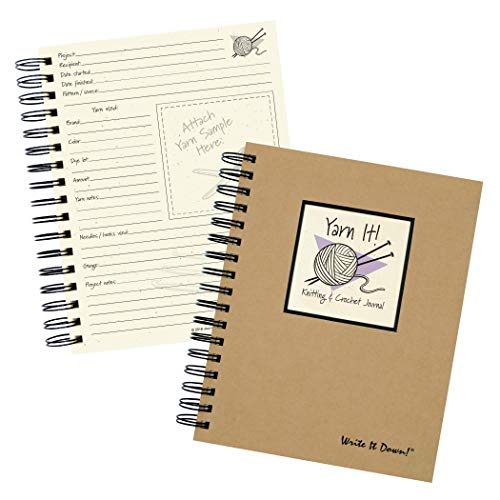
The Mindful Making Knitting Journal leans into the meditative aspect of our craft. It provides ample space for documenting the "why" behind a project, rather than just the "how."
This is the perfect space to record your thoughts on fiber behavior, such as how a specific wool-nylon blend held up after blocking or how a particular alpaca yarn bloomed after washing. These qualitative notes are often more valuable than the technical ones when you are planning your next design.
It is less about strict data and more about the narrative of your making. If you find yourself forgetting which needle material—bamboo versus nickel—worked best for a slippery silk yarn, this journal will hold that wisdom for you.
Ravelry Notebook: The Best Online Archive Tool

The Ravelry Notebook remains the gold standard for cataloging your digital life. It allows you to link your projects directly to specific patterns, yarns, and even the needles you used, creating a searchable database of your entire history.
The beauty of the Notebook is its connectivity. When you log a project, you can see how others fared with the same yarn, helping you predict potential pitfalls like yardage shortages or unexpected drape issues.
While it lacks the physical charm of paper, its ability to filter by project type, fiber content, or date is unmatched. It is the most practical tool for the knitter who wants to learn from their past mistakes at a glance.
The Knitter’s Planner: Best Goal Setting Tool
The Knitter’s Planner is designed for the knitter who treats their craft like a series of milestones. It includes goal-setting prompts that help you plan your year, whether that involves finishing a sweater a month or finally mastering brioche stitch.
It forces you to think about your time as a finite resource. By breaking down large projects into manageable chunks, it helps prevent the "startitis" that plagues so many of us when we see a beautiful new pattern.
It is an excellent tool for those who struggle with project completion. If you have a pile of unfinished objects (UFOs) gathering dust, this planner provides the structure needed to turn them into finished garments.
Fringe Association Field Guide: Best Portable

When you are traveling or heading to a knitting group, you don’t want a heavy binder. The Fringe Association Field Guide is compact, lightweight, and specifically designed for the knitter on the go.
It focuses on the essentials: pattern notes, gauge, and yarn requirements. It doesn’t try to be everything to everyone; instead, it provides just enough space to keep your current project on track while you’re away from your main desk.
It is a minimalist’s dream. If you prefer to keep your notes simple and your project bag light, this guide offers exactly what you need without the unnecessary fluff.
My Knitting Journal by Laine: Best for Keepsakes

My Knitting Journal by Laine is as much an art object as it is a tool. With its high-quality paper and beautiful aesthetic, it encourages you to treat your knitting as a documented journey rather than just a list of tasks.
It includes sections for logging your stash and individual project details, but it truly excels as a keepsake. You will find yourself reaching for this years later to remember the specific yarn you used for a beloved gift or the modifications you made to a sweater.
It is an investment in your legacy as a maker. While it might feel too precious for messy, early-stage notes, it is the perfect place to record your final, triumphant results.
How to Choose the Right Planner for Your Needs
To choose the right planner, start by identifying your primary pain point. Are you losing track of your row counts, or are you losing track of your stash?
- For the data-driven: Choose a digital tool like Ravelry or KnitCompanion.
- For the tactile learner: Opt for the Cocoknits or Mindful Making journals.
- For the goal-oriented: Look toward The Knitter’s Planner to manage your timeline.
Don’t be afraid to mix and match. Many experienced knitters use a digital app for the technical row-tracking during a project and a physical journal to reflect on the process once the final ends are woven in.
Digital Apps vs. Paper Planners: A Comparison
Digital apps offer the advantage of portability and automation. They can calculate yardage, track rows, and sync across devices, which is invaluable when you are working on multiple projects in different locations.
Paper planners, however, offer a level of focus that a phone simply cannot provide. There is a distinct cognitive benefit to writing down your gauge and your modifications; it helps cement the information in your memory.
The best choice depends on your lifestyle. If you are constantly on the move, digital is the clear winner. If you want a quiet, screen-free hour with your knitting, a paper journal is an essential companion.
Tips for Tracking Your Knitting Progress Daily
Consistency is more important than detail. You don’t need to write a novel every day; a simple note on how many rows you completed or a quick check-in on how the yarn feels is sufficient.
Always record your gauge early. If you are knitting a sweater, note the needle size and the specific yarn used immediately after you finish your swatch, as this is the most common data point knitters forget.
Finally, keep your planner right next to your project bag. If you have to go hunting for your notebook, you are far less likely to update it. Make the act of recording part of your ritual, just like picking up your needles.
Organizing your knitting life is a deeply personal process that evolves alongside your skills and interests. Whether you choose the sleek efficiency of a digital app or the satisfying weight of a paper journal, the goal remains the same: to reduce friction and increase your joy in the craft. Start by picking one system, stick with it for a single project, and see how it changes your workflow. Your future self—and your future finished objects—will thank you for the effort.