7 Best Reading Glasses For Fine Gauge Knitting
Master fine gauge knitting with our top 7 reading glasses. We compare magnification and lens clarity to help you stitch intricate patterns with ease and comfort.
When you’re working with cobweb-weight lace or dark, charcoal-colored wool, your eyes are just as important as your needles. Fine gauge knitting demands intense visual precision, often for hours on end, which can leave even the most experienced crafters with throbbing headaches. Choosing the right pair of reading glasses isn’t just about magnification; it’s about finding a tool that supports your craft without adding fatigue. Here are the best options to keep your stitches clear and your focus sharp.
IZIPIZI Reading Glasses: Best Overall Choice


IZIPIZI glasses are a staple in many knitting circles because they balance a lightweight feel with a remarkably clear field of vision. When you’re staring at a complex cable chart or tracking a lace repeat, you need frames that don’t slide down your nose every time you tilt your head.
The rubberized finish on these frames provides a gentle grip that stays put, even during long sessions of stranded colorwork. They are flexible enough to accommodate different head shapes, which matters when you’re leaning over a project for hours.
The main tradeoff here is the frame durability; while they feel great, they aren’t indestructible. However, for the price point, they offer a level of optical clarity that rivals much more expensive options.
Foster Grant Multi-Focus: Best for Transitioning

If you frequently look up from your 2.25mm sock needles to check your pattern or chat with a friend, standard readers can feel limiting. Foster Grant’s Multi-Focus lenses offer a gradient of magnification, allowing you to see your work clearly while keeping the room in soft focus.
This is a game-changer for knitters who find themselves constantly taking their glasses on and off. You don’t have to worry about the "head-bobbing" effect that occurs when you switch between your knitting and your television or pattern book.
Be aware that these require a brief adjustment period for your eyes to find the "sweet spot" in the lens. Once you master the focal shift, you’ll find that your workflow remains much more fluid and less interrupted.
Peepers Center Stage: Best for Eye Comfort

Peepers have become a favorite for those who prioritize a wider field of view. When you’re knitting a large-scale project like a sweater, you want to see as much of the needle tips as possible without moving your head side-to-side.
These frames are designed with a slightly larger lens shape, which helps reduce the peripheral distortion often found in cheaper drugstore readers. This is particularly helpful when working with high-contrast yarns where every stitch definition matters.
They are quite stylish, but the real benefit is the anti-reflective coating that comes standard. This coating is essential if you knit under bright LED lamps, as it cuts down on the glare that bounces off your metallic needles.
ThinOptics Keychain Readers: Best for Travel

Every knitter knows the panic of arriving at a retreat or a coffee shop only to realize their glasses are sitting on the nightstand at home. ThinOptics are designed to be ultra-slim and portable, fitting easily into your project bag or even your wallet.
These are not intended for an eight-hour marathon of lace knitting, but they are perfect for quick gauge checks or fixing a dropped stitch on the go. They grip the bridge of your nose firmly, which is impressive given their lack of traditional arms.
The trade-off is the lack of a full frame, which can feel a bit flimsy if you aren’t careful. Keep these as your "emergency backup" set to ensure you’re never caught without the ability to read your chart.
Caddis Miklos Readers: Best Premium Selection
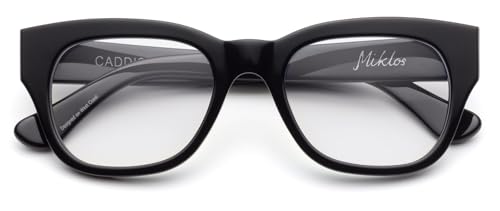
If you are a dedicated knitter who spends more time with needles in hand than not, investing in Caddis is a decision you won’t regret. These are built with high-quality materials and optical-grade lenses that provide a crispness you simply can’t get from mass-market options.
The weight and balance of these frames are superior, meaning they don’t dig into your temples during long knitting sessions. When you’re working with dark alpaca or mohair, where stitch definition is notoriously difficult to see, the clarity offered by these lenses is a genuine advantage.
They are an investment, so treat them as a tool for your craft, much like a high-end set of interchangeable needles. They aren’t just an accessory; they are a necessary piece of equipment for preserving your eyesight over years of fiber arts.
Gamma Ray Optics: Best Value for Knitters

For the knitter who tends to leave their glasses scattered around the house, Gamma Ray Optics offer a fantastic, affordable solution. You can buy them in multi-packs, meaning you can keep one pair by your yarn stash, one in your knitting bag, and one in the living room.
These glasses are surprisingly sturdy for the price and feature a classic design that fits most face shapes. They provide consistent magnification, which is exactly what you need for repetitive tasks like stockinette stitch or basic ribbing.
While they lack the specialized anti-glare coatings of premium brands, they are perfectly functional for standard knitting light. If you are just starting your knitting journey and don’t want to break the bank, start here.
Warby Parker Reading Glasses: Best Custom Fit
Warby Parker offers the closest experience to a professional optical fitting without the cost of a full prescription. Because they offer different frame widths and lens heights, you can find a pair that sits perfectly on your face, preventing the dreaded "slipping" that happens when you look down.
This custom fit is vital for knitters who suffer from neck strain; when your glasses fit correctly, you don’t have to adjust your posture to find the focal point. Their lenses are also incredibly high quality, providing a sharp image that makes counting stitches much less taxing.
The process of ordering online is seamless, and their home-try-on program is perfect for ensuring the frames don’t interfere with your peripheral vision. It’s the best choice for the knitter who wants a permanent, reliable solution for their daily crafting.
How to Choose the Correct Magnification Power
Start by testing your needs at a local pharmacy before committing to a pair. A good rule of thumb for knitters is to start with the lowest magnification that allows you to see your stitches clearly at a comfortable distance—usually about 14 to 16 inches from your eyes.
- +1.00 to +1.25: Best for beginners or those who only need a slight boost.
- +1.50 to +2.00: The "sweet spot" for most knitters working on standard gauge projects.
- +2.50 and up: Often necessary for fine gauge lace or working with dark, low-visibility yarns.
Avoid the temptation to "over-magnify." Using a power that is too strong will force you to hold your work closer to your face, which actually increases eye strain and neck tension rather than relieving it.
Why Blue Light Blocking Matters for Knitters
Many of us knit while watching television or sitting under bright, artificial lighting. Blue light blocking lenses reduce the high-energy visible light emitted by these sources, which can contribute to digital eye strain and even disrupt your sleep patterns.
For a knitter, this means less "eye fatigue" after a long evening of working on a complex pattern. It’s not just about the screen; it’s about the quality of the light hitting your eyes while you focus on tiny, repetitive movements.
While some lenses have a slight yellow tint, modern blue-light technology is nearly clear. The benefit of reduced glare and improved contrast when looking at your yarn is well worth the inclusion of this feature.
Tips for Reducing Eye Strain During Fine Work
Even with the best glasses, you must give your eyes a break. Follow the "20-20-20 rule": every 20 minutes, look at something 20 feet away for at least 20 seconds to reset your focal point.
- Improve your lighting: Use a dedicated craft lamp with a daylight bulb to increase contrast.
- Check your posture: Keep your work at a height that allows your neck to remain neutral.
- Contrast is key: If you are working with black yarn, place a light-colored towel or a white pillow on your lap to help the stitches pop against the background.
Remember that your eyes are a muscle; they need rest just like your hands do. If you find yourself squinting even with your glasses on, it’s a clear sign that you need to put the needles down and step away for a while.
Finding the right reading glasses is an essential step in your evolution as a knitter, ensuring that you can enjoy your craft for decades to come. Whether you opt for a premium pair for your daily projects or a budget-friendly set for your travel bag, prioritize clarity and comfort above all else. Your eyes are your most valuable knitting tool, so protect them with the care you put into your most intricate projects. Happy knitting, and may your stitches always be clear and your tension perfectly even.