6 Best Cutting Mats For Creating Custom Pattern Inserts
Discover the top 6 cutting mats for custom pattern inserts. We compare durability, self-healing surfaces, and precision grids to help you choose the best tool.
Precision is the silent partner of every great knitting project, especially when you are drafting custom patterns or cutting fabric for linings. While we spend hours obsessing over yarn twist and needle material, our workspace surface is often an afterthought. A high-quality cutting mat acts as the foundation for your design work, protecting your table and your blades alike. Investing in the right mat ensures that your pattern inserts are as crisp and accurate as your stitch gauge.
Fiskars Self-Healing Rotating Mat: Best Overall
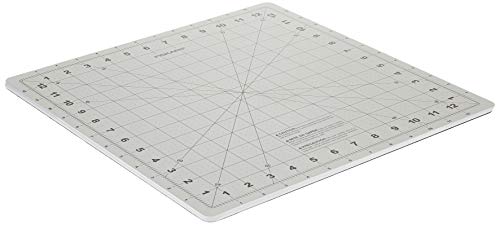

When you are trimming multiple pattern pieces, the constant need to shift your body around the table can cause fatigue and accidental slips. The Fiskars rotating feature allows you to turn your work instead of yourself, which is a game-changer for maintaining consistent pressure on your rotary cutter.
This mat is my top choice because it balances portability with a clever mechanical advantage. If you are working on a small craft table in a shared living space, the 14-inch size is perfect for pattern drafting without dominating your entire room.
The self-healing surface handles the repeated passes of a blade quite well, though it is not invincible. If you are a heavy-handed cutter, just be mindful that deep grooves can eventually catch your blade.
Olfa Double-Sided Rotary Mat: Most Durable

If you have ever had a mat warp or crack after a few months of heavy use, you know the frustration of an uneven cutting surface. Olfa mats are legendary in the quilting world for a reason: they are built to withstand years of abuse from sharp rotary blades.
The double-sided nature is a massive benefit for those who switch between metric and imperial measurements. Having two distinct surfaces means you can reserve one side for delicate pattern paper and the other for heavier fabrics or stiff interfacing.
These mats are noticeably denser than the competition. While they feel a bit stiffer, that density is exactly what prevents your blade from digging too deep and ruining your tabletop.
Arteza Self-Healing Cutting Mat: Best Value

For the knitter who is just beginning to experiment with sewn linings or custom pattern inserts, you don’t necessarily need the most expensive professional-grade equipment. The Arteza mat provides a reliable, non-slip surface at a price point that leaves more room in your budget for luxury hand-dyed wool.
The grid lines are printed with excellent clarity, which is essential when you are trying to align a pattern piece perfectly on the grain. A blurry or offset grid is a recipe for a skewed garment, no matter how well you have blocked your pieces.
Keep in mind that these mats can be slightly more sensitive to heat than premium brands. Avoid placing a hot iron directly on the mat, as it can cause the surface to bubble or deform.
Dahle Vantage Self-Healing Mat: Best Surface
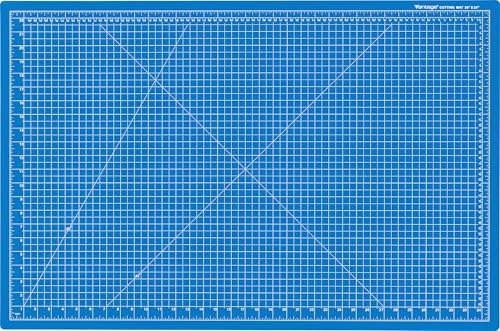
The surface texture of the Dahle Vantage mat is remarkably smooth, providing just enough resistance to keep your pattern paper from sliding while you cut. It feels more "premium" under the blade than many of its competitors, offering a satisfying glide that makes cutting feel less like a chore.
The standout feature here is the five-layer construction. This internal structure is designed to keep the mat flat, preventing the annoying "bowing" that happens with cheaper, thinner mats over time.
If you are working on intricate pattern inserts that require delicate curves, this mat is your best friend. It allows for precise, fluid movements that won’t get hung up on surface imperfections.
Westcott Self-Healing Mat: Best for Precision

Precision is everything when you are drafting a custom gusset or shaping a neckline insert. The Westcott mat features highly visible, high-contrast grid markings that make it easy to see exactly where your blade is landing.
The material used in these mats has a unique "give" that feels very forgiving. If you are prone to pressing down too hard with your rotary cutter, this mat will absorb that force without dulling your blade as quickly as a harder surface would.
It is an excellent choice for those who value accuracy above all else. Just be sure to wipe it down occasionally, as the fine dust from cut paper can sometimes settle into the grid lines and obscure your view.
Alvin Professional Grade Mat: Best Large Size

Large-scale pattern drafting requires a surface that won’t force you to fold or reposition your work constantly. The Alvin mat is a powerhouse for those who have the desk space to accommodate a massive cutting area.
Having a large, uninterrupted surface allows you to lay out entire pattern blocks at once. This is particularly useful if you are grading a pattern up or down in size, as it lets you see the relationship between different sections of the garment simultaneously.
While the size is the primary draw, the quality of the self-healing material is consistently high. It is a workhorse tool that is designed to stay in one place and handle heavy-duty projects for years.
Key Features to Look for in a Cutting Mat
When selecting a mat, prioritize the grid visibility and the healing capacity of the material. A mat with a faint or inaccurate grid is useless for professional-level pattern work, regardless of how "self-healing" it claims to be.
- Size: Always choose the largest size your table can accommodate.
- Grid Accuracy: Ensure the measurements are printed clearly and align with standard ruler increments.
- Non-Slip Backing: This is non-negotiable; a sliding mat is a dangerous mat.
- Thickness: Thicker mats generally offer better protection for your furniture and last longer.
Remember that a mat is an investment in your tools. A cheap mat that warps will eventually lead to inaccurate cuts, which will compromise the fit of your final knitted garment.
Understanding Self-Healing Mat Technology
"Self-healing" is a bit of a misnomer; it doesn’t mean the mat magically repairs itself like living tissue. Instead, the material is composed of a soft, pliable plastic that is designed to "close" the gap left by a sharp blade.
When you cut into the mat, the material parts and then naturally pulls back together, hiding the incision. This prevents deep channels from forming, which would otherwise catch your blade and lead to ragged, uneven edges on your pattern pieces.
Over time, these cuts do accumulate, and the "healing" capability will eventually diminish. This is a normal part of the tool’s lifecycle, and it is the primary reason why you should always rotate your cutting area to avoid wearing out one specific spot.
How to Properly Maintain Your Cutting Mat
The biggest enemy of a cutting mat is heat, which can warp the plastic permanently. Never use your steam iron on top of your mat, and keep it away from direct sunlight or radiators, as heat will cause the material to lose its structural integrity.
Cleaning is straightforward: a soft cloth dampened with mild soap and water is all you need. Avoid harsh chemicals or solvents, as they can break down the self-healing properties of the surface and make it brittle.
If you notice your mat getting a bit "fuzzy" from paper fibers, a gentle wipe with a damp sponge usually does the trick. Always store your mat flat; leaning it against a wall or folding it will create a permanent bend that you will never be able to iron out.
Safety Tips for Using Rotary Cutters and Mats
Rotary cutters are incredibly sharp and require respect, much like a pair of high-quality embroidery scissors. Always keep the safety guard engaged when the cutter is not in active use, and never leave it sitting on your table where it can be accidentally knocked over.
When cutting, always pull the blade away from your body and keep your fingers well clear of the cutting path. It is tempting to get close to the blade for better visibility, but a clear line of sight is far more important than proximity.
- Change your blades often: A dull blade requires more pressure, which leads to slipping.
- Use a ruler: Always use a heavy-duty acrylic ruler to guide your cuts.
- Stay focused: Never cut while you are tired or distracted, just as you shouldn’t attempt complex cable charts when you are exhausted.
Choosing the right cutting mat is about creating a workspace that supports your creative process rather than hindering it. By selecting a durable, high-visibility surface, you are setting yourself up for success with every pattern insert you create. Treat your mat with care, keep your blades sharp, and your custom knitting projects will be all the more professional for it. Happy making!