7 Best Tapestry Looms For Small Scale Practice
Discover the 7 best tapestry looms for small-scale practice. Learn which compact frames offer the ideal tension and portability for your weaving projects today.
Stepping into the world of tapestry weaving is a natural progression for any knitter who has spent years obsessed with the structure of yarn. While your needles create loops, a loom allows you to manipulate warp and weft to build dense, pictorial textiles from scratch. Finding the right tool for your small-scale practice is essential to avoid the frustration of uneven tension or flimsy frames. Here are seven excellent options that bridge the gap between hobbyist curiosity and professional-grade results.
Schacht Cricket Loom: The Best All-Rounder
The Schacht Cricket is a rigid heddle loom that feels like a natural extension of a knitter’s toolkit. It is incredibly versatile, allowing you to weave everything from delicate scarves to dense, sturdy wall hangings.
The beauty of this loom lies in its "all-in-one" nature. Because it uses a rigid heddle to lift and lower threads, you can achieve a consistent shed—the space created between warp threads—with minimal effort. It’s perfect for those who want the precision of a loom without the complexity of a multi-shaft floor model.
However, keep in mind that it is designed primarily for weaving cloth. If you are strictly doing pictorial tapestry, you will need to pay close attention to your beat—the force used to pack the weft down—to ensure your warp doesn’t show through.
Mirrix Lani Loom: Precision for Beginners
If you are coming from a background of intricate lace knitting, the Mirrix Lani will feel like a precision instrument. It is a dedicated tapestry loom that excels at maintaining high, consistent tension.
Tension is the "gauge" of the weaving world; if it’s inconsistent, your piece will warp or pucker just like a sweater with uneven stitches. The Lani’s specialized tensioning device allows you to tighten your warp threads with a simple turn of a knob.
It is compact enough to sit on your lap while you watch a podcast or listen to an audiobook. While it is a smaller investment than a full-scale floor loom, the durability of its frame makes it a lifelong companion for small-scale art.
Ashford SampleIt Loom: Perfect for Small Projects


The Ashford SampleIt is designed for exactly what its name suggests: testing out ideas before committing to a massive project. It is lightweight, portable, and incredibly easy to set up.
For a knitter used to swatching, this loom is a dream. You can experiment with different color combinations or fiber blends—like mixing wool with silk or linen—to see how they behave under tension. It is the perfect place to practice techniques like soumak or rya knots.
Don’t expect to weave a full-sized rug on this, though. Its small footprint is its greatest strength, but it does limit the width of your creative output.
Beka Weaving Frame: Simple and Sturdy Design
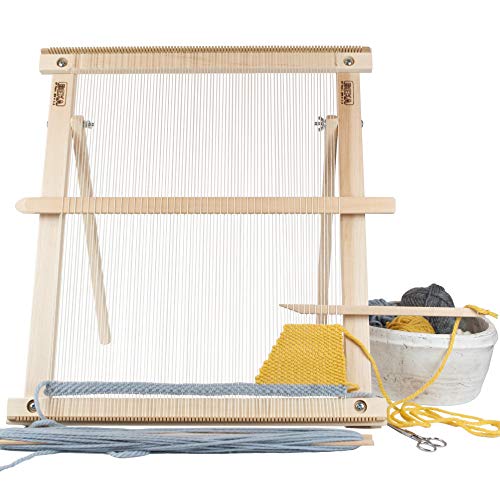
Sometimes, the simplest tools are the most reliable. The Beka Weaving Frame is a classic wooden frame that strips away the mechanics of heddles and levers, focusing purely on the act of weaving.
This is essentially a "what you see is what you get" tool. It is ideal for those who want to practice free-form tapestry where you manually pick up warp threads with your fingers or a needle. It mimics the simplicity of a knitting needle and a ball of yarn.
Because there is no built-in tensioning system, you must be diligent about how you warp the frame. If you start with loose tension, your finished piece will likely lose its shape once cut from the loom.
Harrisville Designs Lap Loom: Classic Choice

Harrisville Designs has a long-standing reputation in the fiber arts community for producing high-quality, long-lasting equipment. Their lap loom is a staple for a reason: it’s built like a tank and designed for ease of use.
This loom is particularly great for beginners who might be intimidated by the mechanical aspects of more complex frames. It provides a stable platform for learning the fundamentals of warp and weft interaction.
It is particularly well-suited for those who like to work with heavier, rustic yarns. If you enjoy knitting with wool that has a bit of "tooth" or grip, this loom will handle that texture with ease.
Kromski Harp Forte: Ideal for Intricate Work
The Kromski Harp Forte is a rigid heddle loom that offers a level of craftsmanship that is hard to ignore. It is beautiful to look at and even better to use, with a design that allows for very precise shed control.
If you are interested in tapestry techniques that require frequent color changes, this loom provides the stability you need. The wooden construction is smooth and snag-free, ensuring that your delicate hand-dyed yarns won’t get caught or frayed during the weaving process.

It is a bit more of a "serious" tool than a simple frame. If you are ready to move beyond basic practice and start producing finished art, this is a fantastic step up.
Schacht Easel Weaver: Great for Desktop Use

The Schacht Easel Weaver is a clever piece of engineering that turns any table into a dedicated weaving studio. It stands upright, which is a massive ergonomic win for anyone who gets neck strain from hunching over their knitting.
Working vertically allows you to see your design develop in real-time, much like a painter on a canvas. This is a game-changer for pictorial tapestry where you need to constantly step back and look at your composition.
It is compact, portable, and keeps your project off your lap. If you have limited space in your craft room, this vertical orientation is the most efficient way to work.
Essential Features for Small Tapestry Looms
When selecting a loom, think of it like choosing your favorite set of needles: the material and mechanics matter. You want a frame that holds tension firmly without snapping your warp threads.
- Adjustable Tension: A must-have for preventing uneven fabric.
- Sturdy Frame: Avoid plastic if possible; wood provides the necessary rigidity.
- Warp Spacing: Look for a loom that offers consistent spacing options to match your yarn weight.
- Portability: Ensure it fits your lifestyle, whether that means sitting on the couch or a dedicated desk space.
Remember, a loom is just a frame for your creativity. Don’t get so caught up in the "best" features that you forget to actually start weaving.
Selecting the Best Warp Yarn for Your Project
Your warp yarn is the "skeleton" of your tapestry, so it needs to be strong and non-stretchy. Unlike knitting yarn, which needs to be soft and elastic, warp yarn should be high-twist and durable.
- Cotton: The gold standard for warp; it has almost zero stretch.
- Linen: Extremely strong and stable, though it can be a bit stiff to work with.
- Wool/Nylon Blends: Use only if they are specifically labeled for warp, as pure wool often has too much "give."
Avoid using standard knitting yarns for your warp. If your warp stretches during the process, your tapestry will lose its tension and shape the moment you remove it from the loom.
Tips for Maintaining Your Weaving Equipment
Treat your loom with the same care you give your favorite bamboo or rosewood needles. Keep the wooden surfaces clean and free of dust, and store it in a temperature-controlled environment to prevent warping.
If your loom has metal parts, keep them lightly oiled if they start to feel stiff. When warping, always ensure your threads are evenly distributed to avoid putting uneven stress on the frame.
Most importantly, keep your workspace tidy. A stray pair of snips or a loose ball of yarn can easily tangle into your warp if you aren’t careful.
Choosing the right tapestry loom is a deeply personal process that depends as much on your physical comfort as it does on your creative goals. Whether you opt for a simple wooden frame or a precision-engineered rigid heddle model, the goal remains the same: to explore the structural potential of fiber. Start small, focus on maintaining consistent tension, and enjoy the rhythmic satisfaction of building fabric one thread at a time. Your knitting experience has already given you the perfect foundation for this new, tactile journey.