6 Best Stitch Scales For Gauge Measurement Worth Owning
Achieving perfect tension is vital. Explore our top 6 stitch scales for accurate gauge measurement, ensuring your knitting and crochet projects always fit.
Every knitter knows the heartbreak of finishing a sweater only to find it fits like a tent or a tourniquet. Achieving the perfect fit begins long before the first stitch is cast on, rooted in the humble yet vital practice of gauge swatching. Investing in a reliable stitch scale or needle gauge is the most cost-effective way to ensure your project matches the pattern’s intent. Here are the tools that have earned their place in my knitting bag over the last two decades.


Cocoknits Maker’s Keep: Best Magnetic Gauge Tool
This tool is a game-changer for those of us who constantly lose our stitch markers in the couch cushions. The Maker’s Keep features a magnetic slap-bracelet design that keeps your metal gauge and markers physically attached to your wrist.
It is particularly brilliant for complex lace or stranded colorwork projects where you are frequently swapping markers. You aren’t just buying a gauge; you’re buying a workflow that keeps your essential tools within reach at all times.
The downside is the price point, which is significantly higher than a standard plastic ruler. If you tend to work on simple projects or don’t struggle with losing tools, this might be an unnecessary luxury.
ChiaoGoo Stainless Steel Needle Gauge and Ruler

If you have a collection of older needles with worn-off labels, this stainless steel gauge is a sturdy necessity. It is virtually indestructible, meaning it won’t warp or snap if it gets buried at the bottom of a heavy knitting bag.
The precision of the holes is excellent, which is critical when you are trying to distinguish between a 2.25mm and a 2.50mm needle. When working with fine sock yarns, that quarter-millimeter difference can be the difference between a fabric that is drapey and one that is stiff.
One minor drawback is that the metal can be slightly reflective under bright craft lights. However, for sheer durability and accuracy, it remains a gold standard in my studio.
Katrinkles Wooden Stitch Gauge and Ruler Tool
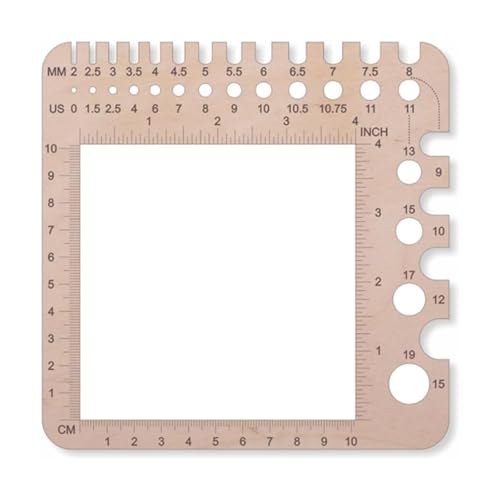
Katrinkles tools are a delight for those who prefer the tactile warmth of wood over cold metal or plastic. These gauges are often beautifully laser-etched, making them a joy to hold during long swatching sessions.
Because they are made of wood, they are lightweight and won’t scratch your delicate bamboo or carbon fiber needles. They also provide a lovely aesthetic touch if you enjoy documenting your projects on social media.
Be aware that wood can occasionally splinter or warp if exposed to extreme humidity or moisture. Treat these tools with care, and they will remain a beautiful part of your knitting kit for years.
Susan Bates Knit Chek: The Classic Metal Standard
The Knit Chek is the tool that has likely been in every knitting shop for the last fifty years for a reason. It is a multi-functional powerhouse that measures needle sizes, stitch counts, and even includes a built-in yarn cutter.
It is incredibly affordable and fits easily into any notions pouch. For a beginner, it is often the only tool you need to get started with checking your gauge and verifying needle sizes.

The metal can be thin and slightly sharp on the edges, which is something to watch for if you have sensitive skin. It isn’t the most "luxurious" tool, but it is undeniably effective and reliable.
Clover Knitting Needle Gauge: Simple and Precise
Clover is synonymous with consistency, and their plastic needle gauge is no exception. It is highly readable, with large, clear numbers that don’t fade over time.
Because it is made of high-quality plastic, it is gentle on your needles and won’t cause any snagging. It is an excellent choice for knitters who want a straightforward, no-nonsense tool that does exactly what it promises.
The only real tradeoff is that plastic can eventually become brittle if left in direct sunlight for long periods. If you keep it in your notions case rather than on a sunny windowsill, it will last indefinitely.
Knitter’s Pride Ginger Needle Gauge and Ruler

The Ginger Gauge is a sophisticated tool that combines a needle sizer with a handy ruler for measuring your swatches. It is designed to match the aesthetic of the Ginger needle line, making it a favorite for those who value a cohesive set of tools.
What I appreciate most is the clarity of the markings, which are easy to read even when your eyes are tired after a long night of knitting. It feels substantial in the hand without being bulky.
It is a bit larger than some of the pocket-sized gauges, so it may not fit in the smallest notions tins. If you prefer a tool that you can easily spot on your desk, this size is actually a benefit.
Why Accurate Gauge Swatching Is Essential for Fit
Gauge is the mathematical bridge between your yarn, your needles, and your body. If your gauge is off by even half a stitch per inch, that discrepancy multiplies across the entire width of a sweater.
A swatch allows you to see how your chosen fiber behaves. For example, a superwash wool will often grow significantly after washing, while a cotton blend might shrink or tighten up.
Always wash and block your swatch exactly as you intend to wash the finished garment. Skipping this step is the most common reason for a project that fits perfectly off the needles but grows to an unwearable size after the first soak.
How to Properly Use a Needle Gauge for Old Tools
Over time, needle markings often rub off due to the friction of the yarn sliding over the metal or wood. When you find a mystery needle, use your gauge to find the smallest hole the needle fits through snugly.
Do not force the needle through the hole; it should slide in with a gentle touch. If it rattles around, the hole is too large; if it won’t enter at all, the hole is too small.
If you are using needles with a tapered tip, measure the shaft of the needle just above the taper. Measuring the very tip will give you an inaccurate reading, leading to needles that are actually smaller than you intend.
Measuring Your Row and Stitch Count With Accuracy
When measuring your stitch count, lay your swatch flat on a hard surface and use a ruler or dedicated gauge tool. Avoid stretching or pulling the fabric, as this will artificially inflate your count.
Count your stitches over at least four inches rather than just one. This helps to smooth out any small inconsistencies in your tension that occur from stitch to stitch.
If you find that your stitch count is correct but your row count is off, don’t panic. You can often adjust the length of a garment by knitting more or fewer rows, but the stitch count is the non-negotiable factor for width.
Common Mistakes When Calculating Knitting Gauge
The most common mistake is failing to account for "swatch bias." We tend to knit more loosely when we are relaxed and more tightly when we are stressed or working on a complex pattern.
Another error is measuring your gauge while the swatch is still on the needles. The weight of the needles and the way they hold the stitches open will almost always distort your measurements.
Finally, remember that your gauge in the round may differ from your gauge worked flat. If a pattern is worked in the round, your swatch should ideally be worked in the round as well to account for differences in how you tension your yarn.
Investing in a quality stitch scale is a small act of self-care for your future knitting projects. By taking the time to measure accurately, you transform your knitting from a guessing game into a precise craft. Choose the tool that fits your personal workflow and keep it close by. Your finished garments will thank you for the extra effort.