6 Best Artist Lamps For Accurate Color Rendering
Discover the 6 best artist lamps for accurate color rendering in your studio. Enhance your precision and lighting quality today—read our expert guide now.
Achieving accurate color perception is the difference between a perfectly coordinated color-blocked sweater and a jarring clash of unintended tones. When working with complex fiber blends or subtle heathered yarns, ambient lighting often masks the true undertones that emerge only after blocking. Investing in a high-quality light source transforms a frustrating session of squinting into a productive, precise knitting experience. Selecting the right lamp ensures that delicate lace motifs remain visible and that color transitions in stranded work are executed with absolute confidence.
OttLite Dual-Shade LED Lamp: Best Overall


The OttLite Dual-Shade LED lamp stands out because it mimics natural daylight with remarkable consistency. For knitters working with variegated hand-dyed yarns, this lamp reveals the specific depth of saturation in each ply, preventing the common mistake of misidentifying a cool-toned blue as a warm slate.
The dual-shade design allows for broad, shadow-free coverage, which is vital when working on large-format items like blankets or shawls. By casting light from two angles, the lamp minimizes the harsh shadows that often hide dropped stitches or split plies when using single-source lighting.
Ultimately, this lamp serves as a reliable middle ground for those who prioritize color fidelity and workspace versatility. It is the ideal choice for a dedicated knitting nook where project needs change frequently.
Daylight Company Lumi Task Lamp: Best for Pros

Professional makers who spend hours on intricate cabling or black-on-black colorwork require the high-contrast visibility offered by the Daylight Company Lumi. This lamp is engineered to illuminate the darkest fibers, ensuring that each stitch definition remains crisp under the beam.
The wide reach of the lamp head is perfect for long-distance knitting sessions where constant repositioning is a distraction. Its tactile dimming controls allow for quick adjustments as natural light fades throughout the evening, keeping eye strain to a minimum.
While the price point reflects its professional-grade components, the durability of the joints and the quality of the LEDs are worth the investment. It remains the gold standard for those who consider their knitting station a primary workspace.
Brightech Litespan LED Floor Lamp: Best Value
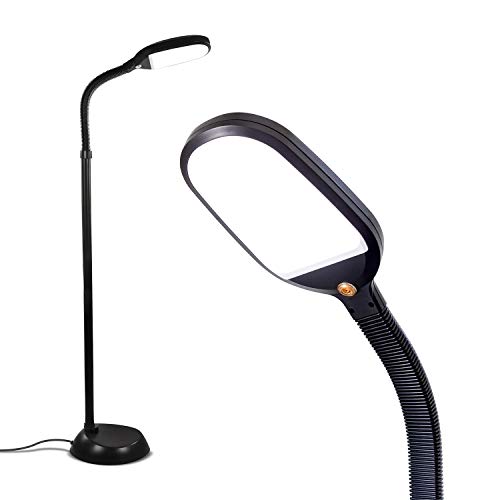
For those seeking an effective lighting solution without a premium price tag, the Brightech Litespan delivers impressive results. It provides a clean, focused beam that makes identifying stitch density and yarn tension significantly easier during late-night projects.
The floor-standing design is particularly helpful for knitters who prefer to move their project chair around the room to follow the best ambient light. Since the neck is highly flexible, it can be positioned directly over a lap-based project without interfering with arm movement.
Though it lacks some of the nuanced color-correction settings found in more expensive models, it vastly outperforms standard household bulbs. It is a practical, no-nonsense upgrade for any knitting corner.
Neatfi XL Bifocals Super LED Magnifier: Top Pick

A magnifying lamp is not just a tool for sight; it is a tool for precision, particularly when working with lace weight yarns or correcting dropped stitches in fine-gauge projects. The Neatfi XL provides a massive, clear field of view that prevents the distortion often associated with cheaper magnifying lenses.
The integration of high-quality magnification and consistent light output allows a knitter to inspect the integrity of every twist in a cable. It removes the guesswork involved in identifying where a mistake occurred, turning a tedious “tink-back” session into a manageable repair.
For those who regularly work with 2.25mm needles and fine wools, the relief afforded by this lamp is immediate. It effectively bridges the gap between vision aid and illumination, making it the most functional tool on this list.
BenQ e-Reading LED Desk Lamp: Premium Choice

The BenQ e-Reading lamp utilizes a specialized curved head design that covers a significantly wider area than traditional desk lamps. This is exceptionally beneficial for large-scale projects, such as intarsia work where multiple yarn balls are spread across a wide surface.
The “Smart” mode automatically adjusts the brightness based on the surrounding ambient light, which helps maintain a steady visual baseline. This consistency is crucial for preventing eye fatigue when working on dark or highly saturated colorways for extended periods.
While the cost is higher, the sheer light uniformity is unmatched. It is the best choice for a dedicated crafting desk where precision and ergonomics are the primary concerns.
Miroco LED Desk Lamp with USB Port: Budget Pick

The Miroco LED Desk Lamp offers a functional, space-saving design that fits well on small side tables near a favorite knitting chair. Its adjustable color temperatures mean a knitter can choose a warmer, softer light for cozy evening knitting or a cooler, bluer light for checking the true colors of a project.
The integrated USB port is a thoughtful feature, allowing for the charging of digital row counters or tablets used for patterns. While it doesn’t offer the massive coverage of high-end floor lamps, its performance for close-up tasks is surprisingly robust.
It is an excellent entry-level lamp that provides the necessary clarity for standard worsted weight knitting. It proves that one does not need a professional studio setup to achieve good lighting for fiber arts.
Understanding CRI, Lumens, and Color Temperature
- CRI (Color Rendering Index): A scale from 0 to 100 indicating how accurately a light source reveals true colors. For knitting, aim for a CRI of 90 or higher to ensure your deep jewel tones look as rich in the lamp light as they do in the sun.
- Lumens: This measures the brightness of the light. Higher lumens provide more visibility, but be cautious of excessive glare, which can bounce off slick metal needles and cause irritation.
- Color Temperature: Measured in Kelvin (K). Warm light (below 3000K) is yellow and relaxing, while cool light (above 5000K) is blue and energizing. Neutral, daylight-balanced light (around 5000K–5500K) is the gold standard for color matching.
How to Choose the Right Lamp for Your Craft Space
When evaluating your space, consider the physical footprint of the project. If you primarily knit sweaters, you need a lamp with a long reach that covers the entire span of the garment. If you are a sock specialist, a compact lamp with high-intensity focus is more effective.
Think about the interaction between your yarn and the light. Superwash wools with a slight sheen can reflect glare, while matte alpaca or mohair might absorb light, making them harder to see. A dimmable lamp is essential to mitigate these surface-level differences.
Always prioritize stability and adjustability over aesthetics. A lamp that constantly drifts or requires two hands to reposition will quickly become a source of frustration rather than a helpful tool.
Do You Need a Magnifying Lamp for Your Knitting?
A magnifying lamp is essential when the yarn diameter decreases or the pattern complexity increases. If you are working with lace weight or fine mohair, the small stitches become difficult to differentiate, leading to increased eye strain and mistakes in the stitch count.
Many knitters resist the idea of a magnifying lens, fearing it suggests poor eyesight rather than a desire for precision. In reality, it allows you to see the individual plies of the yarn, which is vital when performing complex grafting or kitchener stitch.
If you find yourself holding your work closer and closer to your face as the day goes on, it is time to invest in magnification. It turns hours of squinting into a relaxed, comfortable session of focused crafting.
Floor Lamp vs. Desk Lamp: Which Is Best for You?
Floor lamps are superior for knitters who require mobility, as they can be moved between a sofa, an armchair, or a dedicated studio space. Their height allows for a downward light angle that mimics the natural light coming from a window, which is ideal for avoiding shadows in your lap.
Desk lamps are better suited for those with a permanent crafting station. They provide more focused, stable illumination that is perfect for pattern reading and equipment maintenance, such as cleaning needle sets or winding hanks into cakes.
Ultimately, your choice depends on whether your knitting lifestyle is sedentary or mobile. A stationary desk is a luxury, but a flexible floor lamp is a universal workhorse for every knitter.
Selecting the right lighting is an investment in your long-term comfort and the quality of your finished work. By focusing on high CRI ratings and adjustable brightness, you create a space that celebrates your color choices rather than obscuring them. A well-lit workspace ensures that every stitch is intentional, allowing you to enjoy the process of creation as much as the final result.