6 Best Drawing Rulers For Accurate Measurements To Use
Boost your precision with our top 6 best drawing rulers for accurate measurements. Explore our expert-tested picks and upgrade your creative toolkit today.
Precise measurement is the unsung hero of successful fiber arts projects, separating professional-looking garments from those that suffer from wonky dimensions or poor fit. Whether determining the length of a lace shawl before blocking or calculating yardage requirements for a complex cable pattern, the right tool makes every step more accurate. A reliable ruler prevents the common frustration of finishing a project only to find the gauge is off or the hem is uneven. This guide breaks down the essential measuring tools that deserve a permanent spot in every maker’s knitting bag.
Omnigrid Ruler: Best Overall for Quilting


The Omnigrid ruler is a staple for those who require high-contrast visibility when working with dark or multicolored yarns. Its yellow and black grid lines stand out clearly against almost any surface, ensuring that measurements are never misread due to poor lighting.
While designed for quilting, its long, rectangular shape proves ideal for measuring gauge swatches or verifying the length of flat-knit pieces. The heavy-duty acrylic construction resists scratching, providing a stable edge that will not bow under pressure.
Avoid using these on textured or fuzzy fibers like mohair, as the edges can occasionally snag if handled carelessly. For most standard wool or acrylic projects, however, this remains the most reliable, easy-to-read option for consistent results.
Dritz Styling Design Ruler: For Perfect Curves

Drafting custom garment patterns or measuring armscye depth requires a tool that understands anatomy. The Dritz Styling Design ruler features a unique combination of straight edges and curved arcs, making it indispensable for shaping necklines and shoulders.
When knitting top-down sweaters, this ruler helps calculate the rate of increase for raglan sleeves with precision. The curved edge allows for a smooth transition when sketching out a custom fit for a cardigan’s front placket or a complex shawl edge.
It acts as a versatile bridge between simple knitting and technical tailoring. If the goal is to move beyond standard patterns toward custom-fit knitwear, having this curved guide on hand is a professional-grade advantage.
Fiskars Acrylic Ruler: Most Versatile Crafter’s Tool

The Fiskars acrylic ruler is a workhorse that balances durability with a user-friendly design. It is particularly effective for those who frequently transition between measuring fabric for linings and checking the dimensions of finished knitting pieces.
Its transparency allows the maker to see the stitch pattern clearly beneath the tool, which is vital when aligning rows for symmetry in colorwork. The non-slip backing—a feature often overlooked—prevents the ruler from sliding on slippery fibers like silk or bamboo.
This tool is a sensible investment for anyone who appreciates a simple, no-fuss approach to measuring. It is robust enough to toss into a project bag without worrying about minor dings or bends impacting future accuracy.
Westcott Metal L-Square: For True Right Angles
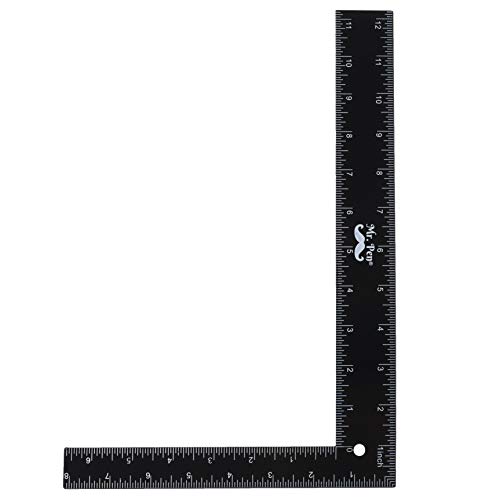
Precision in knitting often hinges on maintaining a perfect 90-degree angle, especially when seaming front bands to body panels. The Westcott Metal L-Square provides a rigid, uncompromising corner that is impossible to achieve with a flexible tape measure.
This is the go-to tool for blocking square motifs or ensuring that sweater sides are perfectly aligned before mattress stitching. Because it is made of metal, it provides a firm edge that can be used as a guide for marking fabric with chalk or a tailor’s pencil.
Unlike plastic, this tool will not warp over time, ensuring that the right angle remains true for years. It is an essential asset for those who take pride in the structural integrity and architectural finish of their garments.
The Gingher 6-Inch Sewing Gauge: Best for Hems
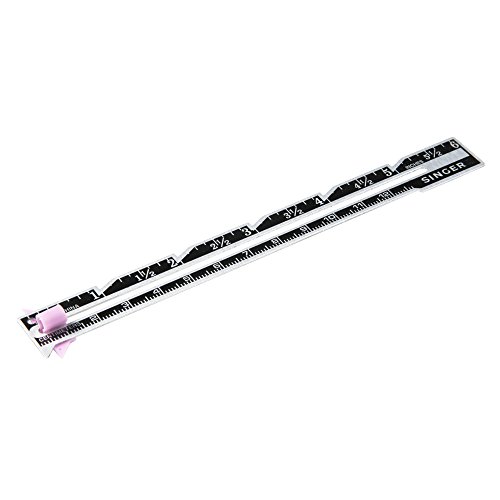
The Gingher 6-inch sewing gauge is the precision instrument of choice for measuring small, repetitive distances. Its sliding marker allows for “set and forget” measurement, which is incredibly useful when checking hem depths or buttonhole spacing.
If a project requires multiple buttonholes at exact intervals, the sliding guide ensures every single one is placed identically. The small size fits perfectly into a needle case or notions pouch, making it the most portable tool for on-the-go measuring.
This tool eliminates the guesswork of counting individual millimeters or eighths of an inch. By locking the marker in place, the knitter ensures every edge is uniform, providing a polished, store-bought look to handmade work.
C-Thru B-95 Ruler: Top Pick for Pattern Drafting
The C-Thru B-95 is designed for those who demand high-fidelity grids on their measuring tools. It features a fine, clear grid that makes it easier to track stitch count density against physical measurements during the design phase.
For designers sketching out gauge-adjusted patterns, the B-95 provides the clarity needed to keep charts and proportions aligned. It is thin, lightweight, and exceptionally clear, allowing for maximum precision when working on detailed schematics.
While it is more fragile than the thicker acrylic rulers, its clarity is unmatched. Treat this as a precision laboratory tool rather than a rugged project bag staple to keep it in optimal condition.
How to Choose the Right Ruler For Your Project
The right tool choice depends entirely on the project’s specific requirements. For general blocking and gauge checks, a longer acrylic ruler is usually sufficient. For bespoke tailoring or complex seaming, an L-square or curved design ruler becomes necessary.
Consider the surface you are working on before selecting a material. Slick acrylic rulers work well on flat tables, while metal options provide a heavier, more stable anchor point for large, heavy blankets or textured sweaters.
- For quick length checks: Stick to a 6-inch sewing gauge.
- For large-scale blocking: Opt for a 12-inch or 24-inch clear acrylic ruler.
- For custom garment shaping: Utilize a design ruler with curved edges.
Clear vs. Metal Rulers: Which Should You Use?
Clear acrylic rulers provide visual confirmation, allowing the knitter to see the stitches underneath the tool. This is vital when matching patterns or checking for consistent row heights in fair isle or cables.
Metal rulers, conversely, offer superior rigidity and durability. They are less likely to crack when stored in a full project bag and provide a sharper edge for marking or guiding a seam.
The best approach is to own one of each. Keep the clear ruler for visual alignment and blocking, and the metal ruler for cutting and structural marking.
Reading Your Ruler: Tips for Total Accuracy
Always measure from the zero mark, rather than the end of the ruler, to account for potential wear or rounded corners. If the ruler’s end has been bumped or dropped, the zero mark might no longer be flush with the start of the measurement.
Take care to view the ruler directly from above to avoid parallax errors. Slanting the head to look at the markings from an angle can shift the perceived measurement, leading to uneven hemlines or incorrectly sized armholes.
Consistent pressure is also a factor. When measuring a knitted piece, do not stretch the fabric; let it rest naturally on a flat surface. Using a light touch ensures the ruler stays in place without distorting the gauge of the fabric.
Caring For Your Acrylic Rulers to Prevent Damage
Acrylic rulers are prone to fine scratches that can eventually cloud the view. Avoid using abrasive cleaning cloths or harsh chemical solvents, which can leave permanent marks or fog the plastic.
Store rulers flat or in a dedicated sleeve to prevent the edges from chipping. Even a small nick in the side of an acrylic ruler can compromise the straightness of the edge, making it less reliable for drafting or cutting.
If a ruler becomes sticky or dirty, wipe it gently with a soft microfiber cloth and a mild soap solution. Keeping the surface clean ensures the visibility remains high for accurate, frustration-free knitting sessions.
Investing in high-quality measurement tools is one of the most effective ways to elevate the standard of handmade knitwear. By choosing a ruler that suits the specific needs of a project, the guesswork is removed, leaving more room to focus on the joy of the craft itself.