6 Gauge Swatches For Pattern Accuracy Tools That Help
Ensure your next knitting project fits perfectly. Explore these 6 essential gauge swatches for pattern accuracy tools to improve your craft. Start knitting today!
The dreaded “gauge swatch” is the most misunderstood requirement in any knitting pattern, yet it remains the single greatest predictor of garment success. Spending hours on a sweater only to have it emerge from the wash as a misshapen tunic is a rite of passage every knitter hopes to avoid. Using the right tools to measure stitches per inch transforms this chore into a precise science. Precision in measurement ensures that the fabric draping off the needles matches the designer’s intent exactly.
Cocoknits Knitters Block: For A Perfect Finish


Blocking is the final act of knitting, where fibers relax into their permanent shape. The Cocoknits system replaces flimsy cardboard mats with heat-resistant, dense foam tiles that interlock for a perfectly level surface.
It is particularly effective for lace projects, where stretching is required to open up intricate eyelets. When the swatch is pinned to the grid-printed tiles, it provides a consistent reference point to measure exactly how much the yarn expands after a soak.
This tool is a substantial investment, but it eliminates the guesswork of pinning a swatch to a carpet or towel. For the serious sweater knitter, having a flat, calibrated surface ensures that measurements reflect the true finished dimensions of the garment.
The Accu-Gauge Tool: For Unbeatable Accuracy

The Accu-Gauge is a classic for a reason: it features precise, laser-cut openings that allow for counting stitches over a specific distance. Unlike a standard tape measure that can stretch or fray, this rigid metal tool provides an unyielding standard.
It excels when dealing with high-twist wools or sticky alpaca blends where the fabric might naturally compress. By placing the metal frame over the swatch, one can count stitches without the bias that occurs when pressing a soft ruler against the fabric.
This is the preferred tool for those who struggle with “counting creep,” where the eye naturally drifts while counting across a long row. It forces a disciplined, repeatable measurement every single time.
Katrinkles Swatch Ruler: A Beautiful Essential
A Katrinkles swatch ruler combines utility with a design-forward aesthetic, often crafted from sustainable birch or cherry wood. Beyond its function as a gauge tool, it serves as a tactile reminder of the craftsmanship involved in the knitting process.
The etched markings are durable and don’t rub off with handling, which is a common failure point for plastic rulers. Because it is lightweight, it is easy to keep in a project bag for on-the-go checks at the local yarn shop.
While it is a functional tool, the primary advantage is its physical presence. It encourages the habit of checking gauge because it is a tactile, enjoyable object to hold during the setup phase of a project.
KnitPro Knit & Purl Gauge: A Budget-Friendly Aid
The KnitPro gauge is a no-frills, plastic tool that gets the job done without unnecessary expense. It serves as a reliable baseline for beginners who aren’t ready to invest in heavy-duty metal instruments.
Its dual-sided design allows for quick identification of needle sizes alongside the stitch-counting window. It is particularly useful for those who have a collection of unmarked vintage needles and need a quick way to verify diameters.
While plastic can warp if left in a hot car or near a heater, it remains a standard utility item. It proves that one does not need expensive equipment to produce professional-level results if the technique remains consistent.
ChiaoGoo Swatch Gauge: A Durable Metal Ruler

ChiaoGoo is known for engineering precision, and their swatch gauge follows the same design philosophy. It is constructed from a sturdy stainless steel that will not bend, break, or distort over years of heavy use.
The fine, etched measurements are ideal for knitters who work with fingering-weight yarn or intricate cables. Because the metal is thin, it lies perfectly flat against the fabric, reducing the parallax error that comes from thicker plastic tools.
If you are a knitter who tends to keep their tools in a crowded basket, the resilience of this steel ruler is a significant advantage. It is a “buy it once” item that will survive decades of swatch-making.
Digital Calipers: For Precision Lace & Fine Yarn
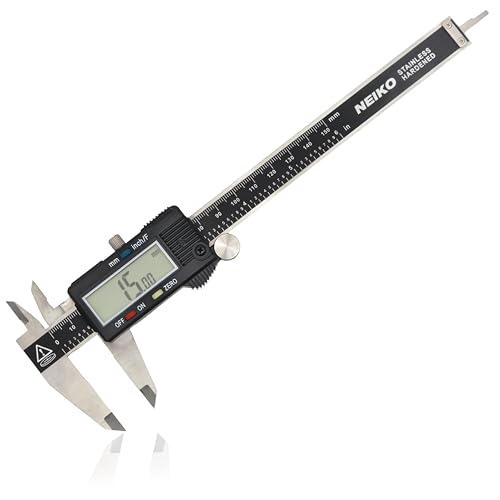
Digital calipers are the gold standard for precision, often used by hobbyists to measure the diameter of hand-spun yarn or verify needle sizes down to the hundredth of a millimeter. When knitting with luxury fibers like silk or cashmere, small variations in tension can have major implications.
These tools are not strictly necessary for standard worsted-weight sweaters, but they are indispensable for fine lace. They remove all human error from the measurement process, providing a digital readout that is indisputable.
Use them to ensure that your needle size is accurate if you suspect a manufacturer’s sizing is slightly off. For the perfectionist, the data provided by calipers takes the anxiety out of working with high-cost yarns.
Why Your Gauge Swatch Might Be Lying To You
A common mistake is knitting a swatch that is too small; a 2×2 inch square rarely accounts for the edge tension that occurs at the start and end of rows. Always knit a swatch at least 5×5 inches, then measure only the central 4 inches.
Furthermore, how the fabric is handled while measuring is critical. Never stretch the fabric or pull it taut against the ruler, as this artificially inflates the stitch count.
Finally, remember that the way you hold your needles while knitting a small square is often different from the way you hold them when carrying the weight of a large sweater. Knitting a larger swatch helps account for this change in natural tension.
How to Properly Block Your Gauge Swatch
Blocking is the process of washing and drying your swatch exactly as you intend to treat the finished garment. If you are knitting a superwash wool, it must be machine-washed and dried to observe how much the fibers expand.
Lay the swatch flat on a moisture-wicking surface—like the Cocoknits tiles—rather than hanging it, which can cause the weight of the water to stretch the fabric. Let it dry completely before taking a final measurement.
If the fabric is significantly different after washing, the swatch has served its purpose. A swatch that is measured before blocking is essentially useless, as it does not represent the “lived-in” reality of the fabric.
What To Do When Your Gauge Doesn’t Match Pattern
If you are getting too many stitches per inch, you are knitting too tightly. Conversely, too few stitches mean you are knitting too loosely.
- To increase gauge: Move up one or two needle sizes to open up the stitches.
- To decrease gauge: Move down one or two needle sizes to compress the fabric.
- Check your fiber: If you are using a different fiber than the pattern suggests, note that wool holds its shape differently than plant-based fibers like cotton or linen.
Sometimes, changing the needle material—from slick metal to grippier wood—is the subtle shift needed to fix a consistent tension problem. Always re-swatch after making a needle adjustment; never guess that the change will work out perfectly.
Swatching Flat vs. Swatching in the Round
Many knitters assume that swatching flat for a sweater knit in the round is acceptable, but this is a frequent cause of disaster. The purl row in flat knitting is almost always tensioned differently than the knit row, leading to a “row-out” effect that is absent when working in the round.
To swatch in the round without knitting a tube, leave a long loop of yarn across the back of the work between stitches. This creates a “ladder” on the back that mimics the continuous nature of circular knitting.
When measuring, cut the ladders on the back to lay the swatch flat. This method provides the most accurate reflection of how your hands interact with the yarn when the fabric is worked in a continuous spiral.
Mastering the gauge swatch is the difference between a project that stays in the closet and a favorite piece that is worn for years. By utilizing these tools and techniques, you gain control over the outcome of every stitch. Take the time to measure, block, and adjust, and the results will always be worth the effort.