7 Best Stitching Wheels For Uniform Stitch Spacing
Achieve professional leatherwork with our guide to the 7 best stitching wheels for uniform stitch spacing. Upgrade your leather crafting toolkit and shop now.
Achieving perfect, consistent spacing in your hand-sewn leather accents or fabric labels is the difference between a project that looks amateur and one that looks truly professional. Whether attaching a custom-knit label to a sweater or adding leather straps to a hand-knit bag, the spacing tool ensures every puncture aligns with uniform precision. These tools eliminate the guesswork of eyeballing distances, allowing for clean, professional results on every stitch line. Relying on these instruments elevates finished work from functional to heirloom-grade craftsmanship.
Clover Serrated Tracing Wheel: Best for Fabric


The Clover Serrated Tracing Wheel stands out as a reliable staple for those working with lighter-weight fabrics and delicate knitting reinforcements. Its fine teeth are designed to grip fabric without causing the snagging or fraying often associated with more aggressive steel tools.
This wheel is particularly effective when marking seam lines or placement guides for knit accessories. Because it leaves a subtle, dotted impression rather than a deep puncture, it is safer for fibers that might run or ladder if pierced too deeply.
Consider this the entry-level standard for consistency. While it lacks the weight required for thick vegetable-tanned leather, it is the perfect companion for marking pattern alterations on fine-gauge merino or lightweight linen.
TandyPro Overstitch Wheel Set: Most Versatile
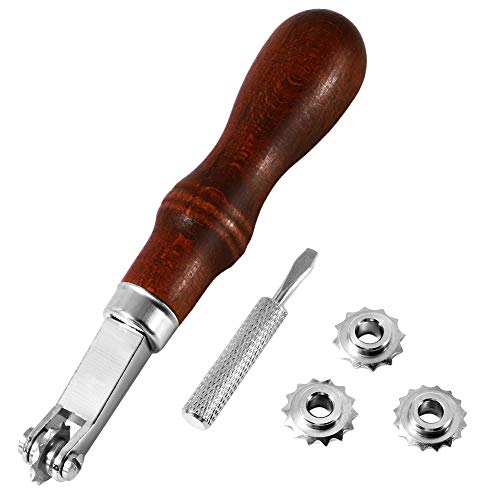
Flexibility remains the primary advantage of the TandyPro Overstitch Wheel Set, which includes multiple interchangeable heads. Different projects require different stitch densities; a chunky cable-knit bag might demand a wide-set stitch, while a delicate leather tag requires a tight, refined spacing.
Having the ability to swap wheels allows a single handle to serve multiple functions across various craft disciplines. This system removes the need to buy individual tools for every possible stitch length, saving space in a cluttered studio drawer.
The build quality is substantial enough for leatherwork yet precise enough for heavy canvas. It is the ideal choice for a maker who transitions frequently between leather straps, fabric trim, and heavy-duty textile construction.
Dritz Ergonomic Tracing Wheel: Most Comfortable

If hand fatigue is a concern during long sessions of marking dozens of custom garment labels, the Dritz Ergonomic Tracing Wheel is the superior choice. Its handle is contoured to fit the palm naturally, reducing the strain that traditional, thin-handled wheels often place on the thumb and index finger.
Comfort directly impacts precision in fiber arts. When a tool is awkward to hold, the pressure applied to the fabric becomes inconsistent, leading to uneven stitch spacing.
This model excels for high-volume marking tasks. By stabilizing the grip, it ensures the wheel rolls smoothly across the surface without slipping, which is vital when working with slippery, high-twist yarns or delicate backing stabilizers.
WUTA Stitch Spacing Wheel: Best Overall System

The WUTA Stitch Spacing Wheel offers a professional-grade feel that elevates the tactile experience of leather and heavy fabric preparation. It features a weighted head that provides enough inertia to create a deep, clear mark on thick materials without requiring excessive downward force.
This system is designed for longevity and structural consistency. The mechanical tension in the head prevents the wheel from wobbling, ensuring the spacing between dots remains identical from start to finish.
This is the tool of choice for crafters who prioritize repeatability and durability. While it represents a higher initial investment, its robust construction pays for itself by preventing the “drift” often seen in cheaper, plastic-based alternatives.
General Tools Spacing Wheel: Best Heavy-Duty Pick
General Tools provides a no-nonsense, industrial-strength spacing wheel for those who tackle rugged materials. If the project involves thick felted wool or reinforced leather gussets for bags, this tool provides the necessary bite.
The teeth on this wheel are pronounced and sharp. This design is not meant for delicate knits, as it can easily damage fibers; instead, use it for marking heavy-duty canvas, leather, or thick felted projects before punching them with an awl.
It represents the quintessential “workhorse” of the tool kit. It is simple, effective, and built to survive years of heavy use in a workshop environment.
L’outil en Main Pricker: Best Heirloom Quality
For those who value aesthetics as much as utility, the L’outil en Main Pricker is a masterclass in design. These tools often feature ergonomic wooden handles that age beautifully alongside the user’s growing collection of equipment.
The balance of this tool is exceptional. A well-balanced pricker allows the hand to guide the spacing rather than forcing it, which is essential for achieving a straight line on curved edges.
Investing in high-quality tools often influences the quality of the final project. A pricker that feels intentional in the hand encourages a slower, more deliberate pace, resulting in fewer errors when working with expensive fibers or premium leather hides.
Olfa Skip-Cut Blade: A Clever Alternative
The Olfa Skip-Cut blade is a unique tool that provides a perforated line rather than just a puncture mark. In fiber arts, this is an ingenious way to create a guide for blanket stitching or decorative embroidery along the edge of a knit project.
It allows for uniform spacing over long distances far more quickly than a standard single-point wheel. It is particularly useful for creating precise guides for attaching knit trim to woven fabric garments.
This tool functions best when paired with a self-healing mat. It provides a clean, consistent cutting edge that is both functional for construction and aesthetic for decorative finishes.
How to Choose Your Ideal Stitch Spacing Wheel
Choosing the right wheel depends entirely on the material thickness and the desired look of the finished stitch. For delicate items like socks or sweaters, look for wheels with fine teeth that won’t compromise the integrity of the yarn.
Material density is the most important factor in the selection process. Follow these general rules of thumb: * Fine Fabrics/Yarn: Use wheels with low-profile, fine-toothed heads to minimize fiber distortion. * Leather/Heavy Canvas: Use weighted, high-profile teeth to ensure the mark is visible through the material density. * Ergonomics: If marking long seams, prioritize handle shape over raw material weight.
Consistency is the ultimate goal. Always test the wheel on a scrap piece of the actual material—whether it is a swatch of the project’s yarn or a similar scrap of leather—to ensure the depth and spacing meet expectations before starting the actual piece.
Serrated vs. Pounce vs. Pricking: Which to Use?
These three tool types serve distinct purposes in the assembly of fiber and leather goods. Understanding the differences will prevent ruined projects and frustration during the sewing process.
- Serrated Wheels: These create a continuous line of tiny dots, perfect for following seam lines or pattern markings.
- Pounce Wheels: These are designed to transfer patterns through paper; they are often too delicate for thick leather but perfect for marking fabric through paper templates.
- Pricking Wheels: These are specifically designed for leatherwork; they don’t necessarily pierce the material, but rather mark the spacing so the user can follow up with a diamond chisel or awl for perfect holes.
Each tool creates a different visual outcome. Serrated wheels are for guidelines, while pricking wheels are for structural accuracy. Select the tool based on whether the goal is visibility or mechanical guidance.
Understanding Stitches Per Inch (SPI) Settings
Stitches Per Inch (SPI) is a critical metric for determining the structural integrity and aesthetic look of a seam. A higher SPI (more stitches per inch) generally results in a stronger, more refined seam, whereas a lower SPI is often used for heavy-duty, decorative stitching.
When working with knit items, keep in mind that the yarn’s weight and elasticity affect how a seam holds up over time. If a seam is stitched too tightly with a high SPI, the yarn can be “cut” or overly compressed, leading to potential weak points or holes in the fabric.
Always aim for an SPI that complements the project’s function. A bag handle needs a lower, stronger SPI, while a decorative label or trim on a lace shawl looks best with a higher, more delicate SPI. Adjust the spacing wheel accordingly to ensure the stitches are never so close that they jeopardize the fiber’s structure.
The right stitching wheel transforms a laborious task into a meditative, precise step in the assembly process. By matching the tool to the material and understanding the technical demands of stitch density, the final results will consistently showcase a high level of professional craftsmanship. Take the time to test, adjust, and refine the process to ensure every project stands the test of time.