6 Best Measuring Scales For Accurate Ratios To Rely On
Achieve perfect precision with our top 6 measuring scales for accurate ratios. Read our expert guide to choose the right tool for your kitchen or lab today.
Precision is the hidden foundation of every successful knitting project, turning guesswork into a predictable science. Whether calculating yardage for a sweater or measuring dye percentages for hand-painted wool, a reliable scale is the most important tool on the workbench. Relying on ball bands alone often leads to yarn chicken, a scenario no knitter wants to face when nearing the final rows of a yoke. Investing in a high-quality digital scale ensures that every gram of precious fiber is accounted for from cast-on to bind-off.
OXO Good Grips 11lb Scale: The Best All-Rounder


The OXO Good Grips 11lb scale is a kitchen staple that crosses over into the craft room with remarkable ease. Its standout feature is the pull-out display, which prevents the screen from being obscured by bulky sweater bodies or large cones of yarn.
This model offers excellent stability for weighing large hanks of wool that might otherwise tip over a smaller, flimsier platform. The stainless steel surface is not only durable but also wipes clean easily if dye splashes occur during a coloring session.
While it lacks some of the hyper-precise calibration of laboratory equipment, it is perfectly suited for general garment knitting. For the knitter who wants one reliable tool that serves both the kitchen and the craft room, this is the gold standard.
Fuzion Digital Pocket Scale: Best for Travel
A pocket-sized scale is an indispensable companion for the traveling knitter who needs to weigh project bags or verify yarn quantities on the go. The Fuzion Digital Pocket Scale fits easily into a standard notions pouch, making it perfect for retreats or destination knitting.
Despite its compact size, it offers surprisingly fine resolution, which is critical when weighing small amounts of lace-weight mohair or expensive silk blends. Accuracy in these smaller measurements is the difference between having enough yarn to complete a project and needing to order a non-matching dye lot.
Because of its portability, it is naturally less durable than larger, stationary scales. Treat it with care and keep it in a protective case to ensure the sensors remain calibrated for years of travel.
MyWeigh KD-8000 Scale: For Serious Yarn Dyers

For those who treat yarn dyeing as a professional pursuit, the MyWeigh KD-8000 is the clear choice for precision. It features a high weight capacity combined with a removable protective shield that keeps the electronics safe from water and dye pigments.
The real advantage here is the consistency; this scale is designed to hold calibration under the repetitive, heavy-duty use required for processing large quantities of fiber. It provides the reliable, repeatable data necessary to replicate custom colorways across multiple batches.
While it takes up significant desk space, the trade-off is superior performance that cheaper consumer scales cannot match. If the fiber arts journey involves large-scale dyeing or blending, skip the basic kitchen models and opt for this workhorse.
Escali Primo P115C: Best Budget-Friendly Pick
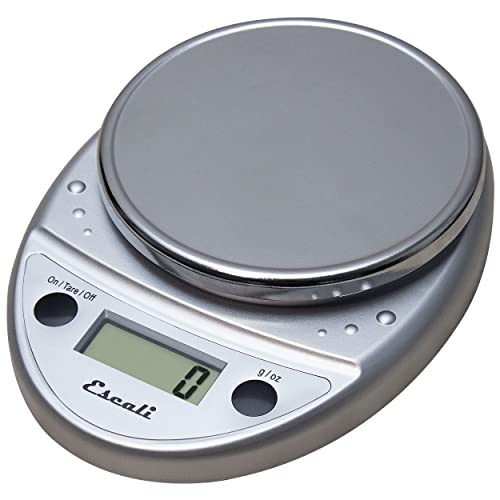
The Escali Primo is a reliable, no-frills scale that gets the job done without unnecessary complexity. Its simple two-button interface is incredibly intuitive, meaning there is no steep learning curve when simply needing to check a weight before starting a new project.
The platform is elevated slightly, which helps keep the scale functional even if a spill occurs on the workbench. It is a favorite among knitters who prefer to spend their budget on high-quality hand-dyed wool rather than expensive electronics.
Be aware that the display is fixed, which can be an issue if weighing very large items that hang over the edges. However, for standard projects like hats, socks, or scarves, its accuracy is more than sufficient for everyday use.
Greater Goods Digital Scale: Simple and Stylish
Design-conscious knitters will appreciate the slim profile of the Greater Goods digital scale. It looks elegant on a craft desk while providing the consistent, accurate readings required for managing yarn stash inventory.
The interface is sleek and responsive, offering a clean aesthetic that doesn’t clutter the workspace. It features a reliable tare function that remains consistent even after months of daily use in a busy knitting environment.
It is an excellent choice for those who value minimalist design but refuse to sacrifice functionality. While it may not handle massive, heavy-duty projects as well as the industrial-grade options, it is a stellar choice for the average hobbyist.
Ozeri Pronto ZK14-S: The Top User-Rated Pick
The Ozeri Pronto has earned its reputation through sheer reliability and ease of use in diverse craft environments. It manages to balance a lightweight frame with a surprisingly large weighing platform, making it versatile for both small notions and large skeins.
Its popularity stems from its consistency; users find it remains accurate over long periods without requiring frequent recalibration. For a knitter who wants to set it up and forget about it, this is the most stress-free option on the market.
This scale is the ideal middle ground for someone who wants more performance than a budget model but does not need the heavy-duty features of a professional dye scale. It is a dependable, high-performing tool that belongs on any knitter’s table.
Why You Need a Scale for Knitting and Crafting
A scale changes the way a knitter interacts with their stash by providing concrete data instead of vague estimations. When planning a project, knowing the exact weight of a partial skein allows for better color-blocking or stripe planning without the risk of running out mid-row.
Beyond just avoiding yarn chicken, a scale allows for precise gauge calculations by comparing the weight of a swatch to the total yardage of the project. It removes the guesswork from substituting yarns of different weights or fiber compositions.
Ultimately, using a scale transforms knitting from a game of chance into a calculated, professional-grade craft. It fosters confidence, allowing for more ambitious projects with the security that the materials are sufficient.
Using the Tare Function to Weigh Your Yarn Scraps
The tare function is a knitter’s best friend when working with oddments, leftovers, or large stash accumulations. By placing a container on the scale and pressing “tare,” the device resets to zero, allowing only the yarn itself to be measured.
This is essential for weighing scrap yarn for colorwork or stash-busting projects like temperature blankets. Knowing the precise weight of leftovers ensures that planned color transitions are balanced and visually harmonious.
Always tare the scale with the exact container intended for use to avoid math errors in the final tally. Mastering this simple feature will drastically increase the efficiency and accuracy of every stash inventory.
Scale Accuracy vs. Capacity: Which One Matters?
Choosing between accuracy and capacity depends entirely on the intended project goals. High capacity is necessary for weighing multiple hanks of bulkier wool or large cones, while high accuracy is required for fine-tuning gauge or measuring dye powders.
Most kitchen scales prioritize capacity, which is generally fine for the average knitter working with worsted or DK weight yarn. However, for those specializing in fine lace, the precision of a jeweler’s scale—often rated to 0.01g—is superior to a standard 1g-resolution kitchen model.
Analyze the weight range of the typical fiber used; measuring a 50g skein on a scale designed for 10lb loads may lack the nuance required for delicate work. A balanced choice is usually best, covering the middle ground between professional precision and hobbyist capacity.
Do I Have Enough Yarn? How a Scale Can Tell You
Determining yarn sufficiency is simple: compare the total weight of the stash to the pattern requirements, then account for a buffer. A general rule of thumb is to keep a 10% safety margin of the total yarn weight to account for swatching and potential weaving in of ends.
To calculate if a partial ball is enough, divide the total weight of the ball by the yardage listed on the ball band to find the “grams per yard.” Multiply this by the yardage needed for the project to see if the current supply meets the requirement.
This calculation saves projects from the heartbreak of mid-pattern exhaustion and avoids the cost of buying an unnecessary extra skein. A scale is truly the ultimate insurance policy against the dreaded “out of yarn” notification.
Mastering the use of a digital scale is a rite of passage for any knitter looking to elevate their practice. By integrating these tools into the workflow, every maker gains the confidence to adjust patterns, experiment with stash, and finish projects with absolute certainty. Choose the model that fits the specific needs of the craft, and enjoy the peace of mind that comes with knowing exactly how much fiber is on the needles.