6 Best Tailor Tapes For Measuring Quilt Dimensions
Find the perfect fit for your next project with our review of the 6 best tailor tapes for measuring quilt dimensions. Read our expert guide and shop today.
Achieving precise dimensions for a quilt is just as vital as maintaining a consistent gauge in a complex stranded colorwork sweater. A reliable tailor tape serves as the foundation for square blocks, accurate borders, and perfectly centered motifs. Investing in the right tool prevents the frustration of distorted seams or mismatched panels during final assembly. This guide highlights the best tapes to ensure every quilt project maintains its structural integrity from start to finish.
Clover “Shiro” Tape Measure: Best for Accuracy
The Clover “Shiro” tape is a benchmark for precision, favored by those who demand exactness in their seam allowances and block geometry. Its distinct, high-contrast markings prevent the eye strain that often occurs during long sessions of measuring multiple quilt units.
This tape features a smooth, matte finish that resists glare under bright sewing room lighting. Unlike cheaper alternatives that may have a slight variance at the starting tab, the Shiro is calibrated for consistent, professional-grade accuracy.
If the goal is to align complex geometric patterns, this tape eliminates the guesswork that leads to “off-by-a-hair” errors. It is the gold standard for makers who treat their workspace like a laboratory.
Singer ProSeries Tape: Best Retractable Option


Retractable tapes provide a convenient storage solution, keeping tools organized and preventing the tangles that often plague loose fabric tapes. The Singer ProSeries offers a robust mechanism that holds steady during use, ensuring the tape doesn’t snap back prematurely.
A locking button is the essential feature here, allowing the tape to stay extended while measuring larger quilt tops. The housing is durable enough to survive a drop onto a hardwood floor, which is a common hazard in a busy studio.
For those who prioritize a tidy workspace, this retractable option is ideal. It keeps the measuring surface clean and protected when not in immediate use.
Fons & Porter 120″ Tape: For King-Size Quilts
Measuring a king-size quilt with a standard 60-inch tape is a recipe for frustration and cumulative measurement errors. The Fons & Porter 120-inch option allows for a single, continuous pass across large surfaces.
Length is the primary advantage here, as it minimizes the need to reposition the tape repeatedly. Repositioning often introduces “creeping” errors, where the tape shifts slightly, leading to inaccurate totals across a 100-inch quilt.
This tool is a necessity for those working on large-scale projects, such as bed quilts or heavy wall hangings. It simplifies the process of checking dimensions against batting sizes before the final quilting stage.
Dritz Fiberglass Tape: Most Durable & Non-Stretch
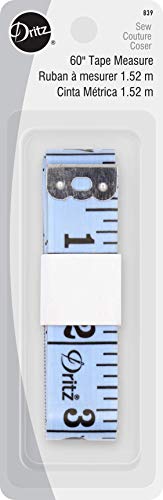
Fiberglass tapes are essential for quilters because they are inherently resistant to the stretching that eventually ruins soft vinyl tapes. When measuring a quilt top to determine binding lengths, even a minor amount of stretch can lead to an inaccurate calculation.
The Dritz Fiberglass tape holds its shape through years of heavy use. It provides a crisp, reliable measurement every time, regardless of how often it is pulled or folded.
While it lacks the softness of some fabrics, its structural stability is unparalleled. It is the best choice for those who need a long-term tool that will not degrade in accuracy over time.
Omnigrid Extra-Wide Tape: Easiest to Read

An extra-wide tape provides a larger canvas for the numbers, which is a significant help when measuring in dimly lit rooms or for those who find small increments difficult to track. The Omnigrid version is designed specifically for high visibility.
The bold print ensures that even at a glance, the measurement is clear. This reduces the time spent squinting at tiny lines, allowing for a faster workflow during block assembly.
Because it is wider, it also sits flatter against the fabric surface. This creates a better contact point for marking quilt boundaries with chalk or pens.
Fiskars Soft Fabric Tape: Best Budget-Friendly

For the beginner or those stocking a secondary sewing kit, the Fiskars Soft Fabric Tape offers excellent value without sacrificing necessary utility. It is lightweight and conforms easily to the drape of the quilt.
While it may not possess the extreme durability of fiberglass, it is more than sufficient for everyday piecing and assembly. It is flexible enough to wrap around edges, making it useful for measuring curved or rounded quilt corners.
Affordability does not mean a compromise on basic function here. It remains a reliable tool for quilters who prefer to keep several measuring devices throughout their studio.
What to Look For in a Quilter’s Tape Measure
- Zero-Point Calibration: Ensure the metal tip is flush with the beginning of the scale to avoid a quarter-inch offset.
- Material Stability: Look for fiberglass-reinforced tapes to prevent the common issue of vinyl “stretching out” over years of use.
- Double-Sided Scales: Opt for tapes that feature both imperial and metric systems to accommodate various pattern requirements.
- Width: A wider tape is generally easier to hold taut and easier to read from a distance.
How to Measure Your Quilt Without Stretching It
Measuring a quilt requires a light touch, as the weight of the fabric can cause it to pull and skew. Always measure on a flat, hard surface like a cutting mat rather than a soft, sagging bed.
Avoid pulling the tape measure tight. Instead, lay it gently along the surface and allow the fabric to remain in its natural, relaxed state. If the quilt is heavily pieced, measure through the center lines and the perimeter to ensure symmetry.
Taking multiple measurements—one down the middle and two along the edges—will reveal if the quilt has become distorted during the piecing process. If the center measurement is longer than the edges, the batting may be causing a “bubble,” requiring a re-press of the seams.
Fiberglass vs. Vinyl: Which Tape Is Best?
Vinyl tapes are generally softer and conform well to curves, but they are notorious for stretching over time. Heat in a sewing room can also cause vinyl to become slightly brittle or gummy, leading to inaccurate results.
Fiberglass-reinforced tapes provide the best of both worlds: they retain the flexibility needed to measure around edges while maintaining rigid accuracy. They do not stretch under tension, which is the most critical factor for precise quilt dimensions.
For a serious quilter, the slight price difference for fiberglass is worth the longevity. It ensures the tool remains a constant, unchanging point of reference for every project.
FAQs: Keeping Your Quilt Measurements Accurate
- How often should I check my tape measure for accuracy? Compare your tape against a metal ruler once a year to ensure no structural stretching has occurred.
- Can I use a metal retractable tape? While common in construction, metal tapes are too stiff and can snag or tear delicate quilt tops. Stick to fabric or fiberglass-reinforced materials.
- What if my tape measure has a metal tab that wiggles? Most quality tapes are designed with a sliding end tab to account for its own thickness, but for quilting, a fixed, flush tab is usually preferred for consistent, non-tensioned readings.
Choosing the right tailor tape is a minor investment that yields significant dividends in the quality of your finished quilts. By selecting a tool that suits the scale and complexity of your work, you ensure that your seams align and your borders lay flat every single time. Consistent tools lead to consistent results, allowing you to focus on the creative joy of your craft.